



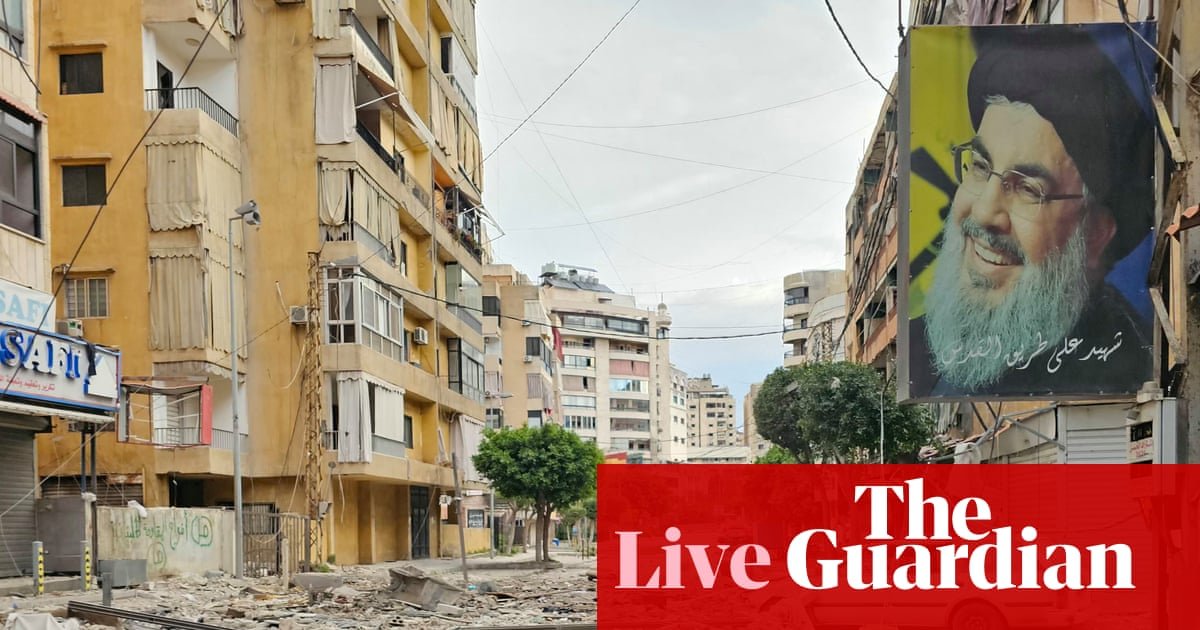
Netanyahu says Israel expanding occupation of southern Lebanon
Benjamin Netanyahu said earlier that Israel’s forces are expanding a so-called “buffer zone” in southern Lebanon as the military presses ahead with its campaign against Hezbollah.
“We have created a ‘genuine security zone’ preventing any infiltration toward the Galilee and the northern border,” Netanyahu said in a video statement.
“We are expanding this zone to push the threat from anti-tank missiles further away and to establish a broader buffer zone,” the Israeli prime minister said.
Israel said on Tuesday that it would seize parts of southern Lebanon to create what it described as a “defensive buffer” – prompting fears that Israel is planning another protracted occupation.
During a meeting with the military chief of staff, Israel defence minister Israel Katz said Israeli forces would “control the remaining bridges and the security zone up to the Litani”, a river in Lebanon that meets the Mediterranean about 30km (20 miles) north of Israel’s border.
Katz added that all bridges over the Litani river “have been blown up and the IDF will control the remaining bridges”.
Israel’s destruction of bridges, homes and other civilian infrastructure in southern Lebanon had prompted fears that it was cutting off the region from the rest of the country, and planning another occupation – with the hundreds of thousands of displaced Lebanese left without homes to return to.
The previous day, Bezalel Smotrich, Israel’s far-right finance minister, had called for annexation outright, saying Israel should “apply sovereignty” in areas in southern Lebanon, signalling this expansionist vision that has alarmed critics at home and abroad.
Key events
‘Gaza model must not be replicated in Lebanon,’ says UN chief
More from the UN secretary-general, António Guterres, who earlier told the US and Israel it is “high time” to end the war and called on Iran to stop attacking its neighbours.
Speaking to reporters earlier, Guterres said people are living under “profound insecurity”, which he saw first-hand on a recent visit to Lebanon.
“There, too, the war must stop,” he said, calling on Hezbollah to stop attacking Israel, and on Israel to cease its military operations and strikes.
He added:
The Gaza model must not be replicated in Lebanon.
The Guardian view on Israel’s war in Lebanon: allies must not accept a repeat of the crimes in Gaza
The intense focus on Donald Trump and Benjamin Netanyahu’s war on Iran has meant scant attention paid to the Israeli war in Lebanon. Yet almost 1,100 people have now been killed there by strikes, according to the health ministry, and a fifth of the population has been displaced.
When Hezbollah fired rockets into Israel shortly after the attack on its patron Iran began, Israel responded with what it called “precise and targeted strikes”. But the offensive quickly escalated. On Tuesday the Israeli defence minister, Israel Katz, announced another occupation of Lebanon – describing a “defensive buffer” running up to the Litani River, about 30km north of the border, and by implication likely to be prolonged. That would be illegal in itself. Bezalel Smotrich, Israel’s far-right finance minister, has called for annexation outright.
Israel says it must protect communities in its north. The international court of justice ruled that self-defence did not justify occupying Gaza. Israel sees an opportunity to finally eliminate Hezbollah – isolated without Syrian support or help from Iran, and still recovering from the decapitation of its senior leadership by the Mossad in September 2024. Yet Hamas has endured through the devastation in Gaza. Hezbollah itself was born of the 1982-2000 Israeli occupation of southern Lebanon.
Netanyahu, fighting an ongoing corruption case and determined to restore his political fortunes and legacy, appears to pursue eternal conflict. His far-right coalition partners have a maximalist vision of territorial conquest. Katz said that Israel would demolish homes along the border as it did in Rafah and Beit Hanoun in Gaza – which were essentially flattened. As in Gaza, Israel has forced civilians to flee en masse, and hit bridges and water and sanitation infrastructure. Health workers and officials accuse Israel of deliberately targeting medical facilities. Human Rights Watch says that it is using white phosphorus.
The widespread failure to take meaningful action against Israel over its atrocities in Gaza, and reluctance even to criticise it more than tepidly, has emboldened Netanyahu’s government and its rightwing supporters. The Israeli military has killed hundreds of Palestinians in Gaza since a ceasefire was announced. The humanitarian crisis continues to grip the territory. Israel’s western allies – including the UK – must apply real pressure, instead of being complicit in a grim future for Lebanon too.
You can read the full editorial here:
Iran wants Lebanon included in any ceasefire – report
Iran has told intermediaries that Lebanon must be included in any ceasefire agreement with the United States and Israel, six regional sources familiar with Iran’s position have told Reuters, linking an end of the war to a halt to Israel’s offensive against Hezbollah that has seen it move to occupy large swathes of southern Lebanon (see my last post).
Iran’s Press TV on Wednesday cited an Iranian official saying Tehran wanted any deal with the US to secure an end to the war both on Iran and other “resistance groups” in the region.
A senior Iranian official told Reuters on Wednesday that Tehran was still reviewing a US proposal to end the regional war, indicating that Tehran had so far stopped short of rejecting it outright.
The six regional sources, who spoke on condition of anonymity, said Tehran had informed mediators as early as mid-March that it sought a deal that would also stop Israel’s attacks on Lebanese armed group Hezbollah.
There was no immediate response from Iran’s foreign ministry, Israel’s foreign ministry or the Israeli military to questions from Reuters on the matter.
A senior Trump administration official told Reuters that ending Iran’s “proxy activities” and disarming Hezbollah were “crucial to ensuring peace and stability in Lebanon and across the region”.
One of the regional sources told Reuters that Hezbollah had received “Iranian guarantees” on its inclusion in any wider deal.
“Iran is prioritizing Lebanon – it will not accept Israeli violations in Lebanon like what happened after the 2024 ceasefire,” the source said, referring to Israel’s continued strikes on Lebanon despite a 2024 truce that ended the last Israel-Hezbollah war.
Israel’s foreign ministry has said that “Israel has not conducted and does not conduct negotiations with the Iranian terror regime”.
A source briefed on Israel’s military strategy has previously told Reuters that Israeli attacks on Hezbollah would probably continue after the air war with Iran, describing the two fronts as unconnected.
Israeli strikes have killed at least 1,094 people in Lebanon, including at least 121 children, and displaced more than 1.2 million.
Netanyahu says Israel expanding occupation of southern Lebanon
Benjamin Netanyahu said earlier that Israel’s forces are expanding a so-called “buffer zone” in southern Lebanon as the military presses ahead with its campaign against Hezbollah.
“We have created a ‘genuine security zone’ preventing any infiltration toward the Galilee and the northern border,” Netanyahu said in a video statement.
“We are expanding this zone to push the threat from anti-tank missiles further away and to establish a broader buffer zone,” the Israeli prime minister said.
Israel said on Tuesday that it would seize parts of southern Lebanon to create what it described as a “defensive buffer” – prompting fears that Israel is planning another protracted occupation.
During a meeting with the military chief of staff, Israel defence minister Israel Katz said Israeli forces would “control the remaining bridges and the security zone up to the Litani”, a river in Lebanon that meets the Mediterranean about 30km (20 miles) north of Israel’s border.
Katz added that all bridges over the Litani river “have been blown up and the IDF will control the remaining bridges”.
Israel’s destruction of bridges, homes and other civilian infrastructure in southern Lebanon had prompted fears that it was cutting off the region from the rest of the country, and planning another occupation – with the hundreds of thousands of displaced Lebanese left without homes to return to.
The previous day, Bezalel Smotrich, Israel’s far-right finance minister, had called for annexation outright, saying Israel should “apply sovereignty” in areas in southern Lebanon, signalling this expansionist vision that has alarmed critics at home and abroad.
UN chief says it’s ‘high time’ to end ‘out of control’ war on Iran
Earlier, the UN secretary-general, António Guterres, said that the conflict in the Middle East is “out of control”, with the world “staring down the barrel of a wider war”.
It was “high time” that the US and Israel end their war on Iran, he said. He also urged Tehran to stop attacking its neighbours “that are not part of the conflict”.
It is time to stop climbing the escalation ladder, and start climbing the diplomatic ladder, and return to full respect of international law.
Chris Stein
in Washington
A potential $200bn request from the Pentagon to pay for the US war effort with Iran was mentioned in a briefing with US senators on Wednesday, but it remains unclear if the Trump administration will formally request that amount, the Democratic senator Tim Kaine said.
“It was discussed,” the Virginia lawmaker said after exiting a classified briefing on the conflict held for members of the Senate armed services committee. However, he noted that the defence department had not formally asked Congress for that amount, and they may ultimately request a different number.
“Until they send it, they’re not making the case,” Kaine said.
Earlier in the day, Lindsey Graham, the Republican chair of the Senate budget committee, announced the majority would begin work on a bill that could include Iran war funding and be passed along party lines using the reconciliation procedure.
Iran’s foreign minister says no talks being held with the US
Iran’s foreign minister, Abbas Araghchi, has said there are currently no negotiations taking place between Tehran and Washington, adding that the exchange of messages through different mediators “does not mean negotiations”.
Iran’s top authorities are currently reviewing the peace proposals that have been put forward, he said, but Tehran has no intention of holding talks with the US “for now”.
Araghchi said the US had failed to achieve its key war objectives against Iran, including securing a quick military victory and bringing about regime change.
He was also critical of the US’s regional role, saying it has failed to protect its allies in the Gulf, despite the presence of its military bases there. He urged Iran’s neighbours to distance themselves from Washington.
Iran warns unnamed regional country against alleged plan to occupy island
Iran’s parliament speaker, Mohammad Bagher Ghalibaf, has warned on X that “based on some information, Iran’s enemies, with the backing of a regional country, are preparing to occupy one of the Iranian islands”.
The post goes on: “All enemy movements are under the full surveillance of our armed forces. If they step out of line, all the vital infrastructure of that regional country will, without restriction, become the target of relentless attacks.”
Neither the regional country or Iranian island are specified, but many commentators remain concerned that the US could send land forces to seize the strategically important Kharg Island.
Last week, the US bombed military facilities on the island – which processes 90% of Iran’s oil exports – but stopped short of striking its oil infrastructure.
As we reported on Tuesday, the US is also preparing to send more than 1,000 additional troops from an airborne assault unit to the Middle East.
Earlier, US Republican congresswoman Nancy Mace said she will not be supporting the deployment of US troops in Iran after leaving a briefing by the House armed services committee on the war.
She said in a post on X:
I will not support troops on the ground in Iran, even more so after this briefing.
In a later post, the South Carolina representative added that the gap between what was presented to the American public and the military objectives presented today is “deeply troubling”.
The justifications presented to the American public for the war in Iran were not the same military objectives we were briefed on today in the House armed services committee. This gap is deeply troubling. The longer this war continues, the faster it will lose the support of Congress and the American people.
Leavitt is then asked about Trump’s repeated comments recently that regime change has been achieved in Iran.
“Has it not?” she cuts in. “Their entire leadership has been killed, and nobody has really seen or legitimately heard from this alleged new leader, so wouldn’t you say there’s been a change in the regime?”
She goes on: “There’s been a change in the regime leadership, which is what the president said, so thank you for confirming he is right.”
Mojtaba Khamenei, son of the late Ayatollah Ali Khamenei, who was assassinated in the initial US-Israeli strikes on Tehran on 28 February, was named supreme leader earlier this month. He was injured in that attack, and has not been seen or heard in public since, though written statements have been released in his name, fuelling speculation about the extent of his injuries. Trump has speculated he could even be dead, and had previously expressed his disapproval of him as leader.
Leavitt is then asked whether Trump still believes the US should have a role in choosing Iran’s new leadership. She replies:
I think the president obviously believes the US wants to have someone in leadership in the Iranian regime that will be much more favourable, that would would be willing to with the US, that would no longer chant ‘death to America’ … These would all obviously be good.
Amid mounting confusion over the 15-point plan, Leavitt is asked a follow-up question.
Q. Just to follow up, because you said that some of the information that’s been out there about the 15-point plan is inaccurate. Can you say what is accurate with respect to ballistic missiles, the nuclear ambitions and the strait of Hormuz, which are things that the president has laid out that he wants to see a couple of times in the past?
Here is the White House press secretary’s brow-raising reply:
If you’ve heard it from the president of the United States, obviously it’s true, as well as the objectives of Operation Epic Fury.
She is also pressed on criticism that Trump’s approach has shifted from demanding that Iran can’t have a nuclear weapon to tighter restrictions on nuclear enrichment generally.
The president has been “quite clear” on what he wants to see from the Iranian regime, she says, without clearing anything up.
Leavitt is then asked what has changed that has made JD Vance emerge as a more active participant in negotiations with Iran.
“I don’t think anything has changed,” Leavitt says. “The vice-president has always been a key member of the president’s right hand man and a key member of the president’s national security team. He’s been part of these discussions, throughout this entire course of the administration.”
She added: “The vice-president has been by the president’s side every step of the way, and any reporting otherwise is just completely false. I see him in the room, again, the president seeks his counsel on all matters, both foreign and domestic.”
It was reported on Tuesday via Pakistani sources that Vance was being put forward as a probable chief negotiator from the US side if talks went ahead – after Iranian sources said they would refuse to sit down with Trump’s Middle East envoy, Steve Witkoff, or Trump’s son-in-law Jared Kushner, who led the nuclear negotiations with Iran before the war, and with whom there was “zero trust”.
White House avoids question of whether US boots on the ground needed to reopen strait of Hormuz if talks fail
Leavitt is then asked if the only other option to reopen the strait of Hormuz if negotiations with Iran fail is to put US boots on the ground, given that the US’s allies have said they’re either unable or unwilling to assist.
Leavitt says she won’t answer a hypothetical question, and that the decision is for the president, as commander-in-chief, to make.
Next, Leavitt is asked if the United States is providing support for Israel’s offensive in Lebanon, and if Trump is concerned that more than a million people have been displaced.
On the first part of the question, Leavitt says she’s “not in a position to comment” on this.
On the second part, she says “of course” Trump is concerned and that is why it’s important to “eliminate the threat” of the Iranian regime and their proxies, including Hezbollah.
That’s why Trump “wants to see this move as quickly as possible over the next couple of weeks”, she says.
White House insists Iran has not rejected US peace proposal
Asked about reports that Iran has rejected the US 15-point plan to end the war, Leavitt says “they have not” and insisted talks are continuing.
She says:
However, I saw a 15-point plan that was floated in the media. I would caution reporters in this room from reporting about speculative points, speculative plans from anonymous sources.
The White House never confirmed that plan. There are elements of truth to it but some of the stories I read were not entirely factual.
White House: Trump’s preference is peace – but is prepared to ‘unleash hell’ on Iran
Leavitt says that following president Donald Trump’s “powerful threat” at the weekend, it was made clear to the US that Iran wanted to hold talks.
She says Trump is “willing to listen” and says he has been engaged in constructive discussions, leading to the postponement of planned strikes against Iran’s energy infrastructure.
She adds:
The president’s preference is always peace. There does not need to be any more death and destruction.
But if Iran fails to accept the reality of the current moment, if they fail to understand that they have been defeated militarily and will continue to be, president Trump will ensure they are hit harder than they have ever been hit before.
Leavitt says Trump is not one to bluff and that he is prepared “to unleash hell”.


