



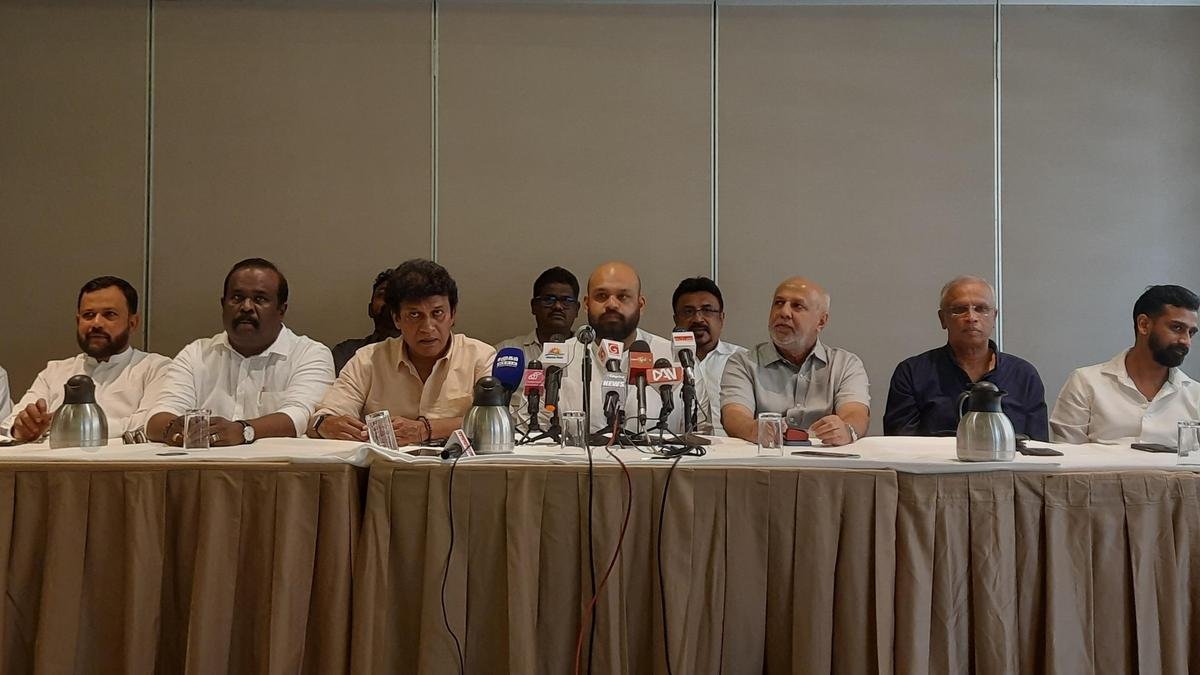
Leaders of parties and groups for ethnic minorities hold a press conference in Colombo on July 13, 2026.
| Photo Credit: The Hindu
Last week, when prominent political parties and groups representing Sri Lanka’s Tamil-speaking ethnic minorities launched a common platform, the move piqued the interest of many. Especially since the platform, or “medai”, as the leaders called it, is neither a conventional political coalition nor an electoral alliance.
Seated next to each other at a Colombo hotel, leaders of the All Ceylon Makkal Congress (ACMC), Ceylon Workers’ Congress (CWC), Democratic Tamil National Alliance (DTNA), Ilankai Tamil Arasu Kachchi (ITAK), Sri Lanka Muslim Congress (SLMC), and the Tamil Progressive Alliance (TPA) took turns to say the common platform would allow them to voice the shared concerns their respective constituencies face — war-affected Tamils in the north and east, the historically marginalised and chronically neglected Malaiyaha Tamils living mostly in the central and southern hill country, and Muslims living in the north, east and the rest of the country.
While the optics and logic of Tamil-speaking minorities coming together in a Sinhala-majority country may seem obvious amid enduring concerns of structural racism and discrimination, the coming together of the six actors draws attention for more than one reason.
All the parties and groups sit in Opposition in the current Parliament, where President Anura Kumara Dissanayake’s National People’s Power (NPP) enjoys a supermajority, following a historic mandate that included support from ethnic minorities across the country. While some parties are directly aligned with the main Opposition Samagi Jana Balawegaya (SJB), others maintain a distance.
Many of them also clash at the polls, competing for the same vote bank. Each party, or breakaway formation, has its own story situated in Sri Lanka’s tumultuous history. Their track records show varied political alignments and departures, shaping their own course and that of national politics on the island. Some were in alliance with former President Mahinda Rajapaksa when he was in power, while others vehemently opposed the Rajapaksas.
The actors represent Sri Lanka’s ethnic minorities — Tamils of the North and East, Malaiyaha Tamils, and Muslims identify as distinct ethnic groups in Sri Lanka — who are Tamil-speaking, but they also grapple with sharp differences and fierce conflicts among themselves, seen, for example, in the competing claims for land in the north and east, or the contestations over natural resources, especially among Tamils and Muslims of the north and east. Regardless of the known tensions and evident contradictions, the leaders behind the platform have clearly articulated a limited and specific programme for now, focusing on three areas — the introduction of a new Constitution, the early conduct of the long-pending Provincial Council polls, and the resolution of conflicts surrounding people’s land, adding that the platform would gradually open up space for conversations around other contentious issues.
President’s pledges
President Dissanayake has made clear pledges on all three areas. The NPP’s August 2024 poll manifesto — subsequently adopted as the government’s National Policy Framework — explicitly promised to introduce a new Constitution, building on the constitutional reform process that began in 2015, and hold Provincial Council elections within a year. Parties of ethnic minorities see both as avenues that would allow them to exercise and assert their political power.
Weeks after being elected to the country’s top office, Mr. Dissanayake told a packed rally in the northern Jaffna district that people’s lands, held by various state agencies, would be returned to them. While his government had initiated the return of land in some areas to the people, huge swathes remain under the control of the military, archaeology and forest departments. Nearly two years since those pledges were made, provincial polls have not been held, and there is no movement on the new Constitution.
In the hill country, where Malaiyaha Tamils have sustained a resolute struggle for land rights, communities are still fighting to rightfully own a piece of land where their ancestors toiled. In October 2023, the NPP said it would ensure a “fair solution” to realising the “land rights of Malaiyaha Tamils”. In identifying the three issues, members of the common platform have sought to hold the Dissanayake administration to account, based on its own pledges to the people. The initiative, they underlined, stems from neither an anti-government nor a pro-opposition stance.
Published – July 19, 2026 02:29 am IST


