






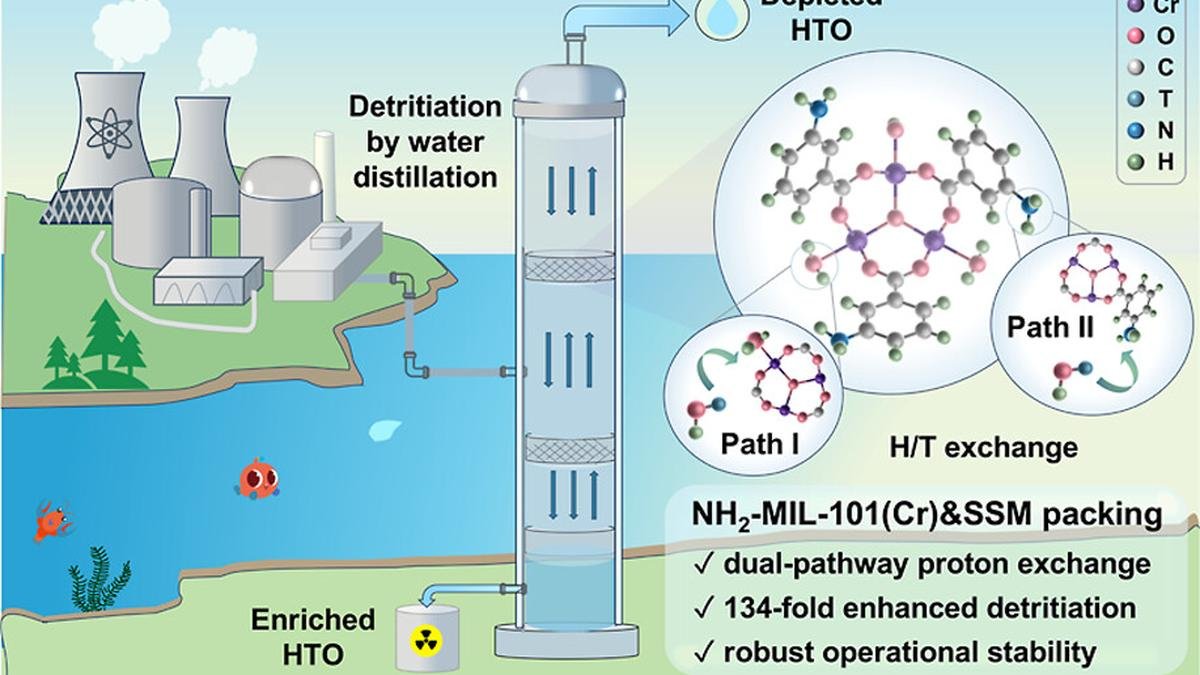
A visual abstract of the technology described in the study. The metal-organic framework is the larger molecule in the middle.
| Photo Credit: Environ. Sci. Technol. 2026
In 2023, Japan began a decades-long and controversial process — it began releasing treated wastewater from the ruined Fukushima nuclear power plant into the Pacific Ocean. The water had been filtered to remove most heavy radioactive elements, yet one particular contaminant remained: tritium.
Tritium is a radioactive isotope of hydrogen. When it bonds with oxygen, it forms tritiated water, or HTO. Because tritiated water is chemically almost identical to regular water, it is extremely difficult to separate the two. For many decades, officials in the global nuclear industry have opted to dilute tritiated water, i.e. mixing it in large quantities of regular water.
In absolute terms, the treated wastewater will make up only 0.000000000189% of the Pacific Ocean’s volume even after all of it is released. However, the effects of the tritiated water are expected to be more apparent in the waters flanked by South Korea and China. M.V. Ramana had also told The Hindu in 2023 that tritium is “easily absorbed by the bodies of living creatures” and “rapidly distributed … via blood”.
A new study published in Environmental Science & Technology may finally offer a way to efficiently clean tritiated water. The research team, from across China, achieved this using a metal-organic framework, work on which won the Nobel Prize for chemistry last year.
The current most practical way to remove tritium from tritiated water is water distillation, i.e. boiling water and separating the components based on their slightly different boiling points. But the difference is so feeble that operators need a distillation tower hundreds of metres tall, which is expensive, uses large amounts of energy, and impractical for the millions of tonnes of water stored at Fukushima.
Current distillation towers use systems called packings — materials inside the tower that provide surfaces where steam and liquid can interact. Until now, these packings were passive: they just sat there and let gravity do the work. In the new study, the researchers made the packing material ‘active’.
They coated a stainless-steel mesh with a metal-organic framework called NH2-MIL-101(Cr). A metal-organic framework is like a microscopic sponge. It has a very high surface area: the study found that adding NH2-MIL-101(Cr) increased the available area of the packing by 32-fold.
Second, the chromium-oxygen clusters inside the framework ‘grabbed’ tritium atoms from the liquid and swapped them with regular hydrogen atoms, with nitrogen and hydrogen attachments also facilitating this swapping.
The results were staggering. In laboratory tests, the team found that the modified packing achieved a separation efficiency of 42.5 theoretical plates per meter — a record-setting figure in the world of chemical engineering. At an industrial height of 10 m, the new material would be 134-times more effective than the current best-reported material.
It is also one-million-times more effective than the standard commercial packings in the industry today.
“This strategy provides a new approach for improving the detritiation of tritiated water and reducing tritium releases to natural water bodies,” the researchers wrote in the paper. “More broadly, the results highlight the potential of programmable porous materials to address challenging isotope-contaminant separations and contribute to safer and more sustainable management of nuclear energy systems.”
Published – July 13, 2026 11:00 am IST


