


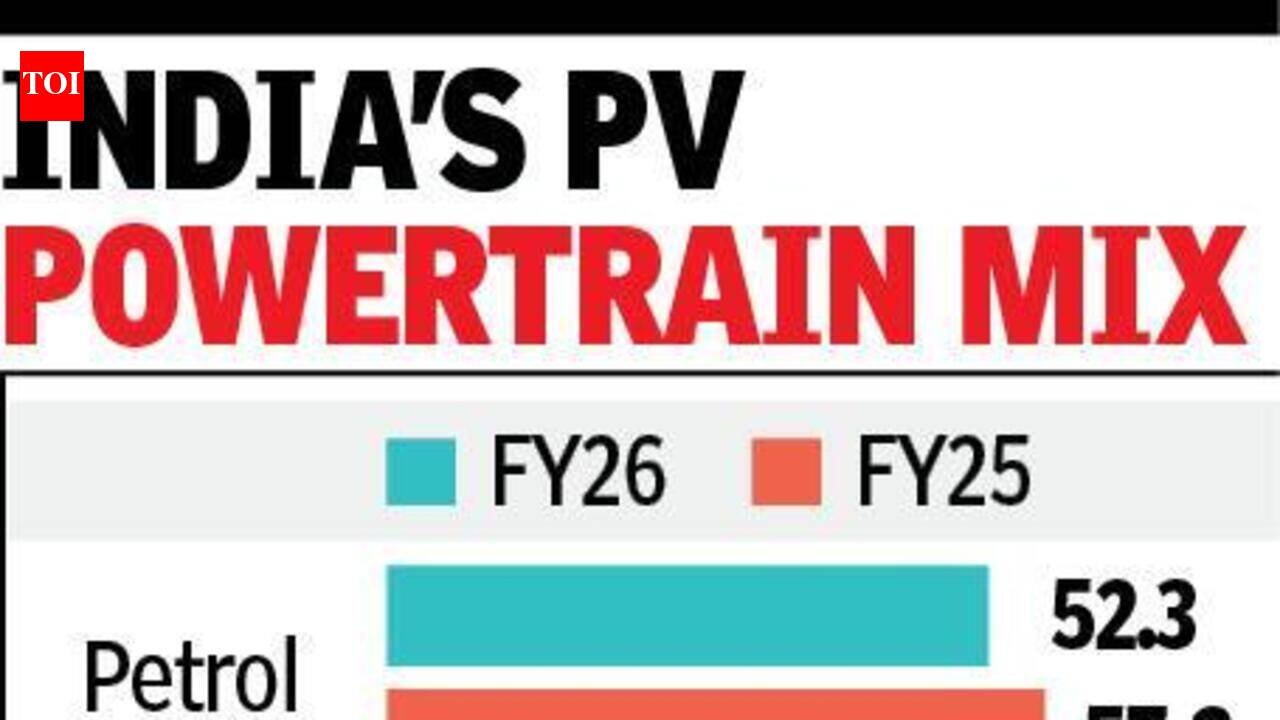
Chennai: More than half of Maruti Suzuki India’s domestic passenger vehicle sales in FY26 came from what the company classifies as “green vehicles”, indicating its bet on multiple technologies rather than a single route to cleaner mobility. The category—which includes CNG cars, mild hybrids, strong hybrids and battery-electric vehicles—accounted for 52% of sales in FY26, up from 48% a year earlier and just 27% in FY22.The shift reflects Maruti’s multi-powertrain approach to cleaner mobility. Instead of relying on a single technology, the carmaker is pursuing several options, with CNG doing much of the heavy lifting for now, thanks to a growing refuelling network and lower running costs than conventional ICE vehicles.CNG vehicles alone accounted for nearly 40% of Maruti’s domestic sales in FY26. The company sold 7.46 lakh CNG cars during the year, up 22%. In the first quarter of FY27, sales rose another 58% to 2.2 lakh units. Maruti’s chairman R C Bhargava expects sales to reach 9 lakh CNG vehicles in this fiscal.The trend is not confined to Maruti. CNG’s share of India’s passenger-vehicle market increased to 21.6% in FY26, from 19.3% in FY25. When CNG, strong hybrids and battery-electric vehicles are taken together, their share of total passenger-vehicle sales rose to 28.9%, from 24.4% a year earlier.Maruti has one of the broadest portfolios of alternative-powertrain vehicles in the market, with 16 CNG models, three strong hybrids and one battery-electric vehicle. The company says its multi-powertrain strategy also helped it exceed the corporate-average fuel-economy (CAFE) Phase-II target for FY26 by a “good margin”.The strategy is set to continue. Under its plan for FY31, Maruti expects battery-electric vehicles (BEVs) to account for 15% of domestic sales, strong hybrids for 25%, CNG for 35%, and petrol vehicles using biofuels for the remaining 25%. By FY31, the company aims to become No. 1 in BEV production, domestic sales and exports, after launching its first BEV last year.Maruti is pursuing several routes to cleaner mobility, including compressed biogas, E20-compatible engines and flex-fuel technology. The company argues that this multi-pathway approach offers a practical way to cut carbon emissions while keeping cars affordable and giving consumers a wider choice of technologies.
