



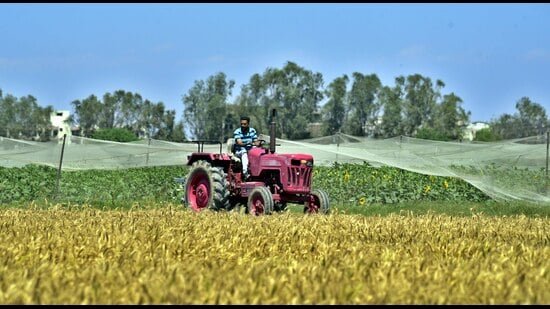
As the region witnesses unusually high temperatures in March, with maximum temperatures soaring 6 degrees Celsius above normal, the lack of visible respite has raised concerns among wheat farmers and experts.


Data from the India meteorological department (IMD) shows that maximum temperature across all stations in Haryana is above 30 degrees Celsius with a couple of them also crossing 35 degrees Celsius on Monday.
According to the IMD’s evening bulletin, Mahendragarh recorded a maximum temperature of 36.2 degrees Celsius and a minimum temperature of 15.2 degrees Celsius in the state.
On Sunday, Hisar witnessed the highest maximum temperature at 37.5 degrees Celsius.
In its forecast bulletin, the department said the weather is likely to be dry for the next six days, with light rain possible at isolated places on March 15 but there will be no large change in maximum temperature for the next three days.
The sharp rise in temperatures has prompted warnings from agricultural experts about the potential impact on the wheat crop.
Kaithal deputy director of agriculture (DDA), Farmers Welfare Department, Ravinder Singh, said that rising temperatures in March could adversely affect the wheat crop as this could impact the grain filling process, resulting in smaller, lighter grains and a potential reduction in overall production.
Karnal-based ICAR-Indian Institute of Wheat and Barley Research (IIWBR) director Ratan Tiwari said, “Though there is a rise in day temperature, there is no stark rise during the night. There won’t be any impact on early-sown crops from October-November and mid-sown crops between November 15-20. However, in view of the current scenario, we have issued an advisory for farmers who planted late-sown varieties in December.”
As per the advisory issued by the wheat institute, farmers have been asked to irrigate the crop as needed to maintain adequate moisture in the field and reduce the impact of high temperatures.
They are also advised to avoid irrigation during strong winds in the evening hours, as this increases the risk of crop damage.
Farmers have also been advised to spray 2% potassium nitrate by dissolving 4 kg of the chemical in 200 liters of water to reduce the impact of heat on the crop.
Tiwari said that most crops grown in the region have crossed the critical period and harvesting is already underway in Madhya Pradesh and Gujarat, thus overall, there is no panic situation in the country.
Experts from Chaudhary Charan Singh Haryana Agricultural University, Hisar, have also advised that in wheat fields where Mandusi/Kanki plants are seen, they should be uprooted by hand and thrown out of the field so that their seeds do not fall in the field and their infestation is reduced next year.


