



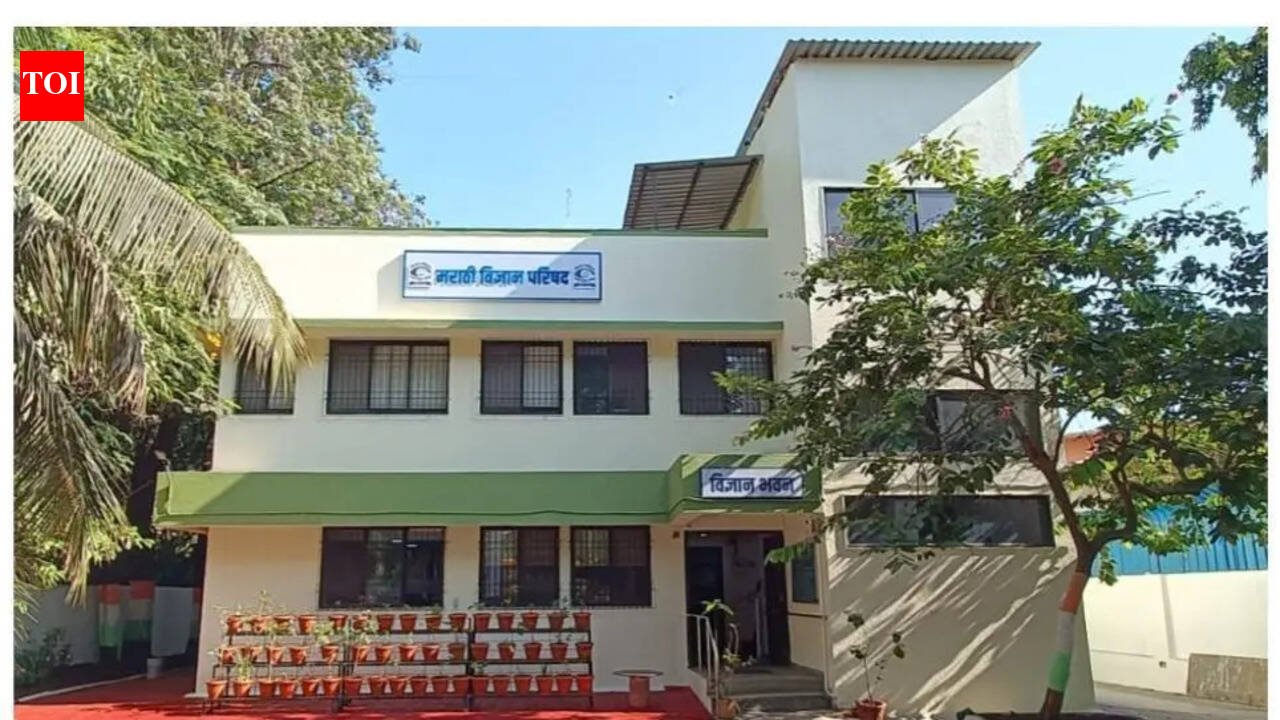
Mumbai: On a sun-soaked terrace in Mumbai, a modest cluster of potted greens thrives on recycled water. Not far away, in a classroom, children gather around a tiny solar panel, their eyes lighting up as an LED flickers to life and science is made visible, tangible. A few hundred kms away, in Masur village of Karad in Satara, research which has demonstrated how biochar (produced from post-harvest farm residue) could boost soybean yields by 25% is transforming farms.These stories—urban and rural, experimental and applied—have a single enabler: the Marathi Vidnyan Parishad (MVP), which has completed 60 years.Founded by R V Sathe and M N Gogate in 1966, the Parishad was built on the belief that science should not remain confined to academic or elite circles. Over time, this became a quiet movement, and today, operating from its headquarters, Vidnyan Bhavan, in Mumbai and supported by a network of nearly 70 branches, including five outside Maharashtra, the group reaches diverse audiences across regions.For Mumbai’s science lovers, the Parishad has nurtured an ecosystem where science is not confined to labs or elite discourse but is part of everyday conversations, culture and choices, said mathematician Dr Vivek Patkar.In the early 1990s, when discussions around adolescent health and gender education were cloaked in discomfort, MVP confronted the subject head-on. Its educators would first present their programme to school principals, mindful of sensitivities. At one Mumbai school, a teacher, Anita Kulkarni, a gender science educationist herself, insisted the session be conducted, but parental backlash forced her resignation. “Yet, what appeared to be a setback became a marker of social evolution. A decade later, the same programme, now distributed through CDs and DVDs, found acceptance in living rooms, with parents themselves purchasing and using the material to guide their children through what was once considered taboo. The arc of change, though slow, bent towards awareness,” said A P Deshpande, who has been the Parishad’s honorary secretary for 52 years.Through its ‘science for society’ initiatives, the MVP has, by promoting solar energy, urban farming, wastewater management and sanitation, helped communities to apply scientific knowledge to real-world challenges, said Dilip Herlekar, another honorary secretary.So when Dr Rohan Oak’s research revealed how useful biochar could be, “the idea did not remain confined to academic journals” but travelled to the fields. “Today, entire groups of cultivators have adopted the technique, turning agricultural waste into a tool for sustainable productivity and resilience,” said Dr Oak.Under MVP’s student engagement programme, called ‘Shanivari Vidnyanwari’ (Science Every Saturday), science sheds its textbook-bound image. “College students mentor schoolchildren through experiments, nurturing curiosity, critical thinking and conceptual clarity,” said Prakash Modak, organiser of the programme. “Children begin to see science not as a subject but as a tool they can use in daily life,” educator Dr Manasi Rajadhyaksh said.Across Mumbai and Maharashtra, MVP’s imprint has been clear in classrooms, in housing societies that embrace sustainable practices, and in communities that turn to reason, said science educator Abhay Yavalkar. “In many localities, interventions have translated into big gains: reduced electricity bills, improved waste management, and heightened environmental awareness. In Mumbai’s dense fabric, such outcomes are not just innovative but essential,” said Sudhir Panse, former principal of Sathye College in Vile Parle East.Public lectures, TV programmes and outreach initiatives under the MVP’s umbrella led by big names such as Jayant Narlikar, Anil Kakodkar and Vasant Gowariker have brought science closer to people, said Suhas Naik Satam, chief executive of National Centre for Science Communicators.And the influence has extended beyond formal education. MVP’s monthly publication, Marathi Vidnyan Parishad Patrika, published without interruption for 58 years, demystifies complex ideas using simple, accessible Marathi, and its long-running newspaper column ‘Kutuhal’ and TV series ‘Vidnyanam Janahitay’ have further carried its message to the people.The Parishad has also nurtured scientific writing, encouraging authors and publishing their works, including award-winning science fiction and popular science books. The result has been the gradual development of scientific literature and terminology in the Marathi language. And it has organised one-act play competitions, making science more engaging and culturally resonant. This interdisciplinary approach, its members said, has fostered a vibrant intellectual environment, bringing together scientists, educators, writers and thinkers.Awards have also come along, like the Science Popularisation Award from the Central govt’s department of science and technology, and the Maharashtra govt’s Kavivarya Mangesh Padgaonkar Language Conservation Award. But at its core, MVP’s work has been more about sowing the seeds of a constitutional value called scientific temper than about reaping the fruits.


