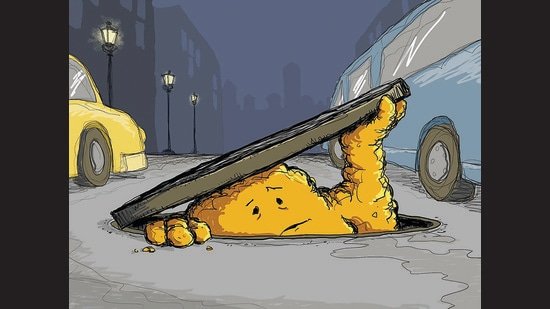
It’s one thing to fall down a rabbit hole. It’s another thing entirely when that rabbit hole is a sewer. But then the story of 21st-century sanitation is shaping up to be an explosive blockbuster. Hold on to the term blockbuster. It will make sense in a bit.
In American illustrator Nathan T Wright’s children’s book, The Adventures of Fatberg (2015), the stinky sewer blockages are imagined as friendly, misunderstood creatures.
First, the villain origin story. In 2013, sanitation workers in Kingston upon Thames, London began to stumble upon gigantic, rock-hard clumps blocking the city’s drains. One, the size of a bus, weighed 15 tonnes.
No one put it there. It formed bit by bit when wet wipes and diapers (both advertised as the flushable kind) congealed with the fat, oil and grease that goes down sewers too, to create a fatberg.
By 2017, a 130-tonne monster had been found in the sewers of Whitechapel in East London.
More began to pop up in the US, Australia and Europe; everywhere that people flushed bulkier materials down the toilet. Then the pandemic hit. Sanitising wipes became a go-to disinfectant, and suddenly the villain was everywhere. Ask Bryan Adams. A concert in Perth had to be cancelled in February 2025, after a fatberg was found to be causing sanitation issues.
Because tonnage doesn’t quite convey the extent of the problem, fatbergs are being given their own units of measurement. Buses help. One, discovered in Sydney this year, was described in the press as being the size of four buses. Another, from London in 2024, was the equivalent of three double-decker buses.
The one near London’s Heathrow Terminal 5 blocked nearly half the sewer and took two weeks of pressure-jets to clear. It, reports fittingly noted, stretched the length of about 700 suitcases lined up end to end. Some have been the size of two Airbus A318s (London, 2017) or as big as seven dump trucks (Vancouver, 2024). One would have made Ishmael proud; a fatberg removed in Oxford last year was described as 1 km long and the size of a whale.
It’s no surprise that they are sparking artists’ imaginations. American illustrator Nathan T Wright was so captivated by the large, hard, unspeakably smelly blockages that he self-published a children’s picture book called The Adventures of Fatberg (2015). “I imagined Fatbergs as friendly, misunderstood creatures,” he says on his website. “The story follows a Fatberg driven out of the sewers into the streets of London, where he attempts to fit in with humans.”
Others have put these things on a literal pedestal. In 2017, the Museum of London displayed a chunk of their Whitechapel monster, so visitors could get a sense of what goes on deep underground. A curator described its mottled texture as “parmesan crossed with moon rock”. Three layers of transparent glass protected human noses from the putrid smell and deadly bacteria.
In Melbourne, in 2016, Philippine artist Catherine Sarah Young took discarded grease from various sources, sterilised it and turned it into soap. Visitors to her exhibit, The Sewer Soaperie, were cautioned against touching the soft grey-beige blocks. Some did anyway; one visitor said they smelled like cookies.
In Australia, artists Arne Hendriks and Mike Thompson have been building their own sanitised fatberg from tallow and lard, hoping to grow it to the length of an oil rig.
Wild ones (those building up in the sewers), however, are where science shines.
Sydney’s sanitation authorities have tried to determine their size by sending a drone into the drain pipes. It doesn’t always work. The swirling gases knock the drones from their path, making for what Wknd’s editor calls the “worst kind of videogame”.
Vancouver has had better luck with sonar. Engineers at Australia’s RMIT University have developed two ways to reduce fatberg formation. They are building better grease traps and adding alum to sewage to catch smaller deposits before they coalesce. They are also coating sewers with chemicals that break fat down faster.
Meanwhile, the problem of what to do with the bus- and plane-sized formations is getting a disgustingly creative solution. London, the city that started it all, is working to turn fatbergs into perfume. Professor Stephen Wallace of University of Edinburgh has been sterilising the waxy sewer residue to create biofuel. He then adds modified bacteria to it. The germs eat away at the residue, producing a chemical with a pine-like fragrance. This, Wallace says, can be used to make perfumes. But what will we call it? Pipe Dreams? Sewage Elixir? We already have Eau de Toilette.