






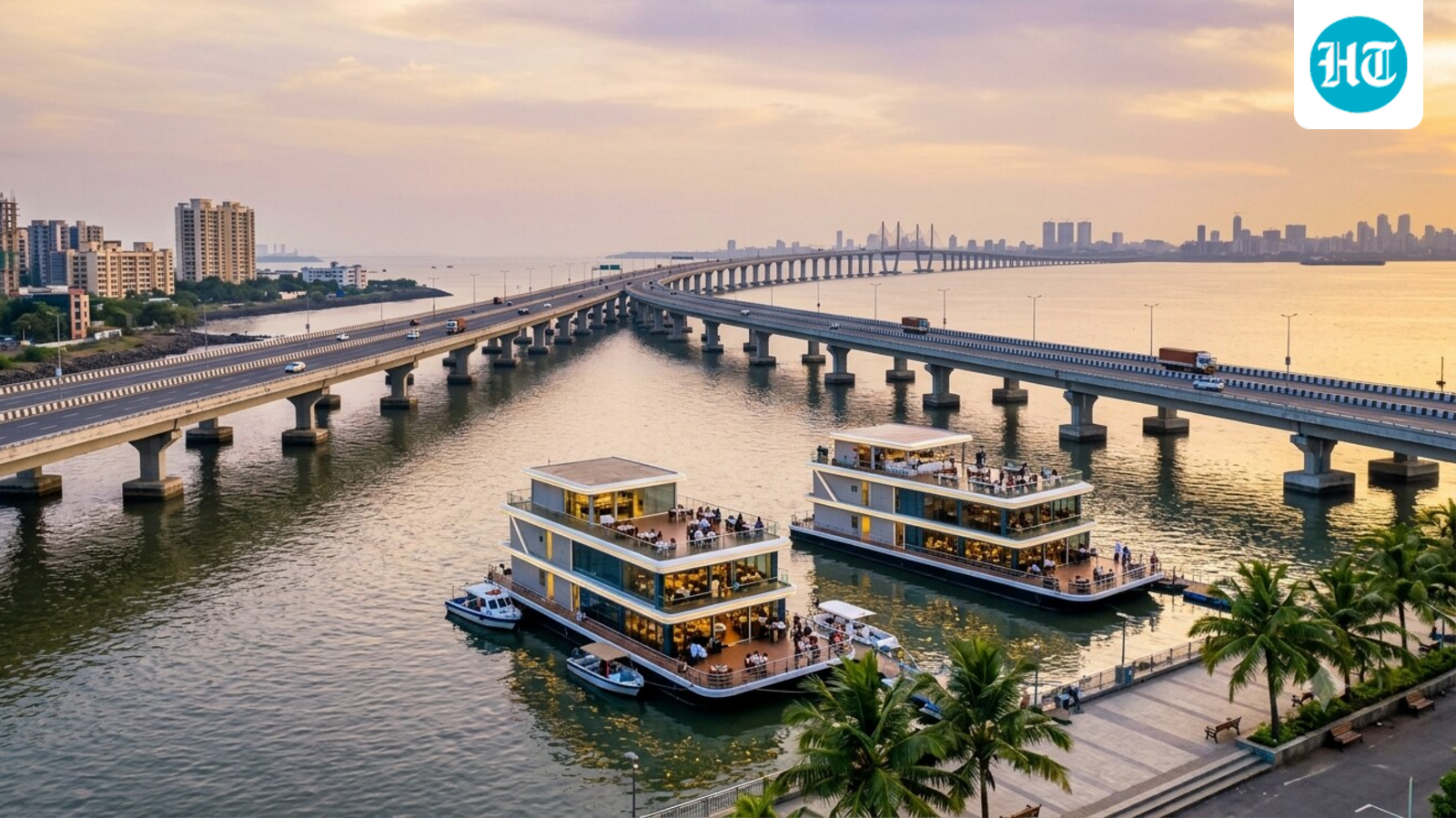
Imagine dining aboard a floating hotel with views of the Atal Setu, India’s longest sea bridge connecting Mumbai and Navi Mumbai, and the waters of Panvel Creek. The Maharashtra Maritime Board (MMB) plans to facilitate the development of three floating hospitality facilities, or floatels, near the Belapur jetty in Navi Mumbai as part of its efforts to promote maritime tourism and waterfront leisure.

The state government’s maritime agency has invited private operators to develop and operate floatels at three locations near the newly developed tourism jetty in Sector 15, Belapur. According to the tender, the floating facilities could offer dining, accommodation, recreation, entertainment and other tourism-related services, subject to statutory approvals and maritime safety requirements.
The proposed facilities would be anchored at locations approved by the MMB. Visitors would be ferried between the shore and the floating establishments using auxiliary boats, also known as tender boats. The tourism jetty at Belapur is envisaged as the boarding and disembarking point for passengers, as well as a route for transporting supplies and equipment to the floatels, it said.
What is a floatel?
A floatel is a floating hotel or hospitality facility built on a vessel or floating platform, offering accommodation, dining and entertainment on water. Unlike conventional hotels built on land, floatels are designed to provide a distinctive waterfront experience. Depending on their design, they may be permanently anchored or capable of moving.
Maharashtra maritime model
The MMB’s tender identifies waterfront hospitality, recreational opportunities, private investment and tourism-related maritime infrastructure as objectives of the proposed project.
As per the tender, the selected operator will be responsible for financing, designing, developing, deploying and commissioning the facility, besides securing the necessary approvals and complying with maritime, environmental and safety rules. The operator will also have to manage passenger transfers and maintain the floatel and associated assets.
The tender states that temporary landside facilities, including ticket counters, will have to be developed by the selected operator at its own cost, with the MMB providing facilitation. The floatel can operate only from a mooring or anchorage location designated and approved by the board.
Also Read: Will US Green Card curbs push GCC expansion, office and premium housing demand back home?
Mumbai’s floatel experiment
Mumbai’s experiment with floating restaurants and hotels has had mixed results. AB Celestial, located near the Bandra-Worli Sea Link, shut in April 2021 amid the pandemic and coastal road construction, while Ark Deck Bar capsized in May 2018.
The Mumbai Port Trust later launched two floating restaurants, Queensline Sea-Yah and Neverland, near the Gateway of India, with another planned near Girgaum Chowpatty. Separately, a proposed luxury offshore floatel near Nariman Point reached a key regulatory milestone in June 2026, when the coastal authority recommended clearance.
However, the floating restaurants that shut during the Covid-19 lockdowns have not reopened since the pandemic.


