



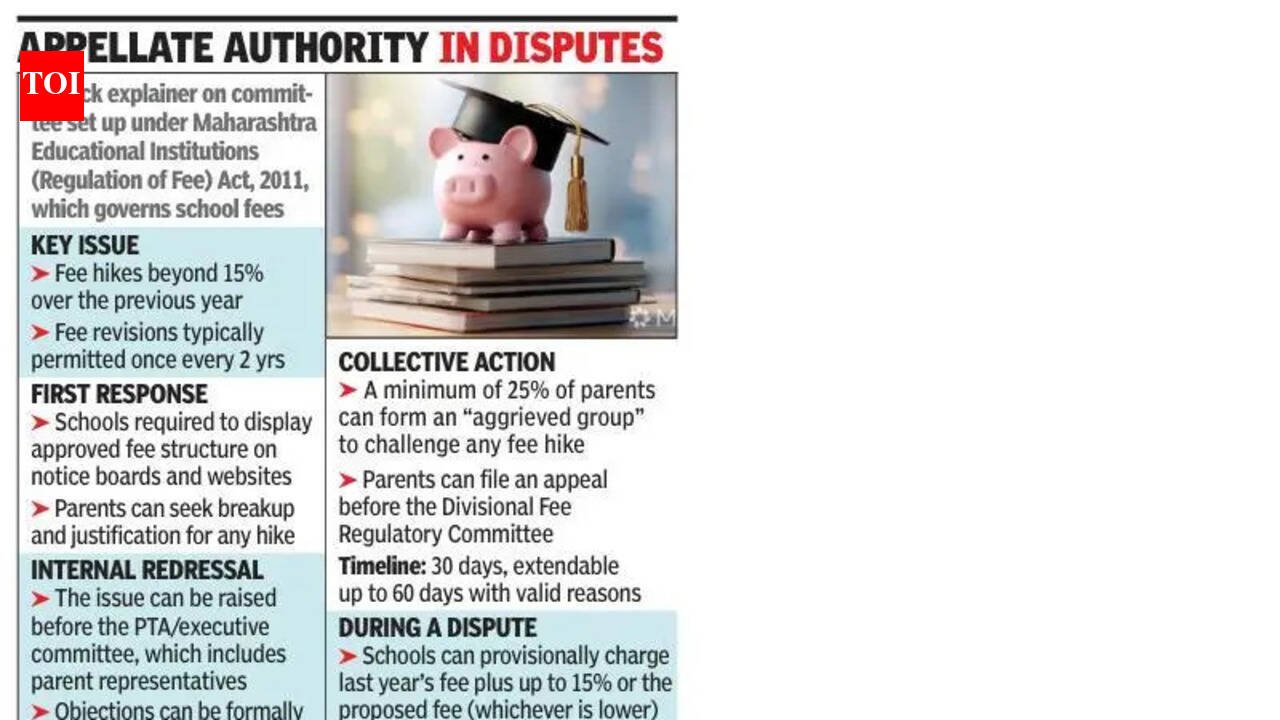
Mumbai: In a significant move to revive fee oversight in private schools, the state govt has reconstituted the long-dormant revision committee under the Maharashtra Educational Institutions (Regulation of Fee) Act, 2011, restoring a key appellate mechanism that had remained largely defunct for the past few years.Retired Bombay High Court Judge M G Gaikwad has been appointed chairperson, with the joint director of education, Pune, serving as ex-officio member-secretary.Empowered under Section 11 of the Act, the committee functions as the final appellate authority in fee disputes, with the mandate to call for records, examine decisions of fee regulatory panels and issue binding orders, including revising or setting aside fee structures.At the regional level, divisional fee regulatory committees (DFRCs) have also been reconstituted. Retired district judges M S Gupta (Mumbai), S S Gulhane (Pune), O P Jaiswal (Nagpur) and K R Devsarkar (Chhatrapati Sambhajinagar) will head the panels, with deputy directors of education acting as ex-officio member-secretaries.Under the Act, schools that do not declare a long-term fee structure can propose increases of up to 15% over the previous year’s fee, with revisions typically allowed once in two years. Any higher or earlier hike requires consent of 76% of parents or must be justified as an unforeseen circumstance. During disputes, schools can collect only the previous year’s fee plus up to 15% or the proposed fee, whichever is lower, until a final order is passed.Parents can approach the committees through the deputy director of education’s office at Charni Road in cases where schools hike fees beyond permissible limits or without due process. The law mandates that proposed fee increases be placed before the Parent-Teacher Association at least six months in advance.Deputy secretary Sameer Sawant said the delay in reconstitution was due to procedural requirements. “As these appointments mandate that it has to be a retired judge, we faced delays since recommendations must come from the district court and the high court,” he said.


