



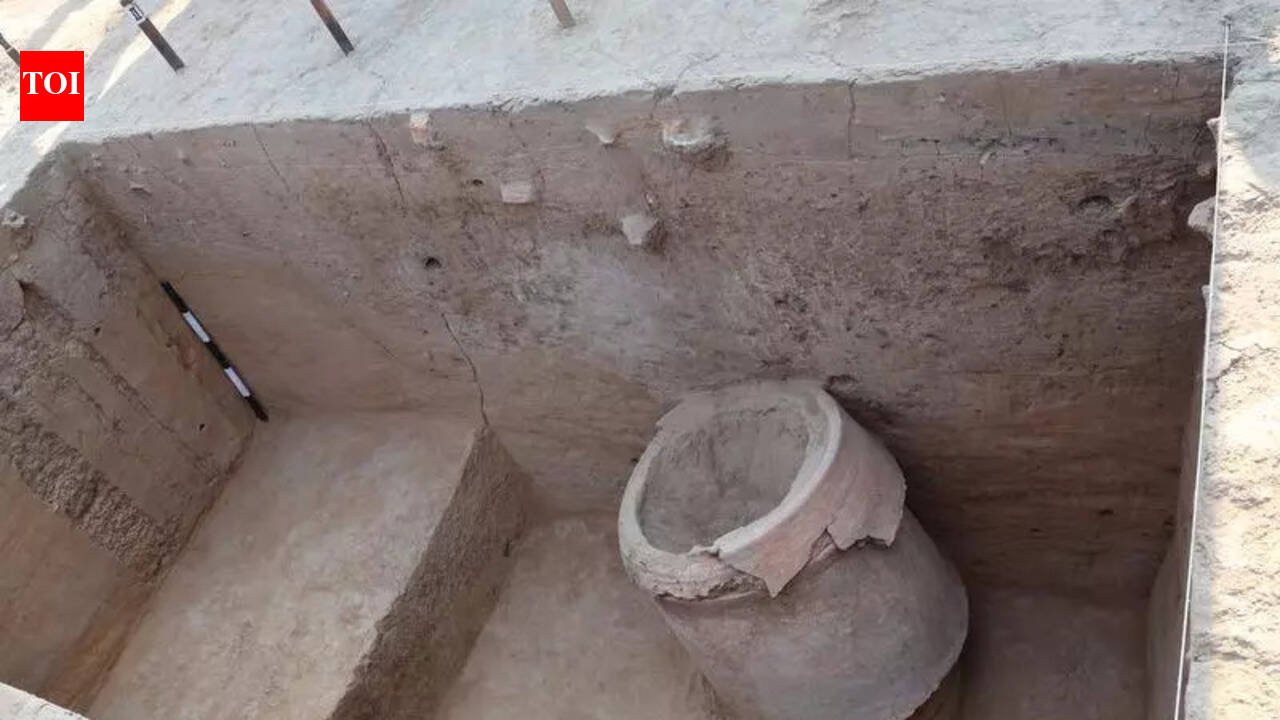
Chennai: A team of students and faculty members from the University of Madras has unearthed a ring well believed to be from Sangam era (the early historic period) at Chettimedu Pathur in Chengalpet district. The university’s department of ancient history and archaeology has been excavating Chettimedu Pathur, a neolithic site, for the second season.“One of the trenches revealed a ring well at a depth of 1.49m. It consists of six rings, each wider at the base and narrower at the top, allowing them to interlock securely, a construction technology found from other Sangam age sites such as Pattaraiperumbudur, and Keeladi,” said Jinu Koshy, excavation incharge. “The associated findings including black-and-red ware, black slipped ware, red slipped ware and Indian rouletted ware also reveal that the ring well could belong to the Sangam age,” he added.The team excavated within the premises of Thiruvathamman temple at Chettimedu Pathur this year.Archaeologists say that finding of the ring well on the Palar river basin is rare. “Only a handful of archaeological sites such as Kancheepuram in Palar river basin have yielded ring wells so far,” said J Soundararajan, head of the department.A few black and red ware and black slipped ware sherds with graffiti marks from iron age layers were also retrieved from the trenches.“Other antiquities included glass, semi-precious stone beads, Chola period coins, a terracotta wheel and potsherds were also recovered,” he added.In the first season of excavation, researchers found burial remains of a child along with potsherds of burnished grey ware, black slipped ware with graffiti marks and bricks from early historic period and red slipped ware with designs in black (iron age) at Chettimedu Pathur.


