



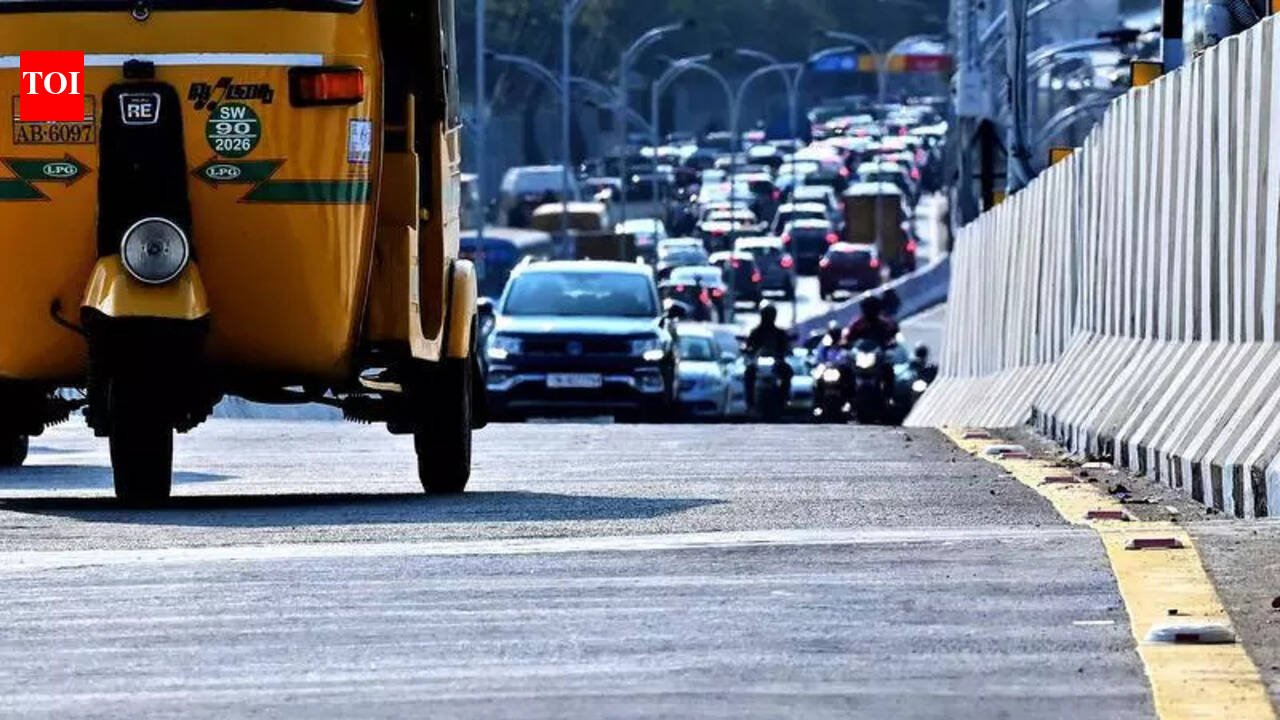
Chennai: Just days after chief minister M K Stalin inaugurated the 60-crore Madhya Kailash flyover, commuters say it’s an unexpectedly bumpy ride on the 652metre-long structure.The flyover was unveiled last week to ease traffic from Sardar Patel Road to OMR. Soon after, videos of the bumpy ride went viral. While there were no bumps for the first 80m from Sardar Patel Road, where the highways laid a bituminous macadam approach road, the remaining stretch was done in concrete and was filled with undulations.
Experts said only a thorough investigation can reveal the real reason. Sampath Kumar, highways and transportation professor at Sathyabama University, said the steel bearings supporting the flyover may deflect much more than expected.“The flyover will be supported by steel reinforcements, pulled and tied by steel wiring. These reinforcements usually deflect to a certain degree when a load passes above them. The deflection is calculated during a load test, and adequate reinforcement is given. If there is an error in the readings during testing, the reinforcements may tend to deflect more, causing a bumpy ride. This will make the flyover structurally unsafe in the longer run, as cracks may emerge from beneath,” he said.” A load test is usually done with multi-axle trucks in the central part of the flyover to assess deflections. So, it has to be studied why bumps are felt for smaller vehicles like cars and bikes,” he added.Another reason for the bumpy rides could be the use of poor grade concrete, he said, “In TN, they use M40 grade, which has a finer mix of granules. Usually, M50 concrete is recommended, and in some metro corridors in Delhi, they use M90 concrete. The higher the level, the more rigid it is,” he said. R Ramarao, a highways contractor for more than three decades, and president of Greater Chennai contractor association, said the uneven bumps can be due to poor levelling of concrete. “Another reason could be the uneven elevation from one expansion joint to the other. Even a 10-mm elevation can feel bumpy. They have to remove the concrete and lay it again, but this is impossible now as the flyover is open,” he said.Highways chief engineer Jawahar Muthuraj and superintending engineer Rajadurai said they were in meetings and would get back later. Another official associated with the project said an asphalt road has better flatness compared to concrete. “We will look into the complaints. The flyover is structurally safe, and the bumps will normalise in concrete over a period of time,” the official said.


