



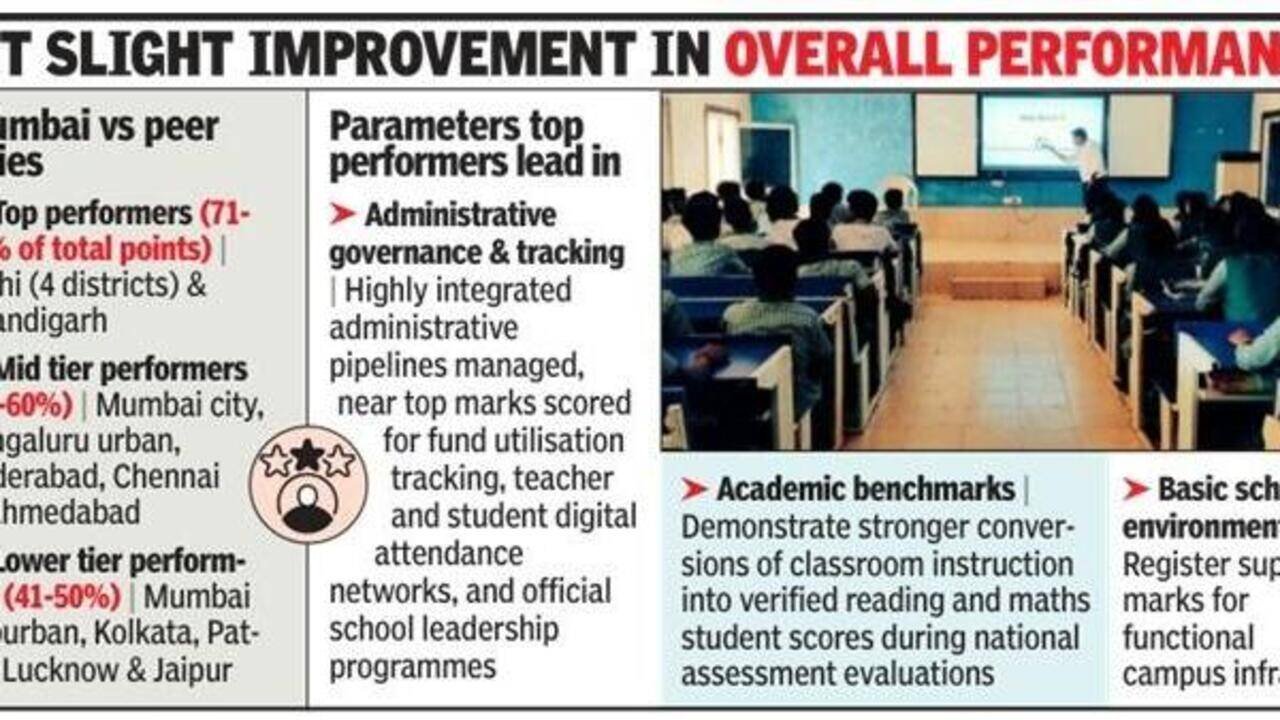
Mumbai: Maharashtra marginally improved its performance on a govt education index in a year, going up from a score of 649.8 out of 1,000 points to 654.6. Nationally, it trails behind top performing regions like Chandigarh, Punjab, Kerala and Delhi, but it maintains a lead over other large industrial states such as Tamil Nadu, Andhra Pradesh, Gujarat and Karnataka.According to the Performance Grading Index for Districts (PGI-D), released by the Union education ministry and based on data from govt-run Unified District Information System for Education Plus (UDISE+), the state’s best performing domain is ‘equity’, where it scored 90.2% (234.4 out of 260 points) by effectively closing the achievement gap between different student groups. In contrast, its worst performing domain is ‘learning outcomes and quality’, where it registered its lowest relative score of 42.8% (102.8 out of 240 points), followed closely by 45.9% (87.2 out of 190 points) in ‘school infrastructure and facilities’.Thirteen states and UTs fall below Maharashtra, scoring between 58% and 64% of the total points. UP, West Bengal, MP, Bihar, Chhattisgarh and Jharkhand scored between 52% and 58% . Meghalaya is at the bottom.The data shows that the top performers outpace Maharashtra because they dominate distinct structural domains. Chandigarh leads the entire country because of its administrative framework, standing as the single territory to score in the highest national bracket for ‘governance processes’, driven by near perfect marks in tracking funds, institutional leadership and digital teacher attendance records. While Maharashtra dropped over half its points in actual classroom delivery, Punjab topped ‘learning outcomes and quality’ with its verified student reading, language and maths proficiency scores.Chandigarh, along with Delhi and Lakshadweep, also dominates the ‘physical assets’ index, reaching top thresholds specifically for providing advanced, functional school environments, building utilities and clean student facilities. In the remaining evaluation areas, Tamil Nadu joins Delhi and Chandigarh at the top post for ‘educational equity’, while Kerala and Lakshadweep lead in ‘teacher education and training’ frameworks.Madhav Suryavanshi of Shikshan Vikas Manch at south Mumbai’s Yashwantrao Chavan Centre said, “Grants given to schools for maintaining infrastructure and developing new facilities are no longer given in Maharashtra while continuing in other states, which has led to a drop in quality across the board in physical infrastructure. More teachers need to be hired, especially in the hundreds of schools with only one or two teachers, and they must be relieved from endless administrative work to allow them to focus on teaching. Most importantly, focus and consistency in education policy is needed to improve the state’s educational outcomes.”He claimed the mandate under RTE Act to promote students automatically till Class 8 has had an unintended consequence of lowering average academic standards, which in turn has driven up dropout rates in later classes. “This requires urgent intervention. Additionally, while funds are continuously poured into physical facilities, there is a distinct lack of monitoring regarding their effective use. When you combine this with the declining enrolment and understaffing plaguing zilla parishad schools, it is clear improvements need to be made.”


