



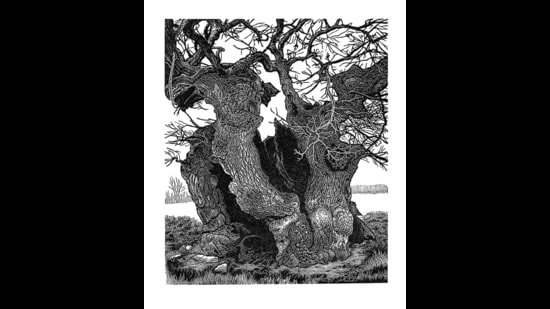
The ancient giants among us carry with them not only wisdom from the past, but also clues to the future. From the snowy plateaus of Northwestern China, to the Balkan peninsula and along the riverine swamps of Mexico, some of the oldest trees — over thousands of years old — survive and thrive to this day.
How do they navigate life in a world that’s constantly changing? A new book, In the Circle of Ancient Trees (2025; Greystone Books / UniPress), edited by dendroclimatologist Valerie Trouet at the Laboratory of Tree-Ring Research, University of Arizona, chronicles ten such iconic tree species through essays by 11 scientists.
Over time, these have evolved distinct adaptations to survive changing environments, from towering European Bosnian pines to China’s resilient dwarf junipers. Elsewhere, some have developed “swollen knees”, while others shed “flaky skin” as a form of protection.
Step closer to see what they teach us.
GIANT SEQUOIA: 3,300 YEARS OLD , CALIFORNIA
The crimson-tinged bark of the Giant Sequoia reaches over 65 ft, even before its first branches appear. To grasp the scale of the world’s largest tree by volume, picture a trunk that soars higher than the Statue of Liberty, with a circumference three times its size. Having survived over a hundred wildfires in its lifespan, the “fire-resistant monarch of the forest” has adapted in spectacular ways.
For one, they are serotinous, learning to use fire to their advantage. The heat of forest fires triggers cones that are sealed shut for over 20 years to dry out, open up, and disperse seeds. Its thick, often fibrous bark can even act as an insulator, producing tannins that resist pests and diseases.
Indigenous people of North America would have been the first humans to interact with the species. The Miwok called them woh-woh-nau, meant to mimic the hoot of an owl, considered the guardian spirit of the tree. They were the first to use controlled fires as a way to clear debris to prevent larger outbreaks,shaping the fire response of the tree along the way. The tree also self-prunes by shedding lower branches so that surface fires don’t spread to the crown.
QILIAN JUNIPER: 2,868 YEARS OLD, QINGHAI-TIBET PLATEAU
For most of its life, the longest-living Qilian juniper has endured brutal conditions in China’s northeastern Qinghai-Tibet plateau. Withstanding intense spells of repeated droughts, nutrient-poor soil, freezing temperatures and high UV radiation.
They rarely exceed 26 ft in height and are just about three ft wide, which gives them the name gaˇlaˇo hàn, which is Chinese for “dwarfed old man.”
With a gnarled, twisted stem and hat-like crown, it is perhaps the most important species for tree-ring studies in China. Its long lifespan and strong climate sensitivity make it valuable for the reconstruction of past environmental conditions. Now also growing in the arid and semi-arid provinces of Qinghai, Gansu, and Sichuan, they have been able to survive terrain that receives less than 250 mm precipitation per year, such as in the Zongwulong Mountains in northwestern China.
Tree-ring studies reveal that around 18,000 years ago, the northeastern Qinghai-Tibet Plateau underwent a rapid transition from temperate forests to grasslands. This likely caused Qilian juniper forests to decline sharply, “forming multiple separate groups along the edges of the Plateau,” writes Bao Yang, a palaeoclimatology researcher at the Chinese Academy of Sciences, Lanzhou, in the book.
The beloved tree threads its way through Tibetan folk tales and songs, its longevity a symbol of undying love and resilience. One folktale tells of a young girl who pleads with the tree to save her village from the demon of drought. The Qilian juniper responds by offering its twigs, which, when burnt emanated a sweet scent, driving the demon away.
BOSNIAN PINE: 1,075 YEARS OLD, SOUTHEASTERN EUROPE
With a winding, scaly bark and long, dark-green needles, the Bosnian pine only grows up to 70 feet, yet commands an imposing presence. The oldest known tree, Adonis, is a 1,075-year-old specimen discovered in Northern Greece’s Pindus Mountains in 2016 and considered the oldest living organism in Europe. The species itself was discovered on Mount Olympus in Greece, where they grew in the harshest of conditions, among chalky rocks, nutrient-poor soils and high altitudes battered by severe wind and heavy snow.
“It is neither tall nor very thick, but seems like an ancient prophet looking calmly at the valley below,” writes Belgian forester and researcher Momchil Panayotov, describing his first impression of the tree. They have crooked stems and irregular crowns – some widely spaced, and others clumped together as though they were deliberately planted together.
And, in a way, they were. When birds stashed their pickings for the winter, seeds from the forgotten cache took root and turned into pine trees.
In the steep Pirin mountains of Bulgaria, researchers now know that the pines have been met with both fires and avalanches. The avalanches would leave scars, break the stems (from where the tree would regrow) or bend or almost uproot it, forcing the stems to grow horizontally and produce what is called reaction wood – an excellent clue used by researchers everywhere.
Fires, on the other hand, were both killers and helpers. “They not only killed younger trees with thin bark, but they also killed larger, thin-barked trees of species that grew faster than Bosnian pine, such as the Norway spruce, silver fir,and Scots pine, essentially wiping out competition,” writes Panayotov.
BALD CYPRESS: OVER 2,600 YEARS OLD, NORTH CAROLINA
Along the Black River in North Carolina stands a mammoth tree, reaching over a 100 ft, with a 12 ft diameter, which is more than 2, 646 years old. Characterised by its “swollen knees” or buttresses that can grow up to 10ft, they make wood that is resistant to decay in a pale-brown, reddish hue.
“Bald cypress tree-ring records have been used to link the failure of early English settlements on the East Coast, such as the Lost Colony of Roanoke and Jamestown’s Starving Time, to some of the worst droughts in the region over the past millennium,” writes Matthew Therrell, a geography professor at the University of Alabama.
Therrell’s team found that climate change and other environmental factors may have brought on severe periods of drought, as opposed to the historical theory that poor management by early settlers of Jamestown in 1607 may have been the sole cause for their struggles.
One would imagine that a tree growing in water would be indifferent to heavy rainfall or drought. Yet bald cypress is extremely sensitive to even fairly minor reductions in its water supply. By growing “swollen knees”, they are able to adapt. These act as storage sacks for nutrients and carbohydrates, apart from transporting air to the root systems that are submerged in water.
In Mexico, the bald cypress (also proclaimed their National Tree in the Early 20th century) attains a venerable position because of its antiquity. Their presence in swamps and along waterways sets an eerie stage for local folklore, such as in the enduring legend of La Llorona (The weeping woman). After his defeat by the Aztecs in 1851, Spanish conquistador Hernán Cortés is said to have wept in the shade of the tree in Popotla.
KAURI: OVER 2,000 YEARS, TE IKA-A-MAUI, NEW ZEALAND
With a commanding presence that invokes awe, the kauri are strong and enduring, held in place with deep, peg roots. Found naturally only in the Te Ika-a-Maui (Upper North Island), they are the southernmost members of the Agathis family and the largest trees by volume in Aotearoa, New Zealand.
The most notable of the lot, Tane Mahuta, is over 16 ft in diameter and almost 150 ft tall. In Maori mythology, the tree is considered a descendant of the Supreme Being, Io Matua Kore, and an embodiment of Tane, the god of forest, birds, and people.
Kauri forests were once fertile playgrounds for birds, bats, reptiles, frogs and invertebrates such as fish and eels in their waterways. This changed around 1250 CE with the arrival and settlement of Maori from Polynesia. “The forest gave way to gardens for growing kumara (sweet potato),” writes archaeologist Gretel Boswijk at the University of Auckland.
The bark has a hammered appearance and peels away in large flakes, revealing a surface with soft red hues. The flaky barks help protect against insects, parasites or epiphytes such as lichen or hanging fork ferns, while their expansive root systems prevent erosion, and contribute to the stability of the soil, especially in mountainous terrain.
A 2019 research by scientists at the Auckland University of Technology discovered that kauri trees, through a grafted root system, exchange water and resources to keep one another alive.
Left to their own devices, these giant trees can outlast us all. However, their biggest threat is a water-mould pathogen that damages root in a disease known as kauri dieback. Hiking boots, shoes, and tyres often spread the pathogen, which is why it is most prevalent alog hiking trails on the island.


