



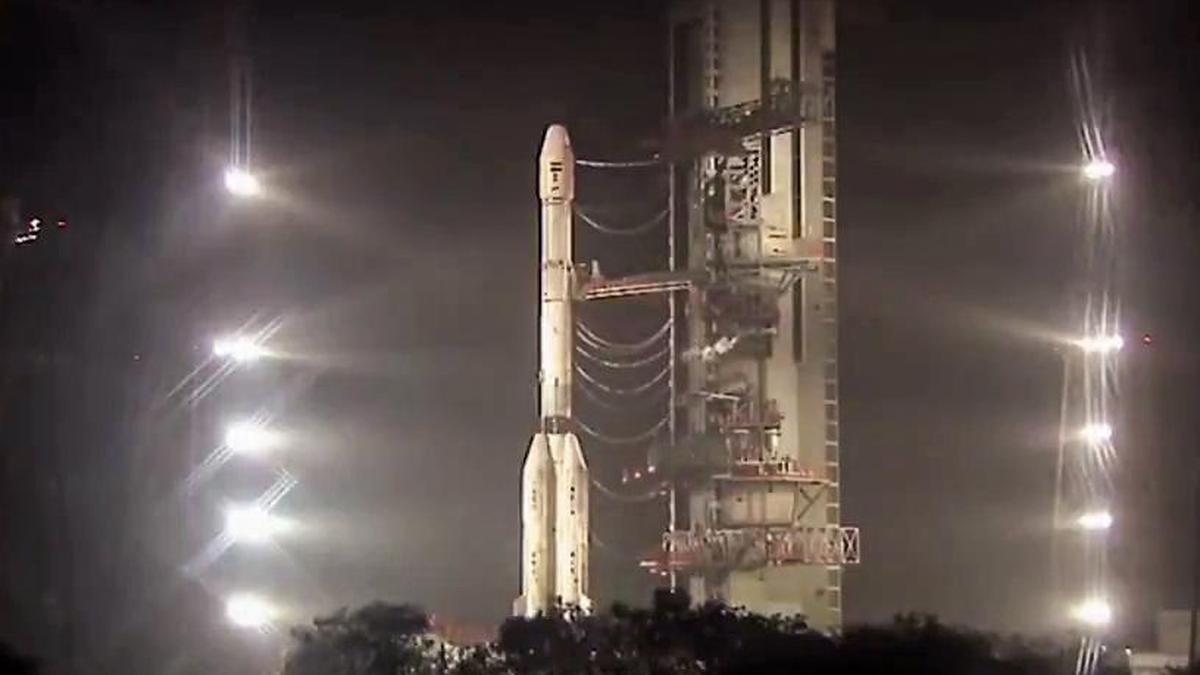
The NVS-02 navigation satellite set to aboard the launch vehicle GSLV-F15, from the Satish Dhawan Space Centre (SDSC) in Sriharikota on January 29, 2025.
| Photo Credit: ANI
After nearly a year’s delay, the Indian Space Research Organisation (ISRO) made public the report of a committee constituted to analyse why the NVS-02 satellite, which was launched aboard a GSLV rocket on January 29 last year, couldn’t be placed in its intended orbit.
The apex committee, as it is called, concluded that the main reason for what happened was that the signal meant to activate a key valve in the engine’s oxidiser line never reached it. This valve is crucial for firing the engine to raise the spacecraft’s orbit.
The committee said the most likely explanation was that at least one connection in the electrical connector — in both the primary and backup lines — came loose or failed, preventing the signal from getting through.
NVS-02, the second spacecraft in the NVS series, was placed successfully into an ‘elliptical transfer’ orbit on January 29, 2025 at 00:53 UT but its subsequent transfer to a circular orbit was unsuccessful. This was also a special occasion being the 100th launch from the Sriharikota launchpad. The spacecraft was separated from the launch vehicle (GSLVF15) following which a series of autonomous activities on the satellite were carried out, including deploying the solar panel and stabilising the orientation for power generation.
The NVS-02 was to be the second satellite in the NVS series, and part of India’s Navigation with Indian Constellation (NavIC).
Also Read | ISRO successfully launches NVS-02 satellite; creates history with the 100th launch from Sriharikota
‘Performed satisfactorily’
The committee, an ISRO statement said, gave a set of recommendations to “enhance” the redundancy and reliability of pyro system operations for future missions. These were “successfully implemented in CMS-03 spacecraft launched on November 2, 2025 by LVM-3 M5, and the pyro systems performed satisfactorily placing the satellite in the intended orbit.”
The CMS-03, or GSAT-7R, is an indigenously designed and developed satellite, weighing approximately 4,400 kg — India’s heaviest communication satellite — and is critical to the Navy’s space-based communications and maritime domain awareness.
The Hindu reported this week that a committee that includes K. Vijayraghavan, former Principal Scientific Adviser, and S. Somanath, former Chairman, ISRO, will probe “systemic issues” underlying the successive failures of ISRO’s Polar Satellite Launch Vehicle (PSLV).
Published – February 25, 2026 10:44 pm IST


