


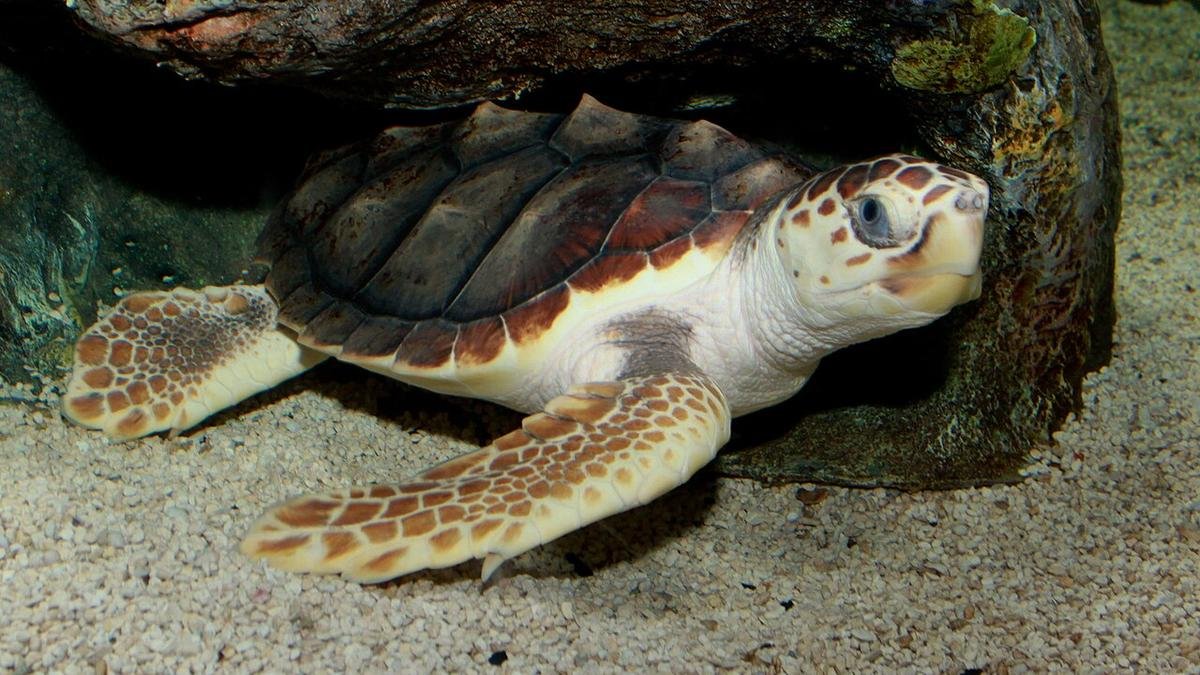
Scientists noticed that loggerhead turtles are getting smaller in size, reducing their reproductive output: smaller females produce smaller clutch sizes.
| Photo Credit: Brian Gratwicke (CC BY)
The spectre of climate change has come to haunt one of the ocean’s most ubiquitous — yet vulnerable — turtles: the strong-jawed loggerhead, named after its exceptionally large head. These omnivorous marine reptiles have been impacted in at least four ways by global warming. As the ocean warms and marine produce dwindle, these turtles are nesting earlier in the year, and more worryingly, they are producing fewer eggs and less often, said a new paper published in the journal Animals. And if that wasn’t enough, this sea creature is getting smaller in size too.
The study of the reptile spanned 17 years, and was conducted in Cabo Verde, an island country off the coast of West Africa where tens of thousands of female loggerhead turtles lay eggs every year. While these new phenomena in the turtle’s behaviour could be “adaptive,” scientists fear that this might portend long-term consequences for the species.
“Sea turtles are adjusting their timing to warmer temperatures, which shows a remarkable capacity for flexibility,” Fitra Nugraha, a co-author of the study, and researcher at the Queen Mary University of London, said in a release. Mr. Nugraha added however that the part of the Atlantic ocean that provides them food are “becoming less productive — and that is quietly eroding their reproductive output.” Female loggerheads have now begun breeding less frequently: from every two years to a four-year gap today. The authors also observed that there were fewer eggs in each nest, and that the turtles are becoming smaller in size.
“The turtles are working harder for less return,” said Kirsten Fairweather, co-author and scientific coordinator at Associação Projeto Biodiversidade. “When you follow individual turtles over many years, a more complex picture emerges.” Researchers looked at population dynamics, population genetic structure, disease ecology, habitat vulnerability, and feeding ecology.
‘Capital breeders’
Satellite estimates of chlorophyll found that food supply is dwindling in the ocean. And these turtles being “capital breeders”, draw from energy stored from foraging at sea, over years, in order to reproduce. The authors found that warmer years were associated with earlier reproductive cycles and longer nesting seasons. They also noticed a trend in their declining size which “further reduces reproductive output, as smaller females produce smaller clutch sizes,” said the paper.
To safeguard sea turtles in a warming world, Ms. Fairweather said we need conservation strategies that extend beyond the shoreline to include protecting feeding habitats, reducing pressures on marine ecosystems, “and recognising that climate change can undermine reproduction even in populations that appear to be thriving.”
Climate change is impacting turtles in multiple ways, Naveen Namboothri,a founder trustee at Dakshin Foundation, told The Hindu. “The rising sea levels erode or inundate beaches, reducing the availability of ideal nesting beaches,” he added. Changes in nest temperatures can affect the sex ratio of sea turtles: “like many other reptiles, in turtles, the sex of the hatchling is determined by the nest temperature and not genetically. Higher nest temperatures can produce more females.”
Dr. Namboothri added that climate change-driven disruptions in ocean circulation can also affect migration patterns of adult turtles and dispersal of the hatchlings as these turtles use water currents to move long distances.
Climate change has indeed been proven to be devastating for marine and terrestrial fauna: they are forced to move to new territories, some dwindle towards extinction and others are robbed of their vibrant colours and even thehir song. And loggerhead turtles like many other wild fauna, are adapting, and this reptile does so by breeding earlier in the year as temperatures rise.
“Sea turtle conservation efforts now need to look beyond conserving nesting sites end extend to their feeding and foraging grounds that could be degrading rapidly,” said Dr. Namboothri.
Published – February 17, 2026 06:00 am IST


