



Lithuania lifts drone alert
The drone alert in Lithuania has just been lifted.
The country’s defence minister was quoted by Reuters as saying that the drone flew by Lentvaris near the capital, Vilnius, before diverting in a different direction.
We will no doubt get more details on this soon.
Key events
‘Russian claim’ on Latvia, Baltics is ‘totally ridiculous, and Russia knows it,’ Nato’s Rutte says
Rutte also gets asked about Russia’s escalating rhethoric and threats against Latvia and the Baltics, as reported in yesterday’s blog.
Russia keeps saying that Latvia and potentially other Baltic countries are about to give Ukraine a permission to attack Russia from its territories with drones. Latvia and Ukraine repeatedly dismissed the claims as “lies.”
Rutte has no time for it:
The Russian claim is totally ridiculous, and Russia knows it.
Rutte gets asked about today’s incident in Lithuania.
He says Nato has offered “a calm, decisive, and proportionate response to these drone incursions” in the region.
“If drones come from Ukraine, they are not there because Ukraine wanted to send a drone to Latvia, Lithuania, or Estonia. They are there because of the reckless, illegal, full-scale attack of Russia, starting in 2022 after, of course, what they did in Crimea in 2014 against Ukraine.”
He hails Nato’s response with a Romanian F-16 fighter jet stationed in Lithuania taking out the drone over Estonia.
He then declines to comment on whether the use of fighter jets is the best way to fight drones.
Rutte also gets asked about the reigning confusion over the US plans regarding its force posture in Europe, including its decision to pull some troops out of Germany and Poland.
As often, he doesn’t really answer the question directly, talking instead about how “the Europeans and the Canadians are massively stepping up in terms of defence spending.”
He says he “totally agreed” with US vice-president JD Vance’s comments from last night that “Europe has to take a bigger role” in Nato, and “take more of the responsibility for the conventional defence” of the continent.
“Against that background, we know that adjustments will take place. The US has to pivot more towards, for example, Asia. This will take place over time in a structured way,” he says.
He points to Nato’s supreme allied commander Alexus Grynkewich’s comments yesterday saying that the changes will not have an impact on Nato’s defence plans (Europe Live, Tuesday).
Rutte gets asked about growing speculations about who could be the EU’s negotiator with Russia if there are ever direct talks about ending the war in Ukraine – and specifically, about Italy’s Mario Draghi as a potential candidate (as covered on Europe Live blog this week).
He says Draghi is a “close personal friend,” but declines to comment.
“I think first the EU has to decide on what role it will play, it wants to play, and then, if the answer is yet, there has to be a debate on who can play that role, but I leave that with the EU. I think it’s really for them to decide, not for me to comment.”
Rutte also turns to the Middle East, criticising Iran for “a direct assault on freedom of navigation and global commerce” through its activities on the strait of Hormuz.
He says several Nato countries are “coming together around plans to ensure freedom of navigation.”
He then turns to Q&A.
Rutte also addresses yesterday’s drone incident in Estonia.
He says that as part of Nato’s Baltic air policing mission, a Romanian F-16 downed a drone over Estonia.
“This was a Ukrainian drone, but it wouldn’t have been there but for Russia’s aggression,” he says.
Rutte stresses that “Nato’s air defences were effective yet again.”
Russia ‘remains most direct threat to Euro-Atlantic security,’ Nato’s Rutte says
In Brussels, Rutte begins by stressing the importance of Nato ministers meeting in Sweden, the alliance’s “newest ally” who joined in 2024.
“This says a great deal about how fundamentally our security environment has changed, especially when it comes to Europe. It is more dangerous, it is more contested and it makes it all the more important that Nato allies work together to safeguard our freedom and security,” he says.
He stresses that “Russia remains the most direct threat to Euro-Atlantic security,” not just for its actions in Ukraine, but over “persistent and growing attempts to underming our security and stability” in the alliance.
He says the question for member states is not on “whether we need to do more; the question is, how quickly allies can turn commitments into capabilities.”
He puts a positive spin on the recent US decisions to reduce its presence in Europe, saying it is a “transformation to a stronger Europe in a stronger Nato,” “moving away from unhealthy overalliance on one ally.”
Tusk, Magyar brief media after talks in Warsaw
Separately, if you want to follow a press conference between Poland’s Donald Tusk and Hungary’s Péter Magyar from Warsaw, you can do it here.
Nato’s Rutte briefing press ahead of Nato ministerial in Sweden on Friday
Let’s cross over to Brussels, where Nato’s secretary general Mark Rutte is briefing the media ahead of this week’s ministerial meeting in Helsingborg, Sweden on Friday.
EU agrees to implement US trade deal struck last summer after night talks
Lisa O’Carroll
Senior correspondent
Meanwhile, the European Parliament will finally vote on the US trade deal on 16 or 17 of June after MEPs won significant amendments to the text of the tariff deal agreed with Donald Trump at his Scottish golf course last July.
Talks between MEPs and the European Commission to finalise the text lasted five hours with the trickiest part centring on the parliament’s insistence that tariffs on steel derivatives be reduced by Trump by the end of the year.
These tariffs were imposed by the US separately to the agreement and see tariffs of 25% and 50% imposed on hundreds of products containing an element of steel from washing machines to €6mn wind turbines.
In a significant victory for MEPs, Lange explained that they forced the insertion of a clause warning that the EU could reinstall tariffs on American products such as motorbikes if the US did not reduce the steel derivative tariffs to the 15% rate agreed in Scotland.
He told reporters on Wednesday that the European Commission was “a little bit nervous about this issue”, referring to a fear of retaliation by Trump.
Lange said the sunset clause in May 2029 was a year later than they had hoped for, but would coincide with the installation of the new US presidential administration following elections in November 2024.
MEPs also won a suspension clause, which would be triggered if Trump breached his side of the deal or if industries were unfairly discriminating against.
This was an important point as there had been no impact assessment before the deal and no one yet knew how it would impact SMEs in particular, said Lange.
AFP notes that it was the first alarm in an EU and Nato member country since Russia’s full-scale invasion of Ukraine began in 2022 to trigger a hunker-down alert for the population – including the president, prime minister and MPs.
Political leaders were ushered into bunkers following a drone alert last year, but not the general population.
Lithuanian authorities have not received any notifications about drones crashing in their territory, LRT reported.
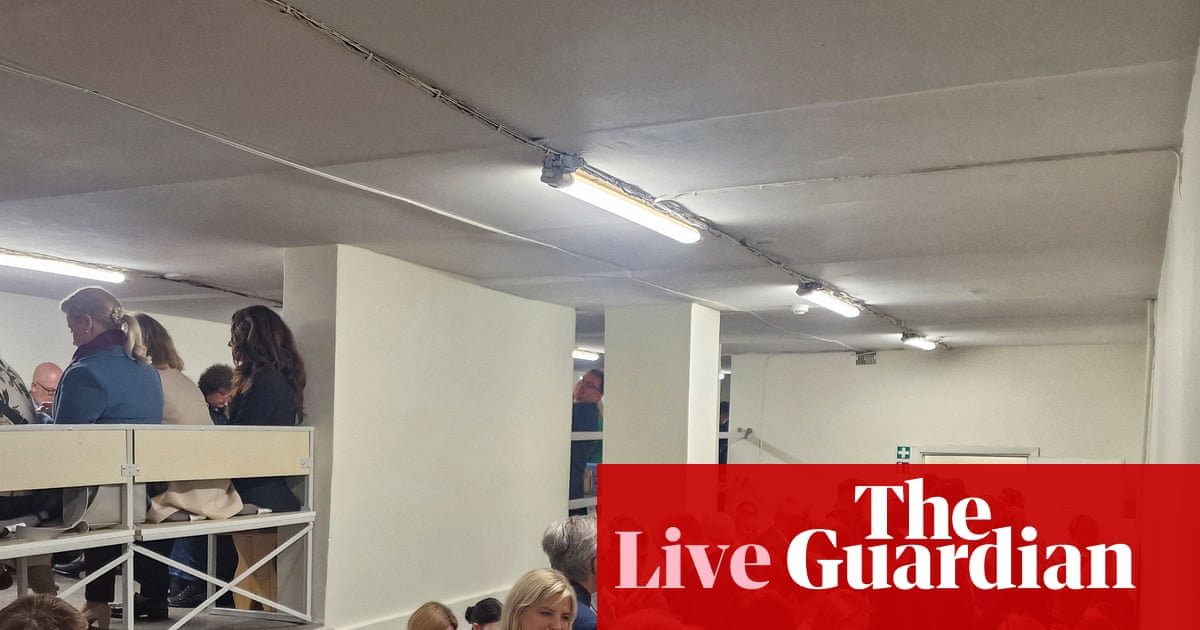
People in shelters in Lithuania during earlier drone alert – in pictures
Lithuania lifts drone alert
The drone alert in Lithuania has just been lifted.
The country’s defence minister was quoted by Reuters as saying that the drone flew by Lentvaris near the capital, Vilnius, before diverting in a different direction.
We will no doubt get more details on this soon.
Putin praises ‘unprecedented’ relations with China with focus on foreign policy, trade, energy
During his talks in China, Putin said that Russia and China were committed to “independent and sovereign” foreign policy, as they signed declarations of closer cooperation.
“Most important is that Russia and China are committed to an independent and sovereign foreign policy, are working together in close strategic cooperation and playing an important stabilising role on the global stage,” Putin said.
Erm.
Putin also said that Russia was ready to continue supplying China with energy, Reuters reported, after his talks with Xi that made him say the Russian-Chinese relations are at an “unprecedented” level.
Xi also stressed the “political mutual trust and strategic cooperation” between the countries, according to Chinese state media. The two leaders have praised each other profusely in the past, with Xi at one point describing Putin as his “best and most intimate friend, AP said.
Morning opening: Drone alerts in the Baltics, again
Jakub Krupa
Lithuania has issued an air alert this morning warning its population near the capital, Vilnius, to shelter in place, the latest Baltic country to see drone incidents impact its life after Estonia and Latvia.
“Lithuania has issued an air alert in parts of the country after a suspected drone approaching from Belarus was detected near the border. Nato Baltic Air Policing has been activated,” Lithuania’s Ministry of Defence said in a statement.
Vilnius airport has suspended flights temporarily, and an alarm sounded in the Lithuanian parliament. Train traffic has also been suspended, with passengers evacuated to shelters, LRT reported.
The incident comes just a day after Nato had to shoot down a suspected stray Ukrainian drone over Estonia, with Russia threatening the Baltics by alleging they were working with Ukraine to launch attacks on its territory.
Elsewhere, there is a lot of focus on Vladimir Putin’s trip to China for talks with Xi Jinping, with the two discussing their foreign policy aims and closer military cooperation, just a week after Donald Trump’s visit there.
The tightening relations between Moscow and Bejing will spook Europe and the US, particularly with Putin talking about “Russia and China playing stabilising role on international stage.” Erm.
I will also bring you an update on the EU-US trade talks, and keep an eye on Hungarian PM Péter Magyar’s visit to Poland where he is due to meet prime minister Donald Tusk and president Karol Nawrocki.
It’s Wednesday, 20 May 2026, it’s Jakub Krupa here, and this is Europe Live.
Good morning.


