



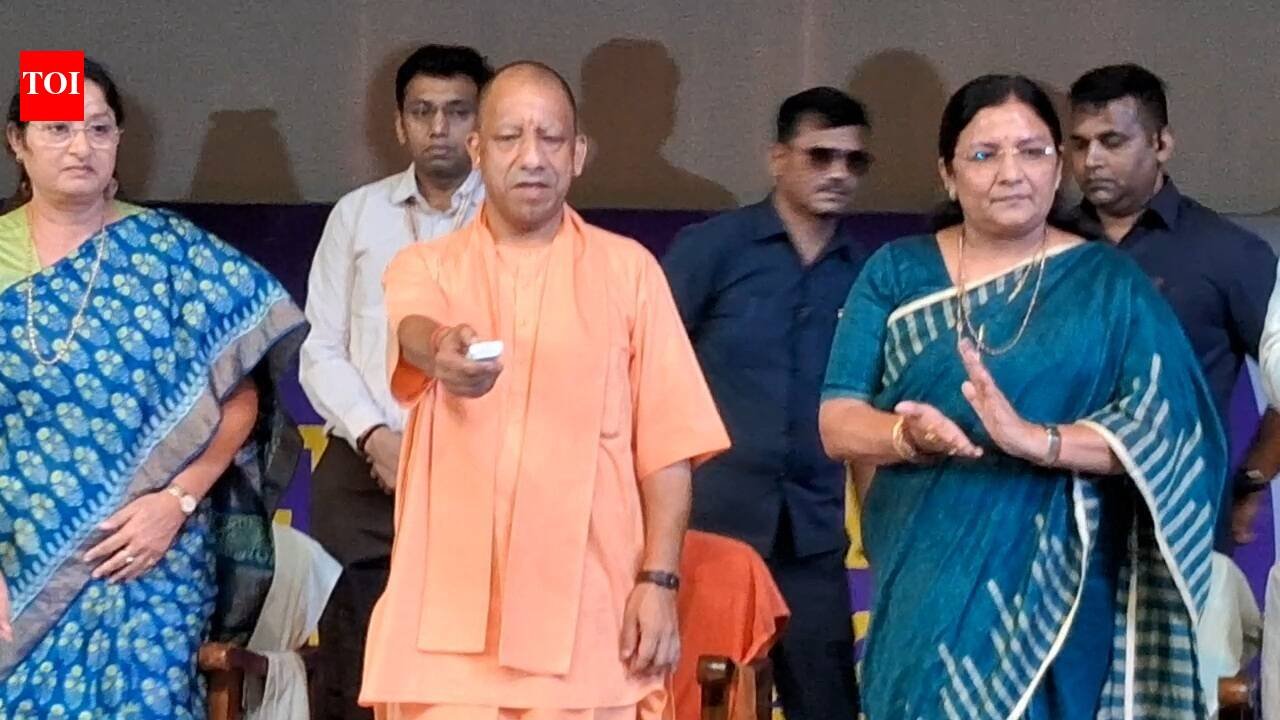
Varanasi: Chief Minister Yogi Adityanath on Wednesday launched a sharp attack on previous govts, alleging that before 2017, even the supply of supplementary nutrition to children was influenced by the liquor mafia. “Ration would not reach Anganwadi centres for three months at a stretch, while children came to the centres carrying their own mats. There were no arrangements for pure drinking water, toilets or hot meals. Under previous govts, someone else would make the mistake, but Anganwadi workers would bear the abuse,” he said.He said the govt changed the supplementary nutrition distribution system after 2017 to ensure transparency and accountability. “Today, Anganwadi centres are being equipped with modern facilities and developed as a strong foundation for nutrition and early education,” he said.Yogi launched the ninth National Nutrition Month in Varanasi on Wednesday. Dedicated to the nutrition, health and care of pregnant and lactating women, children, adolescent girls and their families, the month will be observed from Sept 9 to Oct 8. He inspected an exhibition, held children in his arms, showered them with affection and performed their Annaprashan ceremony. He also interacted with Anganwadi workers from UP and other states and watched a short film on Anganwadi centres.Linking ideal governance with Ram Rajya, Yogi referred to Goswami Tulsidas’ lines, “Nahin Daridra Kou Dukhi Na Deena. Nahin Kou Abudh Na Lachhan Heena.”He said, “Its meaning is a system where no one is poor, unhappy, deprived, weak or helpless and every person can contribute to building a healthy and capable society. With this thinking, Central and state govts are working to strengthen maternal and child nutrition, women’s health, early education and the Anganwadi system.”Yogi said a capable student would become a skilled youth who would contribute to Aatmanirbhar Bharat and take forward the resolve of Viksit Bharat. “Therefore, investing in nutrition, health and education in children’s early years is an investment in the country’s future,” he said.The chief minister said Anganwadi centres were in poor condition before 2017, with many in dilapidated condition and lacking basic facilities such as drinking water, toilets and hot meals. Supplementary nutrition supplies were also irregular.After reviewing the system, the govt found serious irregularities and learnt that a person linked to the liquor mafia was involved in supplementary nutrition supplies. “Orders were immediately issued to examine its quality and changes were made in the supply system,” he said.Over the past nine and a half years, more than 70,000 Anganwadi centres have been given a new look, while new model centres are being developed with modern, child-friendly facilities. Around Rs 30 lakh is being spent on constructing and renovating one centre. Boundary walls, children’s toilets, pure drinking water, nutrition gardens and LED screens are among the facilities being prioritised.Yogi said this year’s theme of National Nutrition Month is ‘Meri Anganwadi, Meri Zimmedari’, stressing that responsibility for Anganwadi centres is not limited to the govt. Anganwadi workers, helpers, Gram Panchayats and villagers would have to take ownership.He identified five focus areas: dietary diversity and adequate protein; fresh, hot-cooked meals at Anganwadi centres; community ownership and accountability; early education; and Pradhan Mantri Matru Vandana Yojana.He said a balanced and diverse diet was essential for children’s physical and mental development and advised against excessive salt or sweetness. Adding carrots and other vegetables to moong dal khichdi, he said, could improve its taste, colour and nutritional value.Yogi said around 1.90 lakh Anganwadi centres had been sanctioned in the state, with services being provided through 897 Child Development Projects. Nutrition services reach around 1.56 crore beneficiaries every month. Around 35.46 lakh children are provided hot-cooked meals, while the weight, stunting and health of around 46 lakh children are regularly monitored.He said the first 1,000 days of a child’s life, from pregnancy through the early years, were extremely important.In line with the Centre’s new nutrition guidelines, the state has implemented recipe-based supplementary nutrition. The Take-Home Ration (THR) system has been made technology-based, transparent and accountable. As many as 204 THR plants have been established, with women’s Self-Help Groups playing an important role. More than 20 lakh women are associated with the system.GPS tracking and real-time monitoring have been introduced from THR transportation to delivery at Anganwadi centres. A QR code has been placed on every packet for digital traceability. Quality control of supplementary nutrition has been entrusted to an important institution of the Government of India.Yogi said Anganwadi centres were also being developed as hubs for early education and children’s all-round development. In Bal Vatika, children are taught letters and numbers through games and activities according to their age and interests.Sharing his experience at an Anganwadi centre in Kanpur, he said 20 to 22 children were being taught through games and songs. An Anganwadi worker was teaching number recognition through the rhyme, “Ek, ek, ek, meri naak ek and do, do, do, meri aankh do.” Yogi said a three-year-old girl immediately repeated the rhyme when asked what she was learning.Referring to facilities in schools under the Basic Education Department, Yogi said the govt’s objective was not merely to ensure children’s access to schools but also to provide them with a respectful and better environment.He recalled seeing a girl going to school barefoot and without adequate warm clothes. Her younger brother had shoes, which made him realise the discrimination between sons and daughters in families and society. He immediately directed that uniforms, shoes, socks and sweaters be provided to daughters, which was later extended to all children.Today, 1.60 crore children in the state receive two uniforms each, bags, books, shoes, socks and sweaters every year. Arrangements are now also being made to provide two uniforms each to children attending Bal Vatika.Under Operation Kayakalp, 1.36 lakh schools have been provided better buildings and basic facilities, including drinking water, separate toilets for boys and girls and improved educational environments.Yogi said a study had found that many children, particularly girls, were leaving school between Classes 3 and 7 due to the lack of basic facilities such as food, drinking water and toilets. Strengthening these facilities had improved the dropout situation.He said children’s educational foundation was being strengthened through the NIPUN Bharat Abhiyan after they learnt letters and numbers in Anganwadi. The effort to develop reading and writing skills, earlier limited to Class 2, has now been extended to Class 5.The chief minister also referred to work under Project Alankar in secondary education. Funds have been provided to govt and government-aided inter colleges that are 40 years old, and around 2,100 inter colleges have been revived. Smart libraries, smart classes and better furniture are being developed, while students are being connected with modern technology through Atal Tinkering Labs and space technology.He said the educational journey from Anganwadi to NIPUN Bharat, Basic Education, secondary education and skill development was being linked with employment to create a strong education and employment-oriented ecosystem.Calling Pradhan Mantri Matru Vandana Yojana an important part of the nutrition campaign, Yogi said around five crore mothers across the country had so far received more than Rs 21,000 crore. “Investment in a mother’s health and nutrition strengthens the foundation of the child’s entire life,” he said.Describing Varanasi as Prime Minister Narendra Modi’s workplace, Yogi said Kashi was not only the sacred land of Baba Vishwanath but also the spiritual and cultural capital of Sanatan. He said Modi had preserved Kashi’s ancient identity while giving it a new form and identity.“Just as a coordination of tradition and modernity is visible in Kashi, similarly, there is a need to adopt modern facilities while remaining connected with our roots in the country’s development model,” he said.Speaking on the occasion, Union minister Annapurna Devi said the ninth Nutrition Month campaign, launched from the land of Baba Vishwanath, was connected to every household and formed the foundation of a developed India. She said nutrition was a people’s movement that must continue every day with the participation of the entire society.She noted that the Poshan Abhiyan began in 2018 and said that just as a strong building needs a strong foundation, a developed India needs strong and healthy children. She praised Chief Minister Yogi Adityanath’s efforts in strengthening the campaign in Uttar Pradesh.Union minister of state Savitri Thakur said the launch of the Nutrition Month campaign from Kashi was significant because it is the land of Maa Annapurna. She praised Anganwadi workers and said the govt had increased maternity leave from 12 weeks to 26 weeks to support mothers and children.
