



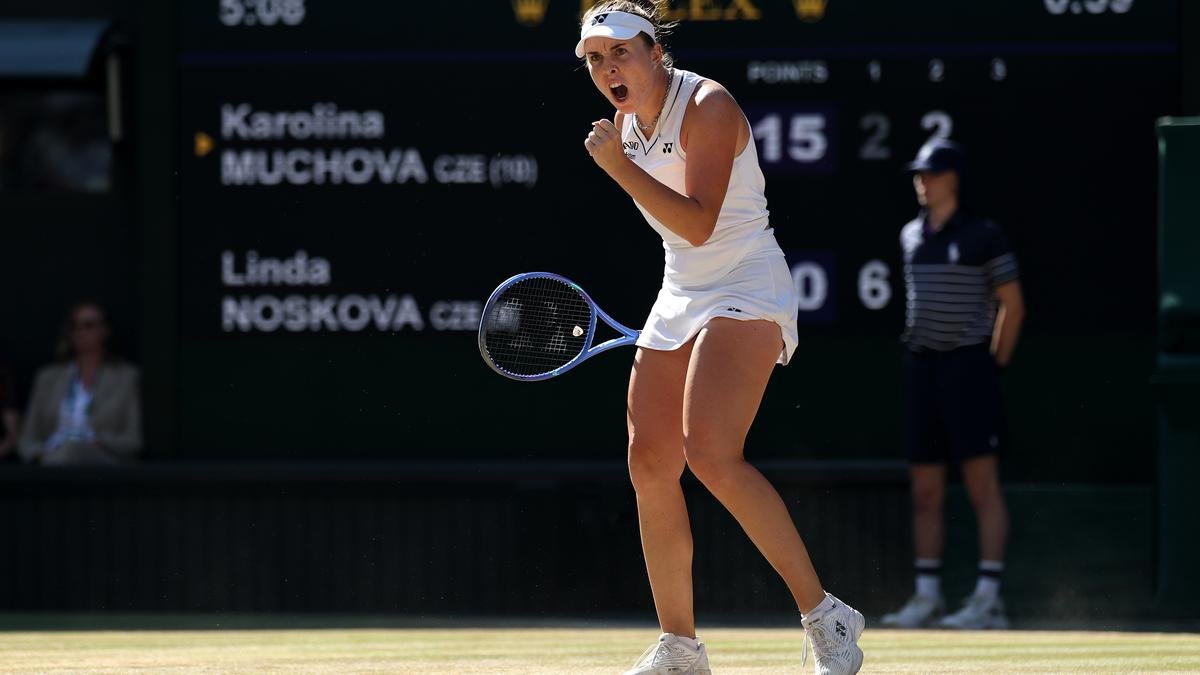
When Linda Noskova squandered five match-points and conceded the second set of a drama-filled final against Karolina Muchova, tennis fans of a certain vintage will have been reminded of one of Wimbledon’s more evocative moments, featuring another Czech woman.
Jana Novotna’s tears on the shoulder of the Duchess of Kent after throwing away an apparently decisive advantage against Steffi Graf in the 1993 final remains one of The Championships’ most enduring scenes. Noskova was showing worryingly similar signs of a meltdown.
Hard to watch
“It’s hard to watch,” two-time Major champion Tracy Austin said on the BBC. “We know what that feels like when you start to get tight and you can’t loosen up and then the lead starts to unravel.”
Novotna had refused to give up on her dream and earned her cathartic winning moment at Wimbledon five years later. Noskova did not give in to despair either, but she turned her fortunes around even quicker. She went from choking to mastering her nerves almost instantly, which very few players manage to do when so much is on the line.
Noskova placed fingers in both of her ears to drown out the Centre Court crowd. She draped one of Wimbledon’s strawberry-red towels over her head. She left the court completely for a bathroom break and splashed cold water on her face. The sight of the Venus Rosewater Dish during her time off the court only stiffened her resolve to “leave my soul on court in the third set”.
That she did, staving off break-points at the start of the third set before landing a crucial break and closing the match out with cold-blooded ruthlessness.
In a candid admission after the final, she conceded that the pressure-packed situation had overwhelmed her in the second set as the match-points slipped through her grasp across three different games. “My hand kind of froze at certain moments. My feet were not as quick as they had been before,” she said. “Winning it this way, really having to fight for it, having all these ups and downs, it matters a lot. I have to learn a lot from this match.”
The ability to come in clutch on the biggest stage is an excellent barometer of an athlete’s temperament. It’s a quality opponents immediately recognise. Muchova, who pushed her young compatriot into revealing her character in the final, described Noskova as a “calm fighter” in the big moments. “She’ll go after every point; she’ll fight for every point, so she’s really competitive. It’s definitely tough to play her on any surface,” Muchova said.
On the prowl: Noskova’s ability to seize the initiative paid dividends on Wimbledon’s grass. It’s a quality that works in big moments across surfaces.
| Photo Credit:
Getty Images
Noskova is aware that she possesses this ability. “When I am putting pressure on myself, that is usually when I play my best,” she said after her quarterfinal win over Elise Mertens. This was on display when she first caught the tennis world’s attention. At the 2024 Australian Open, a 19-year-old Noskova downed top seed Iga Swiatek in three sets. She held her nerve on the big points in the deciding set, much like she did against Muchova in her finest moment yet.
Perhaps it’s not surprising that she handled adversity in the final with such aplomb. She spoke emotionally of her mother Ivana who died two years ago from cancer and throughout her career has impressed observers with her level-headed approach to life and tennis.
A world outside tennis
Last year she spent part of her off-season in Zanzibar, volunteering for a charity by working at a school. “I didn’t think of tennis once,” she said, calling the experience “unforgettable”. “In 90 percent of cases, mental comfort is more important than physical comfort.”
Noskova, who grew up in a village in a Czech forest, has also expressed her concern for environmental issues and has a career plan mapped out after she is done with tennis. “I’m very much like a nature lover, I want to do some volunteering with nature. I have always been very active during whatever crisis,” she said after beating Marta Kostyuk in the semifinals.
Interestingly, Noskova has married this big-picture perspective with deep inward-looking focus.
“I don’t need people around me. I’m happy on my own,” she said. “Our community wants and expects us to live in a bubble. Meet duties, show up at social events, meet sponsors… I don’t want to get absorbed by this. I have always been like that. I want to manage my tennis myself.”
Noskova became the third Czech woman in four years to win the grass-court Major, after Marketa Vondrousova (2023) and Barbora Krejcikova (2024). Noskova’s idol Petra Kvitova won Wimbledon in 2011 and 2014, while Martina Navratilova won two of her record nine titles before being granted US citizenship.
How do you explain all the Czech success on grass? “They play on clay in the summer where you have to out-manoeuvre your opponent and then in the winter they go indoors and it’s first-strike tennis,” Austin said. “The best of both worlds to create an all-court player.”
Noskova did not merely diversify across court surfaces; she also diversified across sports, pursuing swimming, cycling, athletics and more as a child to develop into a well-rounded athlete. A powerful ball-striker, she also showcased fine touch during her two weeks on Wimbledon’s grass, a double-handed short backhand slice to open up angles, a stroke all her own.
Explosive ball-striker: Noskova’s all-round athleticism was honed by her immersion in multiple sports, including swimming, cycling and athletics, as a child.
| Photo Credit:
Getty Images
Noskova is the youngest women’s winner at The Championships since Kvitova. Her triumph also marked the second consecutive Grand Slam won by a player 21 or younger after Mirra Andreeva claimed the French Open at 19 last month. It’s the first time that has happened for Roland Garros and Wimbledon in the same year since Justine Henin and Serena Williams, respectively, claimed those titles in 2003.
Add two-time Major winner Coco Gauff, still only 22, to the mix, and it makes for an intriguing set of intra- and inter-generational rivalries, with multiple Grand Slam champions Aryna Sabalenka, Elena Rybakina and Swiatek defending their positions against the younger lot.
What’s next
Noskova has shown she has the game and the mentality to compete at the business end of Majors. A junior champion at Roland-Garros, she should contend on all surfaces — even if she did struggle on the dirt this year, failing to reach a semifinal in the clay-court season and crashing out in the first round in Paris.
As a Grand Slam winner and World No. 7, she will also have a target on her back. How she handles the attendant pressures of success will determine just how far she goes in the game.
“When I play my best I know I can play with the best players in the world,” she said. “You can’t really plan your success or good times. It always comes out of nowhere, I guess. If I could do it, I would definitely be planning it in every Grand Slam.”
Published – July 17, 2026 11:48 pm IST


