






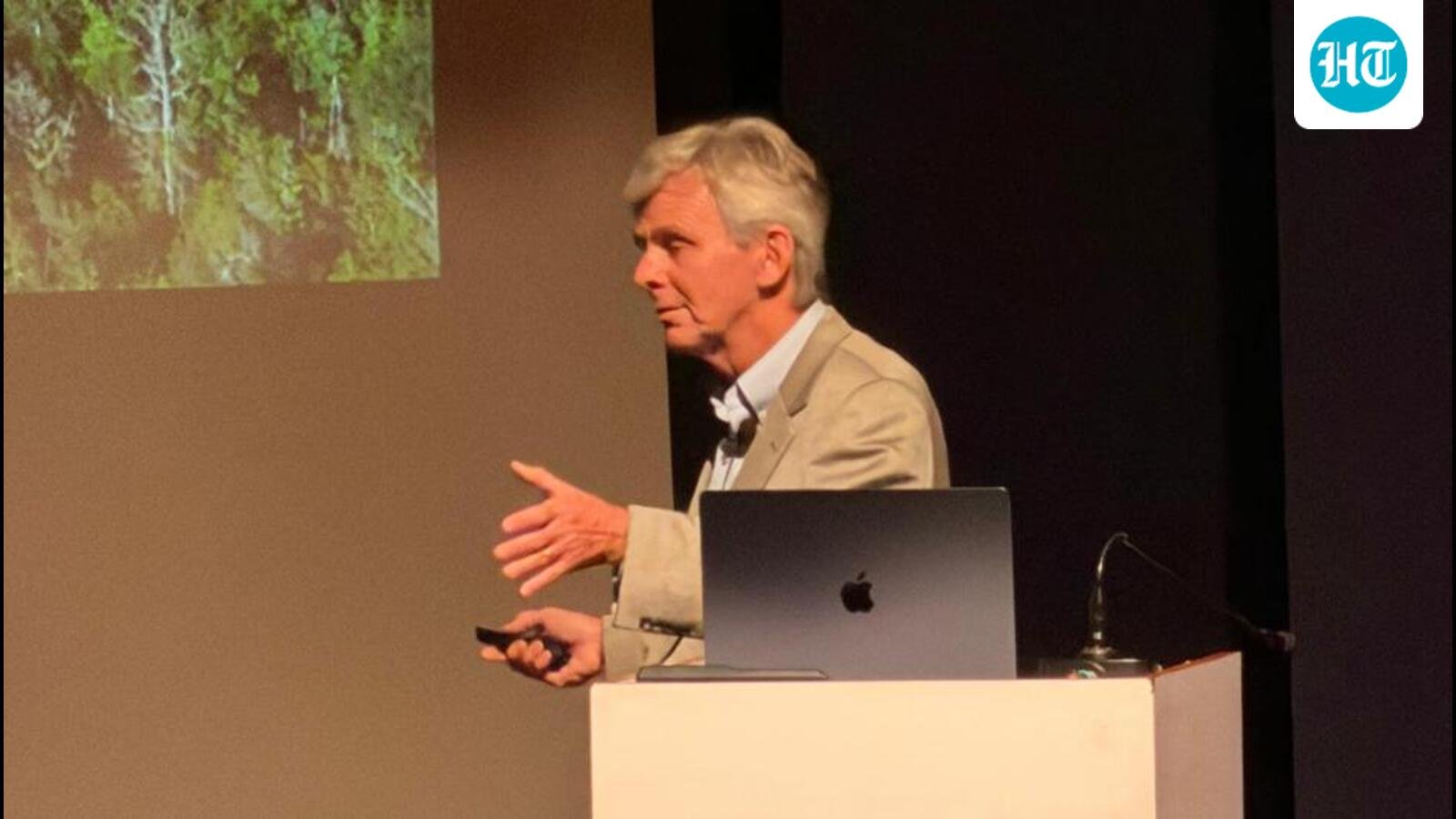
PUNE: The global network of gravitational-wave observatories could begin working with LIGO-India within the next five years, LIGO Laboratory director David Reitze said during a lecture at the Inter-University Centre for Astronomy and Astrophysics (IUCAA) in Pune on September 22.

Explaining the expanding international network, including Virgo in Europe and KAGRA in Japan, Reitze said, “Very soon, hopefully within the next five years or so, we’ll be working with LIGO-India.”
The addition of LIGO-India would expand the geographical spread of the network. Signals detected at multiple observatories can help scientists determine the direction from which gravitational waves arrive and better study the astrophysical events that produce them.
Gravitational waves are ripples in space-time generated by accelerating massive objects, with some of the strongest signals produced by collisions involving black holes and neutron stars. Unlike electromagnetic radiation, they interact only weakly with matter and can travel through the universe largely undisturbed.
Explaining the sensitivity required to detect these waves, Reitze said a merger involving two black holes, each about 10 times the mass of the Sun and located about a billion light years away, could produce a gravitational-wave strain of roughly 10⁻²¹.
Strain represents the fractional change in length caused by a gravitational wave. LIGO uses interferometers with two perpendicular arms, each four kilometres long. At a strain of 10⁻²¹, a four-kilometre arm would undergo a change of less than 10⁻¹⁸ metres — around one-thousandth the diameter of an atomic nucleus.
Reitze compared the precision to measuring the distance between Earth and Proxima Centauri, about 4.26 light years away, with an accuracy comparable to the width of a human head.
Maintaining such sensitivity requires isolating the detectors from disturbances that are many orders of magnitude larger than the signals being measured.
“The challenge is that by basically building this interferometer on the ground, it’s subject to lots of different noises. Anything that moves that mirror by 10 to the minus 18 metres is going to look like a gravitational wave signal,” Reitze said.
Seismic motion is a major challenge. Reitze said the Earth can move by roughly 10⁻⁶ metres over several-second timescales. LIGO uses active seismic-isolation systems to measure and counteract such movement. Its four-kilometre arms are also maintained under vacuum to prevent air from affecting the laser measurements.
Other sources of noise include fluctuations in laser wavelength, frequency and amplitude, residual gas and thermal motion of components.
Reitze said quantum mechanics presents another fundamental challenge. Fluctuations in the arrival and properties of photons contribute to shot noise, while photon momentum creates fluctuating radiation pressure on the detector’s mirrors.
LIGO uses quantum squeezing to redistribute quantum uncertainty between different properties of the laser light. Reducing uncertainty in the phase can lower shot noise, while increasing uncertainty in the corresponding amplitude, allowing researchers to optimise the measurement.
“These are state-of-the-art fundamental quantum techniques, quantum sensing techniques,” Reitze said.
The interferometer’s mirrors are also critical. Laser light travels down the two arms, reflects off highly engineered mirrors and returns to a central beam splitter. A passing gravitational wave stretches one arm while compressing the other, changing the interference pattern and producing a signal detected by a photodetector.
Reitze described the mirrors as the “crown jewels” of the observatory and said strict contamination controls are required because even dust can affect the detector at the required sensitivity.
LIGO currently operates two observatories in Hanford, Washington, and Livingston, Louisiana, while Virgo operates in Europe and KAGRA in Japan. The observatories use the same basic interferometric principles but provide measurements from different locations.
LIGO-India’s addition would further strengthen this global network, enabling scientists to combine observations from multiple locations and improve their ability to locate and study gravitational-wave events.
Reitze also highlighted how gravitational-wave astronomy complements traditional astronomy. While telescopes observe electromagnetic radiation from astronomical objects, gravitational-wave detectors measure the effects of waves travelling through space-time, providing another way to study the universe.


