



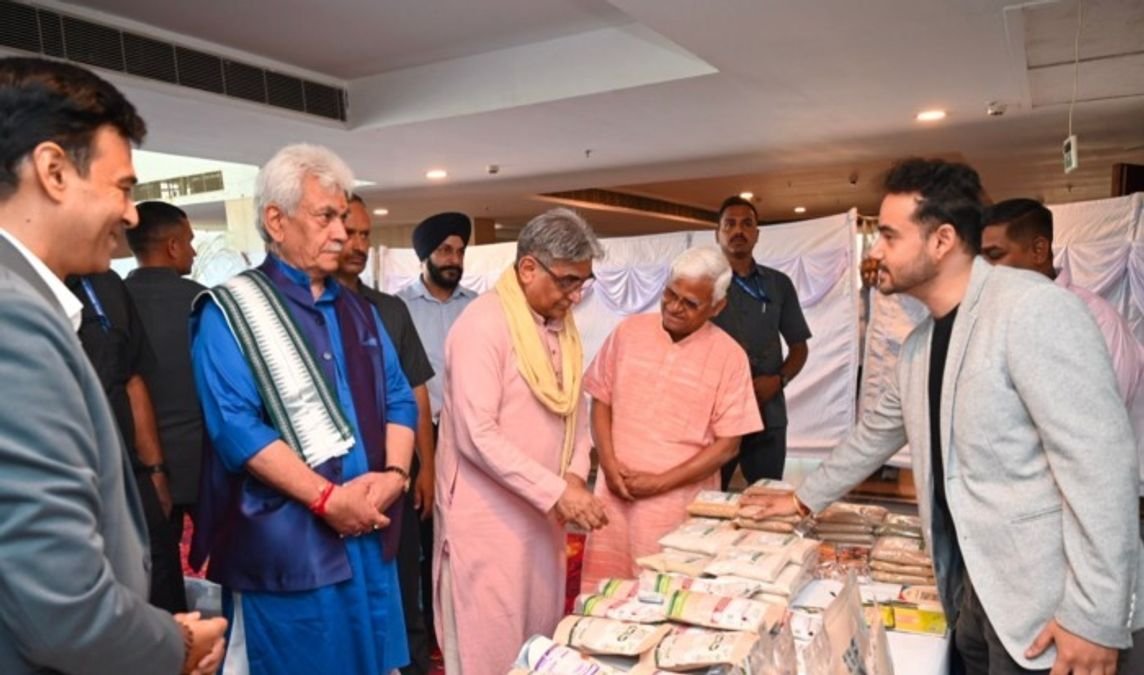
JAMMU, SEPTEMBER 21: The Lieutenant Governor, Manoj Sinha today inaugurated the National Dialogue on Millets for Health: Building Healthy Ecosystems, Climate-Resilient Agriculture and Sustainable Food Systems at SKUAST, Jammu.
Expressing gratitude to Padma Shri Dr. Khadar Vali, popularly known as the “Millet Man of India” and Shri Umendra Dutt of Kheti Virasat Mission, the Lieutenant Governor lauded their efforts in creating a new awakening through the Millets Mission in UT of Jammu Kashmir. He emphasized that the occasion was not merely a seminar but a celebration of a revolution rooted in India’s villages.
The Lieutenant Governor said that the pioneering role of the Hon’ble Prime Minister, Shri Narendra Modi, who declared millets as “nutri-cereals” in 2018 and gave them the name Shree Anna, will be remembered by history. Hon’ble Prime Minister’s initiatives led to the United Nations declaring 2023 as the International Year of Millets, bringing global recognition to India’s traditional wisdom.
Tracing the heritage of millets, the Lieutenant Governor noted that sorghum, pearl millet, finger millet, kodo millet, little millet, foxtail millet, and barnyard millet have nourished generations of farmers and families. Once sidelined as “food of the poor,” millets are now reclaiming their place at the intersection of tradition and modern science. He reiterated the ancient wisdom—“Annam Brahma”-food is divine, and healthy food builds healthy citizens, strong societies, and resilient nations.
“The experts are aware that millets nourished the families of small and marginal farmers in different parts of the country for many decades. At that time, modern irrigation facilities were not available. Marginal farmers had neither access to fertilisers nor accurate weather forecasts. However, millet crops did not require these to the same extent, because they could grow even in the most difficult weather conditions and provide support to families.
Today, science is understanding this traditional wisdom through new research and evidence. Countries across the world that are facing the challenge of climate change are also realising that the food of the future will not merely be food that can be produced in large quantities. It will have to be nutritious, profitable for farmers and sustainable for the planet,” he said.
Highlighting the relevance of millets for Jammu Kashmir, the Lieutenant Governor underscored that over 80% of the region’s farmers are small and marginal, dependent on uncertain weather. Millets, requiring less water and fewer inputs, offer them confidence and sustainability. He urged farmers to embrace millet cultivation as a pathway to self-reliance and resilience against climate change.
“I see the Millets Mission as the greatest hope for the smallest farmer in our villages. Under the Holistic Agriculture Development Plan, we prepared a strategy 3-4 years ago to ensure the health of future generations, the prosperity of our farmers and the protection of our earth.
I believe that millet cultivation can give marginal farmers in Jammu Kashmir a new sense of confidence while also helping reduce the risks associated with farming. On this occasion, I would like to tell all our marginal farmers that although the size of your landholding may be small, your contribution to building a self-reliant Jammu Kashmir can never be small,” he said.
The Lieutenant Governor also emphasized the health benefits of millets, noting their dietary fibre, low glycaemic index, and rich nutrients such as iron, calcium, magnesium, and zinc. He called upon citizens to bring millet-based foods like bajra rotis, ragi dishes, and barnyard millet rice back to their plates to combat lifestyle diseases such as diabetes, obesity, and hypertension.
On the economic front, the Lieutenant Governor highlighted the Hon’ble Prime Minister’s vision of creating a millet economy from farm to market.
“With India producing 18 million tonnes of millets in 2024–25 and accounting for 38% of global production, the importance of value-added millet products is immense. We must encourage women’s self-help groups and young entrepreneurs in Jammu Kashmir to innovate with millet-based enterprises, packaging, and branding under initiatives like One District, One Product,” he said.
The Lieutenant Governor urged all stakeholders including farmers, researchers, doctors, entrepreneurs, and citizens, to make food systems diverse, nutritious, sustainable, and resilient.
“I call upon every household to give millet products a place on their plate and strengthen farmers, empower women, and ensure a healthier future for generations. I also want all of you to carry this message to the villages that millets are not merely a heritage of the past but they are a strategy for the future of Jammu Kashmir. Let us work together to ensure that every village has opportunities and future generations inherit a healthy planet,” the Lieutenant Governor said.
On the occasion, the Lieutenant Governor released several publications including ‘A Laboratory Manual on Soil Microbiology’; ‘Fundamentals of Geographical Information Systems and Remote Sensing’, and ‘Package of Practices for Minor Millets’.
Padam Shri Dr Khadar Vali; Prof BN Tripathi, Vice Chancellor, SKUAST Jammu; Shri Umendra Dutt, Executive Director, Kheti Virasat Mission; Dr. Anjani Kumar, IFPRI; Prof. SK Gupta Director Research, SKUAST Jammu; experts, policy makers, researchers; senior officials, progressive farmers, agri-preneurs, members of Self-Help Groups, faculty and students attended the inaugural ceremony.
