






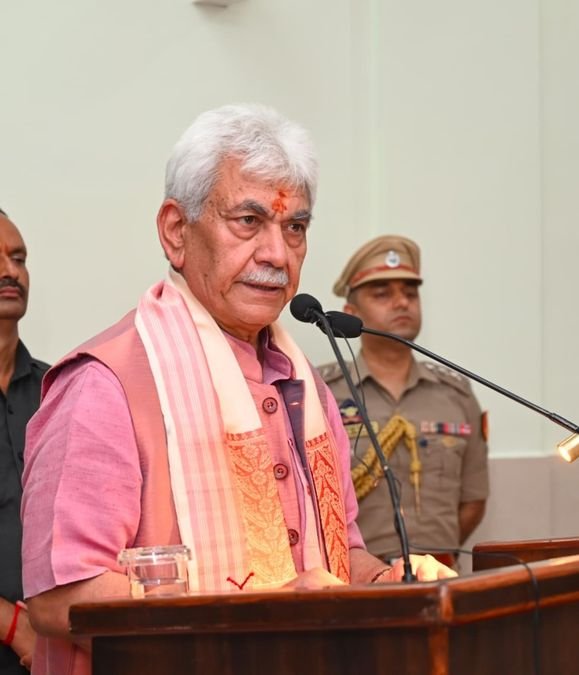
Jammu, Sep 22: “Technology must remain humanity’s servant, never its master. The day technology becomes the master of humanity, our very existence will be at risk,” Lieutenant Governor Manoj Sinha said on Monday, as he inaugurated a series of new facilities at the University of Jammu and called for tradition, innovation and human-centric technology in the age of Artificial Intelligence.
The Lieutenant Governor raised a critical question—in the age of AI, what does it mean to be educated? He highlighted global concerns about AI’s accelerating power, citing experts, and warned that AI, as a “quadruple-use” technology, could operate independently, producing both beneficial and harmful outcomes.
Stressing that decisions affecting human dignity, livelihood, health and freedom must always be made by accountable humans, not machines, the Lieutenant Governor said, “Machines can calculate, but they cannot feel. Machines can predict, but they cannot bear responsibility for decisions. Machines can mimic the language of compassion, but they do not stand at a patient’s bedside at midnight, nor do they carry the moral weight of a judge’s verdict.”
“My clear view is that every decision that deeply affects a person’s freedom, livelihood, health, education, or dignity must have a human behind it, who understands the decision, accepts responsibility for it, and can be held accountable,” he said.
Sinha said that in the age of AI, modern tools and machines have become more powerful than ever, and so the hands that wield them must possess greater steadiness, values, Sanskar and wisdom. “Powerful tools in honest hands can achieve great work, but in the wrong hands, the same tools can cause serious harm,” he said.
He encouraged youth to dream big, linking aspirations to service for society and the nation. He reminded them that they are the first generation growing up with AI as a companion and bear the responsibility of shaping a future where humanity flourishes.
The Lieutenant Governor outlined five pressing challenges for higher education. He said focus should be on relevance, and curricula must adapt rapidly to match the pace of change. He observed that rote learning should be avoided, and classrooms must focus on application and purpose, not memorisation. He highlighted that students must provide original answers, prioritising curiosity and reasoning, and that technology must not widen the gap between rural and urban learners.
“It is true that no technology can replace a teacher. But it is equally true that technology will certainly change the teacher’s role. The teacher of the future will not merely be an information-giver; they will be a mentor, a guru, a questioner, and an inspiring personality who ignites curiosity and builds character in students,” he said.
For students and teachers, the Lieutenant Governor shared six guiding messages—embrace lifelong learning, cultivate uniquely human capacities like creativity and empathy, build bridges across disciplines, contribute to national development, balance academics with sports, and remain rooted in traditions and values. He urged students to become embodiments of both science and Sanskar.
The inauguration included a modern sports complex, a shooting range, high-mast lights for the cricket stadium and the Tawi Guest House complex, developed at a cost of nearly Rs 10 crore. These facilities, the Lieutenant Governor noted, will empower the University’s athletes, scholars and visitors, strengthening its role as a hub of excellence in the Union Territory.
Prof. Umesh Rai, Vice Chancellor, University of Jammu; Ramesh Kumar, Divisional Commissioner Jammu; Tejinder Singh, IGP, Jammu; Shridhar Patil, DIG, JSK Range; Dr Rakesh Minhas, Deputy Commissioner Jammu; Prof. J.P. Singh Joorel, Dean Academic Affairs; Prof. Neelu Rohmetra, Dean Research Studies; Prof. Sangita Gupta, Dean Planning and Development; Dr Neeraj Sharma, Registrar; Heads of Departments, faculty members and students attended the inaugural ceremony.


