



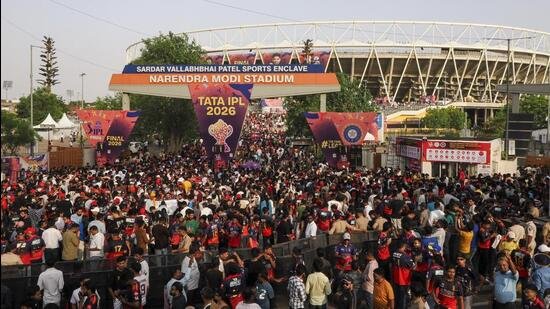
Bet the tens of thousands of IPL fans this season heading to the grounds hours in advance, bracing themselves for queues, searches, snaking lines for toilets, food and water, never thought the police would ever be on the same page as them.
When Bengaluru Police Commissioner Seemant Kumar Singh spoke about waking up at 5am to watch live Tests from Australia, he was himself that fan. At the RCB Innovation Lab Indian Sport Summit in Bengaluru, Singh remembers being “surprised” at how cricket could be watched. “I thought what is going on in Australia… people just enjoying themselves, enjoying the cricket and the food and drinks, all of it.”
Singh took over as Bengaluru commissioner after the stampede outside M Chinnaswamy stadium last June and was at the summit with joint commissioner of police (West), C Vamsi Krishna, talking about the external bandobast required to host RCB’s five matches this season. When Singh was asked what needed to be done differently at India stadia, he spoke as an Indian fan and for the Indian fan. “The spectators come to enjoy, let’s give them a great place to enjoy.” He had noticed he said the “different categories” of spectators at Indian grounds – VIPs, hospitality boxes, the masses – and how they were treated.
Singh said, “if you are giving… (comfort, hospitality) to one section and depriving the other, it will create tension”. The average fan being pushed around feels, “Look, I paid for that but I am not getting it…” If that tension dissipates, “once they are enjoying the match, the role of the police becomes lesser.” This is not radical desi policing but rather the three pillars – safety, security, experience – that are common international practice while hosting large sporting/entertainment events. Each in sync, not like in Indian cricket, entangled in a constant contest. The Chinnaswamy stampede was not directly related to the staging of a sporting event but connected to one, and led to the deaths of 11 people (average age 21), the worst sporting tragedy in India over a quarter of a century.
The Summit session was titled, “Full House: Design, Safety, and the Future of the Live Sports Experience” – around which entire conferences could have been held. Paul Foster, CEO One Plan, a digital crowd management and design planning platform used by Paris Olympics and Paralympics and Milan Cortina Winter Olympics singled out the largest, common issue around crowd disasters at stadia around the world over the last fifty years – complacency.
Foster, with a background in crowd science, has worked on nine Olympics and Paralympics and multiple football World Cups. He says complacency rises particularly in old, historic venues, based on the confidence that nothing has happened before. “People never record near misses, things that nearly caused an issue. It’s like, oh really got away with that one and not but, let’s evaluate it. Make sure it never happens again. We just jump past it, and say fine, let’s move on.”
Every cricket fan who travels to matches in India will no doubt have one of those near-misses in memory. Or will have run into spots in grounds like Chinnaswamy before its remodelling that felt like they were moving around in an accident zone. While old inner-city sports venues need modernisation and upgradation, Foster said they don’t need instantly to be brought down. “Initially, you have to use what is available,” Foster said, “and in this case – (Bengaluru and the Chinnaswamy) they had a really short period before the first game of the season. They had to work with what they got.”
The issue that was addressed in Bengaluru during IPL, “was not just looking at the people going into the stadium but those that are around it. We always spend as much time (planning for) the non-spectator as the spectator… the biggest challenges are outside, because it’s so dynamic.”
Four months after the stampede, in October the Karnataka cabinet gave ‘in principal approval’ to build a ‘world class sports complex including an 80,000-seater cricket stadium’. In the last 15 years, India has inaugurated five 50-000-plus cricket stadia but the spectator experience is nowhere near world standard.
Ryan Sickman, global director of sport, Gensler, designing and managing sport stadia across all levels of sport internationally, said that stadium design for a long time had been to works outwards from the venue itself. Rather than starting from the wider view – where are the spectators coming from, how are they heading to the venue, what’s the mass transportation, parking, and how do they get into the stadium, the building’s place in the community. The venue – its designs, its seats – should be “the last thing… That’s really where the planning should start – from the outside.”
New Indian cricket stadia are misfits in this template but there is an opportunity for India’s mega-event ambitions to use these practices. With one 21st century acceptance: big is not beautiful. Sickman pointed out that the US too had caught the bug. “We were bigger, bigger, bigger, bigger and now it is how do we take these seats out? We are having an absolute contraction in the US.” It is now smaller, more intimate, closer to the action venues, responding to the diversity of a sporting audience.
He said, “It’s funny that the police made the comment about the diversity of seating types and hospitality and not the architect in the room,” Sickman said while there were many design and management practices that could not similarly be applied around the world, “what does translate across cultures, across regions, across everything that exists as a differentiator between markets around the world is a good experience.”
In resource, energy, enterprise-rich Indian cricket where today the pillar of the ‘live sport experience’ has been refabricated into the ‘televised sport experience’, their global domination must surely include an improved spectator-friendly future.


