



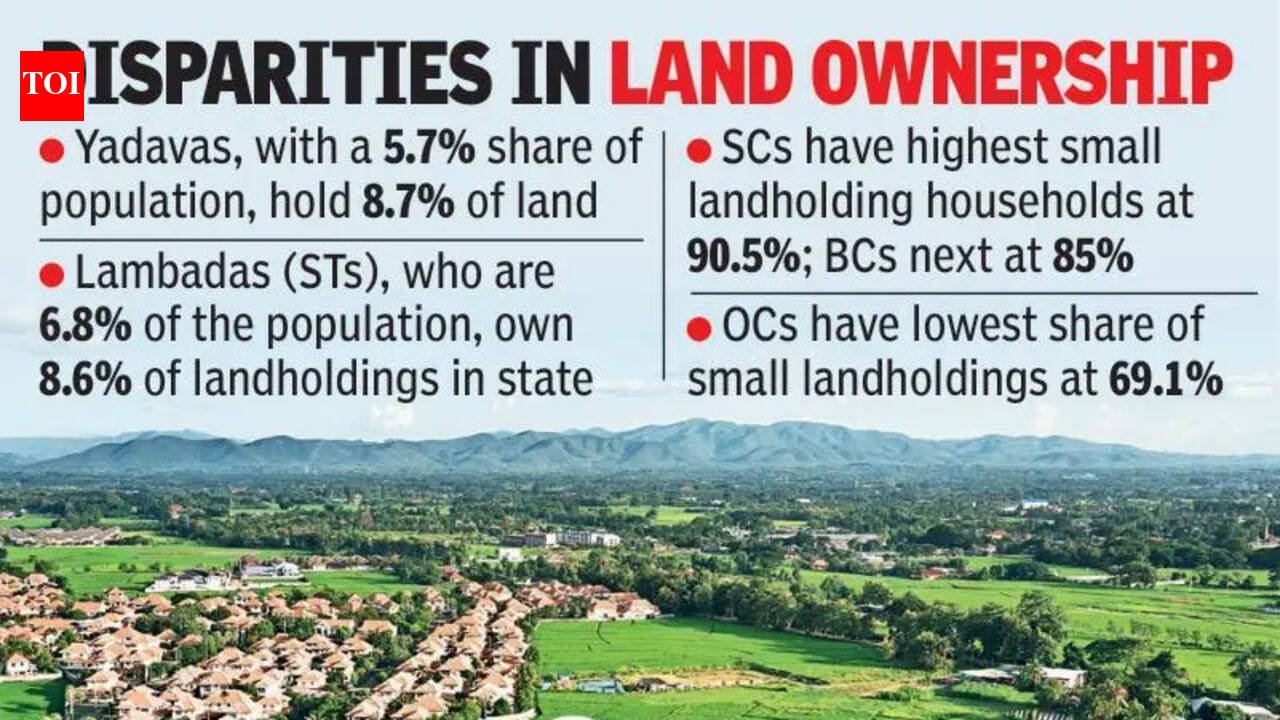
Hyderabad: Land ownership patterns in Telangana tell a story that goes beyond simple population share, revealing how economic power is unevenly distributed across castes. The SEEEPC Survey-2024 shows that several communities with relatively smaller populations command a disproportionately higher share of land, while others continue to remain land-poor despite larger numbers.Among the most striking examples are Reddys (OCs), who own about 13.5% of the state’s land despite accounting for just 4.8% of the population. Yadavas (BCs), with a 5.7% population share, hold 8.7% of land, while Lambadas (STs), constituting 6.8% of the population, own 8.6% of landholdings. The survey also found that Velamas (OCs) and Koyas (STs) enjoy relatively higher land ownership compared to their population size. Lower land ownershipIn contrast, communities such as SC Bedas and OC Muslims have significantly lower land ownership relative to their population, underscoring their historical exclusion from land assets. The report highlights that seven castes — Reddy, Yadav, Lambada, Mudiraj, Munnuru Kapu, Kuruma and Koya — together make up 32% of Telangana’s population but control 51% of its land. This concentration underscores how land continues to shape economic strength and social standing. “Land ownership is especially significant because it offers not only a source of income through agriculture or rental but also social status, economic security and bargaining power. Lands below five acres are considered as small landholdings, 5 to 20 acres medium and above 20 acres large landholdings,” the report said.The independent experts group that analysed the SEEEPC report said there is no link between the owners of land and overall backwardness of castes. STs score better“First, the disparities in land ownership between OCs and the marginalised groups are not as large as in education, occupation and living conditions. Second, STs, by virtue of large ownership of dry or fallow land, score better than BCs and SCs in this parameter. Third, mere ownership of land or being less backward in land parameter does not translate into reducing overall backwardness,” the report said. The report also pointed out that some BC castes, such as goldsmiths or BC Christians, own limited land yet are less backward overall due to better performance in education and occupations. Conversely, castes like Kuruma, where many own land—often in small parcels—continue to face higher levels of backwardness. The survey further shows that SCs have the highest proportion of small landholding households at 90.5%, followed by BCs at 85%. This suggests a heavy dependence on fragmented and often unviable plots. In contrast, OCs have the lowest share of small landholdings at 69.1%, indicating greater access to medium and large land parcels, which offer stronger economic stability and better agricultural returns.


