



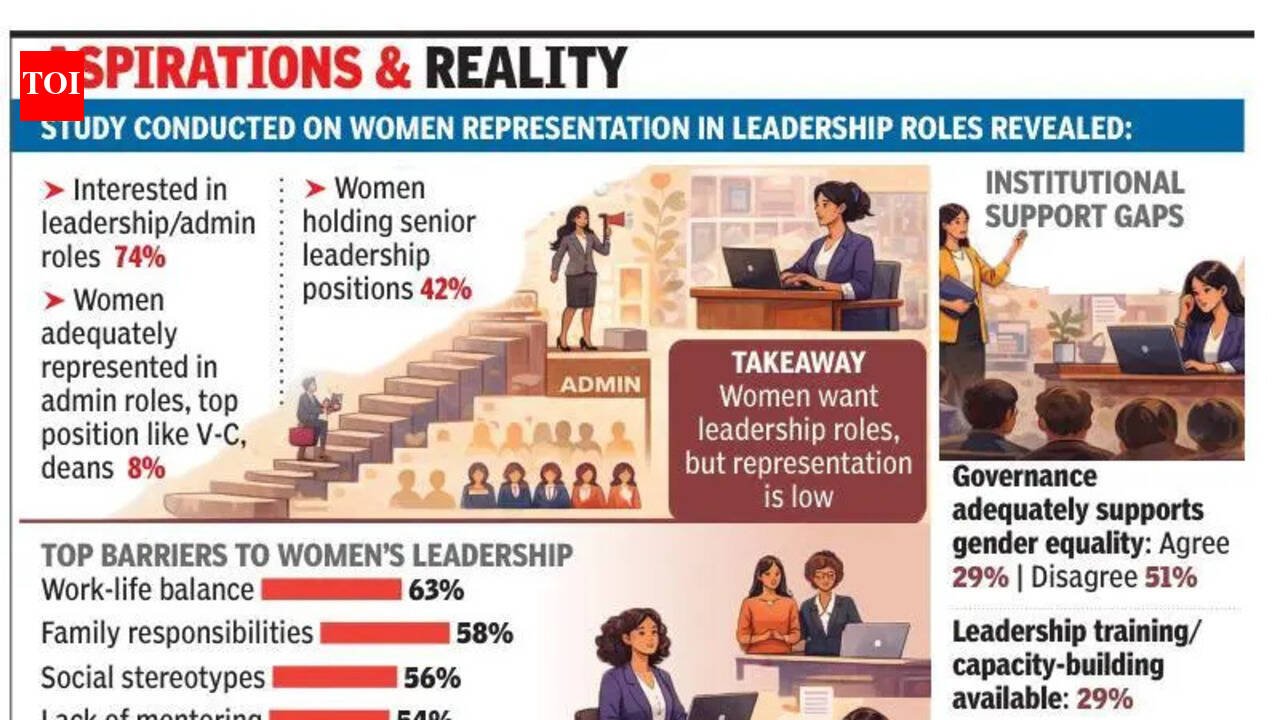
Lucknow: Low representation of women in senior academic and administrative positions in higher education institutions across Lucknow division is not due to lack of interest, merit or capability, but because of weak institutional frameworks, non-gender-responsive policies and limited support systems, a study has found.The findings are part of study titled “Challenges to Women’s Leadership in Higher Education: A Policy-Oriented Study in Central, State, Private Universities, and Affiliated Colleges of Lucknow Division conducted by RMLNLU associate professor Shashank Shekhar with the support of the Association of Indian Universities, New Delhi. It highlighted that work-life balance, family responsibilities, social stereotypes, lack of mentoring and training, limited institutional support, networking opportunities as compared to male counterparts, and gender bias as some of the major hurdles. “The research is based on responses from 100 participants drawn from central, state and private universities, govt and private colleges, deemed institutions and other higher educational institutions in the region. Of the total respondents (including male and female), only 8% believed that women are adequately represented in administrative roles,” said Shashank Shekhar. He said lack of aspiration was not an issue. About 74% of respondents said they were interested in pursuing leadership or administrative roles but cited weaknesses of the institutional routes. The study shows that actual representation remains weak. While 42% of respondents said women hold senior leadership positions in their institutions, only 8% believed that women are very adequately represented, which means they got top positions like vice chancellor, directors and others. A large number of respondents felt that women’s representation is either very limited or nearly absent. “Only 8% said women got key positions, 26% were moderately represented, like given roles of department head or appointed as assistant in a board, 41% were slightly represented, which means they were just a part of an administrative body, while 25% were not represented at all,” said Shashank. The study also raises concern about the governance environment within institutions. Only 29% of respondents felt that institutional governance adequately supports gender equality while 51% disagreed. In addition, only 29% reported the availability of leadership training or capacity-building programmes, and only 24% said mentoring programmes existed in their institutions. This points to a serious weakness in the systems, he said. Around 72% of respondents said flexible work policies can strengthen women’s leadership in higher education. Support needed from the institution is of time flexibility, care responsibility support and better administrative engagement pathways. The study recommended transparent selection procedures, mentoring and sponsorship systems, leadership development programmes, gender audit, better representation in committees and adoption of workplace policies sensitive to care responsibilities.


