






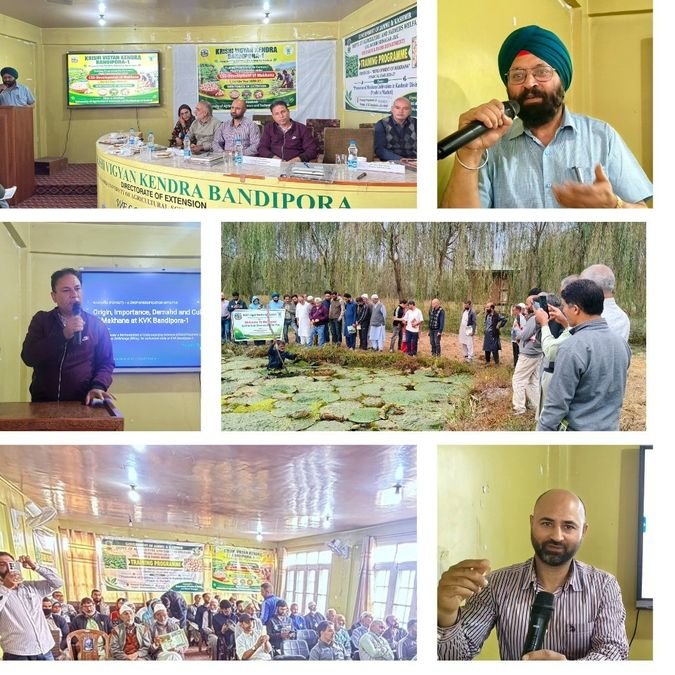
Bandipora, Oct 8: Krishi Vigyan Kendra (KVK) Bandipora-1, SKUAST-Kashmir, in collaboration with the Department of Rakhs and Farms, Kashmir, organised the first training programme under the Central Sector Scheme on Development of Makhana at KVK Bandipora-1, Potushai.
The programme aimed to sensitise farmers about the scope of Makhana cultivation and provide technical guidance on crop establishment, management, harvesting, processing and value addition under Kashmir conditions.
Ajab Singh Ajeeb, Director, Rakhs and Farms, Kashmir, was the chief guest. He highlighted the potential of Kashmir’s wetland resources for Makhana cultivation and stressed their scientific utilisation for crop diversification and livelihood generation.
Feroz Ahmad Shapoo, Assistant Director, Rakhs and Farms, Kashmir, outlined the department’s initiatives for promoting Makhana in the Valley and emphasised farmer capacity building, technical guidance and coordination among stakeholders.
Dr Tariq Sultan, Professor and Head, KVK Bandipora-1, gave a detailed presentation on Makhana cultivation, management, harvesting, processing and value addition.
He said KVK Bandipora-1 had initiated trials for introduction and evaluation of Makhana in Jammu and Kashmir following an MoU between SKUAST-Kashmir and the National Research Centre for Makhana (NRC-Makhana), Darbhanga, Bihar.
He highlighted the scope of Makhana for wetland-based livelihood diversification, particularly in combination with aquatic crops such as Lotus and Water Chestnut, and stressed the importance of scientific crop management and value addition.
Scientists Dr Tahir Saleem, Dr Bilal Ahmad Zargar and Shabnum Mumtaz interacted with the participating farmers and provided technical guidance on aquatic crop cultivation.
Farmers from Bandipora and Baramulla districts participated in the programme and raised queries related to planting material, crop establishment, management, harvesting, processing and marketing.
As part of the practical session, the participants visited the KVK Farm and observed ongoing demonstration and trial plots of Makhana, Lotus and Water Chestnut. The scientists explained the cultivation practices and potential of these crops under local conditions.
The programme concluded with discussions on strengthening farmer training, field demonstrations, technology transfer and institutional collaboration for Makhana development in Kashmir.


