



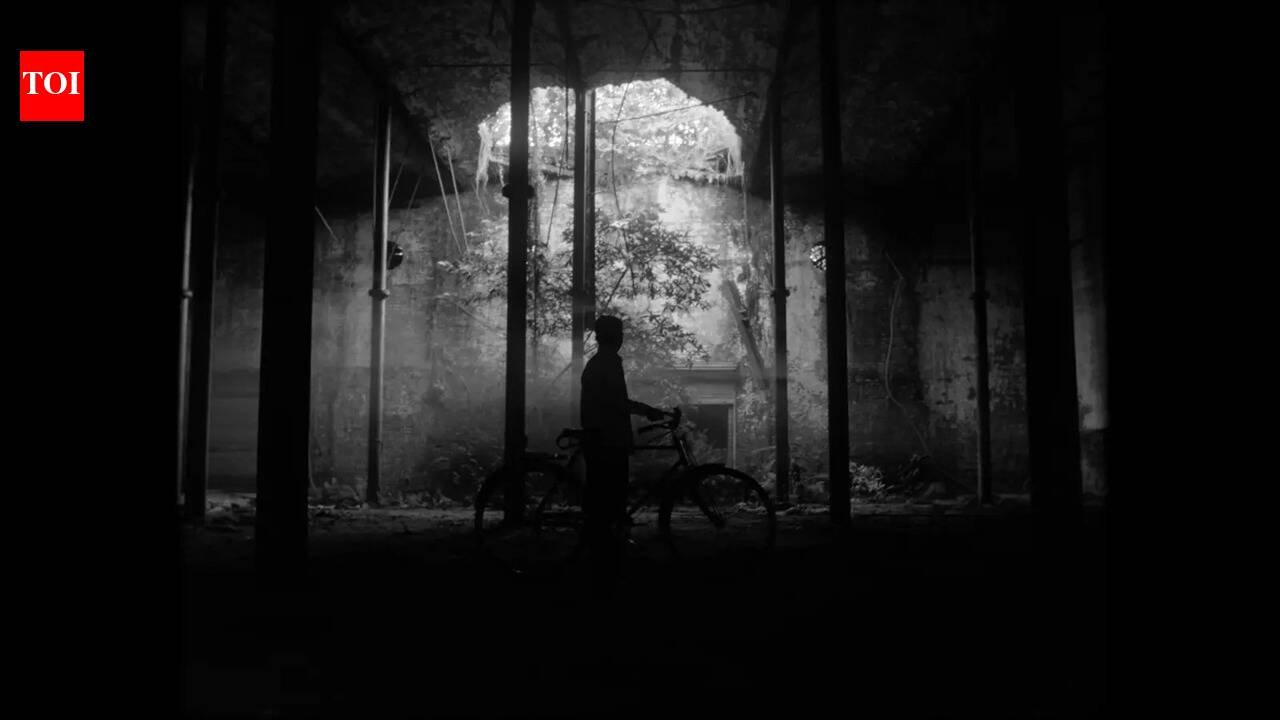
Kolkata: Soumya Mukhopadhyay’s ‘A Chronicle of the Lost’ – a film about loss and longing of migrant workers – has been selected to compete at one of Switzerland’s most prestigious documentary festivals, Visions du Réel. Based on the testimonies of former migrant workers, the Hindi film – shot partially on a 1950-made 16mm camera – follows a migrant worker wandering through Kolkata’s abandoned jute mills with a voiceover reading aloud letters to his wife left back in the village.This hybrid documentary, which is in the only South Asia film in the International Medium Length & Short Film Competition of Visions du Réel, has emerged from the director’s years of fieldwork along the Hooghly River and multiple conversations with jute mill workers affected by factory closures, unpaid labour, and forced migration. The unhurried pace of the film starring Sraman Chatterjee and Katha Nandi and its aesthetic choice of not romanticising loss and longing add a poignant feel to the narrative. “My film is anchored in the historical disappearance of Bhikhari Paswan and his wife, Lalti Devi, both workers at the now-shut Victoria Jute Mill, but it does not seek a factual reconstruction. Instead, it constructs an imaginary protagonist, a dramatised figure shaped by the testimonies, memories, and uncertainties shared by multiple workers during the research process,” Mukhopadhyay said.
A Chronicle of the Lost
Scenes at the shadowy portico of Chhaya cinema, the haunting emptiness of Bauria’s Gloster Jute Mill, Khardah’s NJMC Jute Mill and Sankrail’s National Jute Mill or the lived-in feel of daily chores at Mallikbazar ghat and Uttarapara’s Patni ghat lend so much of authenticity to the 25-minute-long film. What makes it unique is the director’s decision to not go on an activist model while touching upon strong issues like how working-class lives vanish without acknowledgement. Rather, it uses stylistic experiments to delve into hard-hitting existential issues plaguing the lives of migrant labours. Shot by Manas Bhattacharyya, with voiceovers by Vijay Patidar and Bhumisuta Das, sound design and mix by Dibakar Saha, music by Tajdar Junaid and Mohit Shankar and edit by Amit Ray, the film is a visual delight where monochrome tints sometimes overlap with coloured visuals. “Analogue images carry the residue of repetition and history, while digital images confront the immediacy of the present. Shot extensively inside functioning, shuttered, and abandoned jute mills, these spaces are treated not as backdrops but as material witnesses to labour, neglect, and erasure,” Mukhopadhyaya said.


