



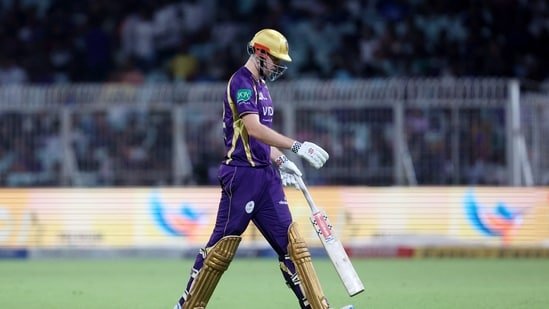
Kolkata Knight Riders ended IPL 2026 with a season that never fully escaped the weight of its own auction ambition. They entered the tournament with one of the loudest overseas buys in league history, placed Cameron Green at the centre of their balance-sheet gamble, stayed alive deep into the league phase, and still finished with a campaign where the numbers looked harsher than the promise.
Green was the symbol of that bet. KKR paid ₹25.20 crore for an all-rounder who could lengthen the batting, offer overs, protect the fielding unit and change the shape of a match from two disciplines. The season is now complete, so there is no remaining-match denominator left to soften the Alsocalculation.
Also Read: Jofra Archer single-handedly takes RR to the play-offs; his contribution can’t be overstated enough
Green recovered ₹16.17 crore and still left KKR with a ₹9.03 crore hole
Cameron Green’s season cannot be dismissed as empty. That would be lazy and unfair. The monetary model values his overall rating-adjusted contribution at ₹16.17 crore, which means he did give KKR substantial cricketing value across the tournament. The problem is the purchase price. At ₹25.20 crore, useful was never going to be enough. KKR needed a season that looked close to elite across multiple weeks, not one built around two high-return games and several nights of incomplete value.
The final profit-loss figure is a loss of ₹9.03 crore. In cost-recovery terms, Green gave back 64.17% of his auction price. That means KKR effectively lost around ₹35.83 for every ₹100 committed to him. For a mid-range player, that may have been framed as a survivable shortfall. For the most expensive overseas signing in the league’s auction history, it becomes a major underperformance.
The per-match cost makes the damage clearer. Spread across 14 counted appearances, Green’s season cost KKR ₹1.80 crore per match. His value crossed that bar only twice. Several other matches came close enough to prevent the ledger from becoming disastrous, but the overall pattern stayed negative. A player bought at this level has to keep dragging the match economy towards his side. Green did it in bursts, not often enough to justify the bill.
Two profitable games kept the season from becoming a financial collapse
The ledger is not flat. Green had two matches that genuinely carried premium value. His best return came against the Gujarat Titans in Match 60, where his adjusted worth touched ₹5.99 crore and produced a profit of ₹4.19 crore on the night. The earlier Gujarat Titans game in Match 25 also stood out, bringing ₹4.51 crore in worth and a profit of ₹2.71 crore.
Those two matches matter because they prevent the analysis from turning into a simple failure label. Green showed KKR why they chased his profile. He had nights where his batting impact, context value and all-round presence created exactly the kind of surge that expensive players are bought to deliver. In those games, the price did not look irrational. It looked ambitious.
The issue is what came around those peaks. KKR did not get enough repetition. Match 38 against LSG in the Super Over win produced ₹1.79 crore in value, almost exactly matching his per-match cost but still falling marginally short. Match 51 against Delhi Capitals produced ₹1.67 crore, again close to par but still negative. These near-par games softened the fall, yet they did not create surplus.
The worst nights dragged hard. Against Chennai Super Kings in Match 22, Green’s adjusted worth fell to – ₹0.45 crore, creating a loss of ₹2.25 crore for that match alone. In KKR’s final league game against Delhi Capitals, he again finished negative, valued at – ₹0.21 crore with a match loss of ₹2.01 crore. Those are not small dents when the player’s cost line is already so high. They are the kind of games that erase the buffer created by big performances.
Also Read: INR 23 crore loss tells MI’s real IPL 2026 story: Scouting worked, superstar investment failed
The batting carried the ledger, the bowling did not complete the all-rounder case
Green’s batting was the strongest part of his monetary defence. He finished with 322 runs from 221 balls, striking at 145.70, with an average of 32.720. In impact terms, his batting produced 346.81 points, far ahead of his other departments. That tells the real story of his value. KKR paid for an all-rounder, but the ledger was mostly held together by batting.
Those numbers are not poor. A strike rate above 146 with that volume gives a middle-order or floating batting option enough attacking credibility. Green was not a passenger with the bat. He had enough productive phases to remain relevant in the model, especially because the rating-adjusted layer rewards context and pressure beyond raw scorecard weight.
The problem is that his bowling did not match the commercial expectation attached to his profile. Green bowled 22 overs, took seven wickets and conceded at 10.64 runs per over. Seven wickets can be useful in isolation, but the economy rate hurt the value. At this auction price, KKR needed his bowling to either control phases or deliver high-leverage breakthroughs with greater regularity. Instead, the bowling stayed closer to supplementary value than premium all-rounder value.
His fielding was clean and useful. Green took eight catches and had no drops recorded in the ledger. That added 58.90 impact points and prevented avoidable deductions. But fielding cannot rescue a ₹25.20 crore player’s financial season by itself. It can add polish to a strong ledger. It cannot repair a gap of ₹9.03 crore when the batting is doing most of the heavy lifting and the bowling is not returning enough.
KKR bought a premium all-rounder
The fair verdict is uncomfortable for KKR. Green was not a failed cricketer in IPL 2026. He was a failed investment at that price. The difference is important because the ledger does not say he gave nothing. It says he gave ₹16.17 crore of value in a season where KKR had committed ₹25.20 crore.
That gap defines the story. KKR did not buy Green to be useful. They bought him to be a season-shaping force. They paid for a player who could tilt match-ups, protect balance, influence multiple phases and reduce dependency elsewhere in the XI. Instead, they got a batting-led season with two major returns, a few near-par games, and too many nights where the cost line ran ahead of the cricket.
The model’s base impact worth was even harsher at ₹9.03 crore. The rating-adjusted calculation lifted him substantially to ₹16.17 crore, which means the contextual layer recognised that some of his contributions were more valuable than plain scorecard reading would suggest. That actually strengthens the conclusion. Even after giving him credit for match context and quality of contribution, he still finished ₹9.03 crore short.
For KKR, this is the danger of buying profile over repeatable return. Green’s skill set is rare, and rare skill sets become expensive in auctions. But a rare skill set still has to appear frequently enough in the ledger. In IPL 2026, the flashes were real, the recovery was respectable, and the loss was still heavy.
Method note and disclaimer
This analysis uses the completed-season monetary ledger for Cameron Green. Since KKR’s season is complete, his full ₹25.20 crore auction price has been charged against his IPL 2026 output rather than spreading the cost across possible future matches. Fielding-only noise has been excluded from the appearance logic where relevant, and the final worth is based on the rating-adjusted monetary model, which combines match impact, role value, batting, bowling, fielding and context-sensitive manual ratings.
The figures should be read as an analytical estimate of cricketing value converted into monetary terms, not as an official IPL accounting record or salary judgement. The model is designed exclusively by the author to measure performance return against auction cost and may differ from franchise assessments, which can include off-field value, squad balance, injury cover, marketing value and long-term planning.


