



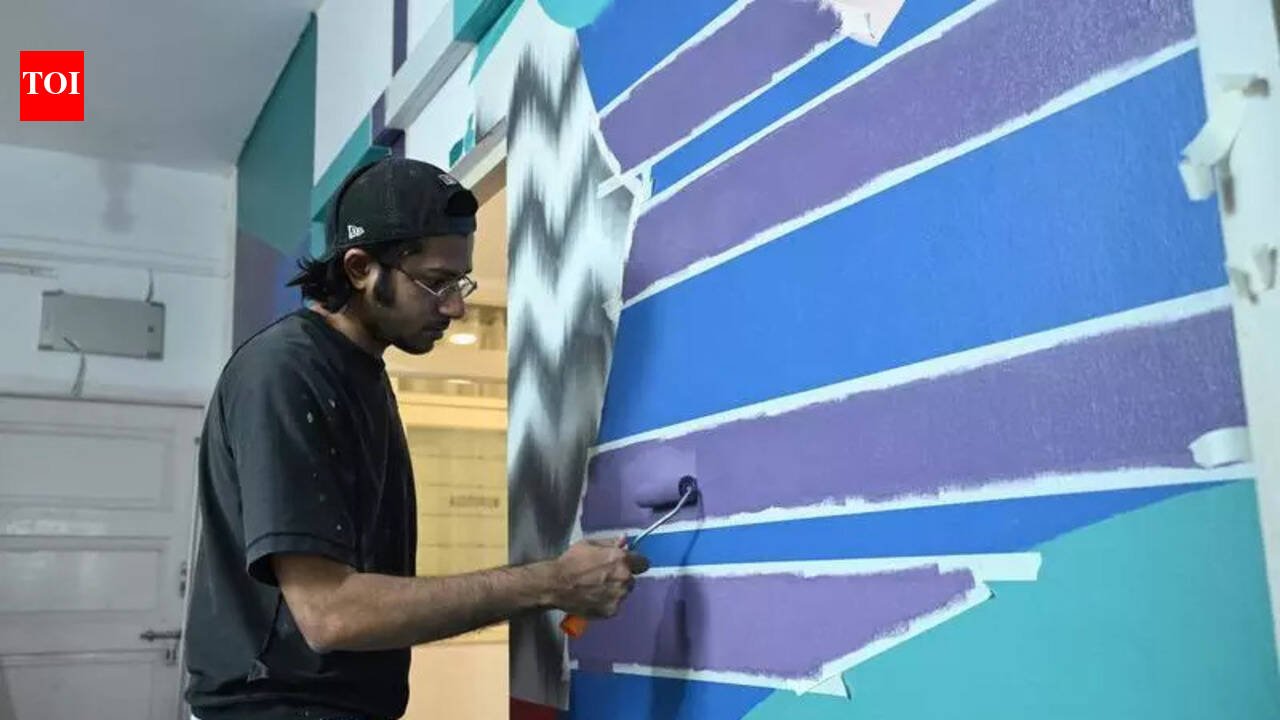
Hyderabad: In the layered, fast-evolving landscape of India’s street art movement, Siddharth Gohil aka Khatra has transformed the city into an open gallery with his bold, disruptive artistic instincts.The Vadodara-based mural and graffiti artist traces his moniker back to his college days. He was experimenting with stencil graffiti inspired by the ubiquitous “danger” sign, replacing its warning symbol with visuals reflecting social issues and contemporary realities. Friends began calling him “Danger.” The label endured, eventually becoming his artistic identity.Khatra has been in Hyderabad for the fifth edition of Wall Art India, an urban art movement connecting India and France from Feb 24 to 27. Running from Feb 10 to March 9, the festival is organised by the Alliance Française network of India. The month-long festival spans 15 cities and brings together four internationally recognised artists — three from France and one Indian artist. Currently, Khatra is working on a façade mural at Alliance Française de Hyderabad. The piece is an abstract composition spanning multiple sections of the building, drawing inspiration from both French and Indian visual traditions.Warm and cool tones interplay across layered forms, producing a vibrant, playful rhythm. Typography — his enduring love — remains embedded in the composition, even when it dissolves into pattern.This is not Khatra’s first visit to Hyderabad. One of his most memorable projects is Maktha Art District, where he painted in 2016. Then, working as a graphic designer with St+art India Foundation, he initially assisted artists. Towards the end of the project, a small group — including Khatra — were given a wall of their own. Exploring the neighbourhood for inspiration, they created a humorous mural: an old man with a single tooth holding a toothbrush with just one bristle. Playful and slightly absurd, the artwork struck a chord with residents — especially children, who gathered around the wall as it came to life.“It was spontaneous and community-driven,” he recalls. Another significant work of his was at Chennai’s Indira Nagar railway station — which is touted to be India’s largest panoramic mural. The project, which took nearly 2 months, aimed to de-stigmatise the HIV and AIDS affected community and empower them while sharing hopeful stories of survivors.As a child, he was fascinated by letterforms, filling sketchbooks with carefully drawn alphabets. That early curiosity matured into formal study in typography and graphic design during art college, alongside training in calligraphy.A turning point came when he began working with Anik Pureshi, founder of the St+art India Foundation. Under his mentorship, he witnessed first-hand the shaping of India’s contemporary street art movement — from grassroots graffiti to organised public art festivals.“Graffiti began as a protest,” he reflects. “It was about writing slogans and names as a political expression. Over time, artists developed distinct hand styles, and eventually it evolved into street art with scale, concept and global recognition.”Despite his growing portfolio of public murals, Khatra resists being defined by a single style. His visual language continues to evolve through experimentation with colour, form and material.Recently, he has expanded into a studio practice, working with typography on canvas and exploring new surfaces beyond concrete walls. He has participated in several group exhibitions and is preparing fresh works for an upcoming show.


