






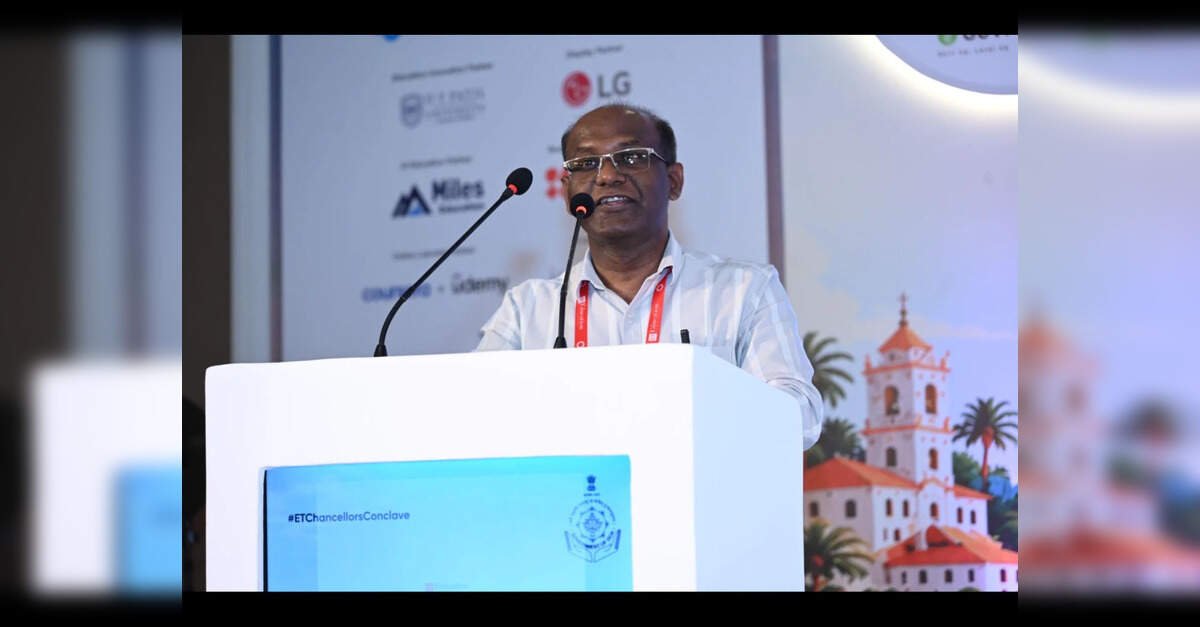
Goa: India’s ambition to develop world-class universities must be driven by sustained investment in research, innovation and transformative student experiences rather than institutional rankings or infrastructure expansion alone, said Prof Vithal Tilvi, Distinguished Astronomer and Professor, Centre for Research, Development & Innovation, Goa State Higher Education Council, Directorate of Higher Education.
Delivering a keynote address at the ETEducation Chancellors’ Conclave 2026, Tilvi drew on his academic and research experience in India and the United States to explain how leading global universities build their reputations through research excellence and opportunities for students to participate in pioneering scientific work.
He argued that while global university rankings remain important benchmarks, the reputation of leading institutions such as Harvard, Stanford, Princeton and MIT extends beyond their positions in ranking frameworks.
Research investment creates lasting institutional value
Tilvi highlighted the substantial financial resources available to leading American universities, pointing to multibillion-dollar endowments that support advanced research, scientific infrastructure and academic opportunities.
Citing Harvard’s endowment of more than $50 billion and major investments across institutions such as Stanford, MIT and the Texas A&M University System, he explained that the real value of such funding lies in the research opportunities and educational experiences it creates.
According to Tilvi, a world-class university should ultimately be judged by the academic rigour students experience and the value they associate with their education, rather than by campus size or infrastructure alone.
Scientific exposure distinguishes leading universities
Sharing an experience from his postdoctoral research at Texas A&M University, Tilvi recalled a conversation with a colleague involved in a Mars rover mission.
The researcher described how his work enabled him to explore previously unseen locations on Mars, illustrating the extraordinary scientific opportunities available within well-funded research ecosystems.
Tilvi also referred to NASA’s Jet Propulsion Laboratory, managed by the California Institute of Technology, as an example of how long-term institutional investment and research partnerships can create globally significant scientific capabilities.
He noted that such environments give undergraduate, postgraduate and doctoral students opportunities to engage with advanced research and technologies that extend far beyond conventional classroom learning.
Building India’s next generation of research universities
Connecting these experiences with India’s aspirations, Tilvi highlighted the enthusiasm generated by missions such as Chandrayaan-3 as evidence of the scientific ambitions of the country’s younger generation.
He emphasised that universities have a responsibility to translate those aspirations into meaningful academic and research opportunities.
For India to develop its next generation of globally competitive institutions, he argued, investment must go beyond physical infrastructure to create research ecosystems where students and faculty can participate in ambitious scientific projects.
The defining measure of a world-class university, Tilvi suggested, is not simply the resources it possesses, but the opportunities those resources create for students to discover, innovate and contribute to knowledge.


