



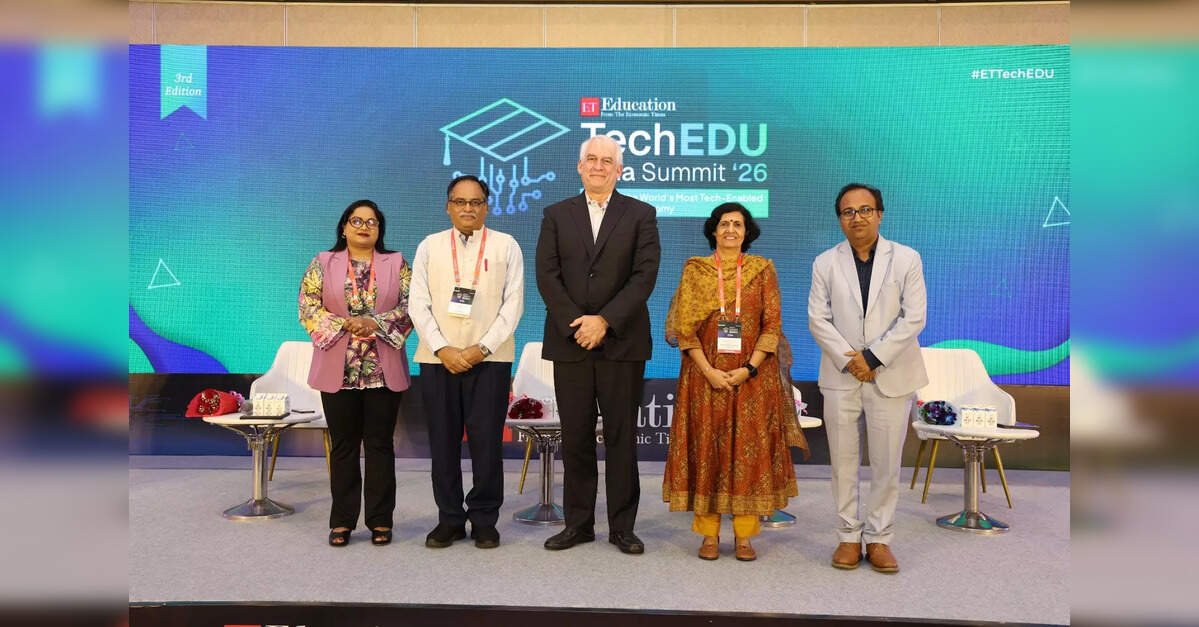
The 3rd edition of the ETEducation TechEDU India Summit 2026 opened at NESCO, Mumbai, with a powerful inaugural session centred on the theme “Building the World’s Most Tech-Enabled Education Economy.” Bringing together leading voices from policy, academia, and industry, the summit set an ambitious tone — positioning education not merely as a sector in transition, but as the engine of India’s next economic and technological leap.
Welcoming the gathering, Yasmin Taj, Editor – ETEducation & ETHRWorld, The Economic Times, underscored the urgency of aligning education with the country’s digital growth trajectory. She framed the summit as a strategic platform to examine how AI, digital infrastructure, and deep tech innovation must converge to build globally competitive talent at scale.
At the ETEducation TechEDU India Summit 2026, the message from keynote speakers was unequivocal: India’s next wave of economic acceleration will be determined not merely by technological adoption, but by how deeply its education ecosystem integrates AI, digital infrastructure, and deep tech innovation into its core architecture.
Across academia, governance, and industry, leaders articulated a forward-looking blueprint — one that moves beyond incremental reform toward systemic reinvention. From digital credentialing and infrastructure modelling to AI-powered learning and deep tech incubation, the focus was clear: building future-ready talent at scale.
Mayur Zanwar, Co-Founder, TruScholar, framed this shift as a transition from traditional credentialism to measurable, outcome-driven learning. Calling for a move “from credential to career” and “from just training to skill,” he emphasised the economic multiplier effect of robust digital adoption. When skills are transparently validated and digitally verifiable, corporates reduce hiring and training inefficiencies, learners gain tangible economic mobility, and employment outcomes improve organically. Education, he argued, can become a catalytic force in driving not just national growth, but a global economic shift. Bringing a global infrastructure perspective, Chris Bradshaw, Chief Education and Sustainability Officer at Bentley Systems, contextualised India’s moment within what he described as one of the most consequential decades for infrastructure development. In this new era, he asserted, capability — not merely capital — will define success. “Today, most infrastructure systems are digital before they’re physical,” he noted, explaining how digital twins — virtual replicas of physical assets — are revolutionising design, simulation, and lifecycle management. Calling for the rise of “digital engineers,” Bradshaw underscored a fundamental industry shift: “This is not how everybody in industry works today, but it is how everybody in industry is going to work tomorrow.” Beyond efficiency, he highlighted the role of digital twins in modelling climate risk and societal impact, ensuring infrastructure is resilient, transparent, and equitable.
From an academic lens, Prof Shireesh Kedare, Director, IIT Bombay, emphasised that digital transformation must transcend access and infrastructure to fundamentally reimagine pedagogy itself. While AI and digital tools can enable personalisation, contextualisation, and learning in Indian languages and dialects, he cautioned against surface-level integration. “We need to transform from teaching to learning… We should not just give information, but teach students how to learn,” he remarked. He further pointed to India’s deep tech opportunity, advocating structured pathways from research to incubation to patient capital, encouraging students to move beyond startup immediacy toward sustained, high-impact innovation.
Dr Rajul K Gajjar, Vice Chancellor, Gujarat Technological University (GTU), demonstrated how large university ecosystems can operationalise digital governance at scale. Leading a university affiliating hundreds of institutions, he detailed initiatives spanning AI-powered research integrity systems to blockchain-enabled certificates with QR-based authentication. “All our certificates and transcripts are now on blockchain, ensuring the highest standards of integrity,” he said, positioning digital trust as foundational to global mobility and academic credibility. GTU is simultaneously embedding AI, experiential learning, industry-aligned minors, and global research collaborations into its curriculum — bridging theory with validated skill acquisition.
Collectively, the keynote deliberations reflected a decisive paradigm shift — from mass education models to intelligent, infrastructure-backed, and innovation-driven learning ecosystems. As India advances toward its 2047 aspirations, the consensus was unmistakable: the convergence of AI, digital infrastructure, and deep tech entrepreneurship will shape not only the future of education, but the nation’s economic resilience and technological leadership on the global stage.


