






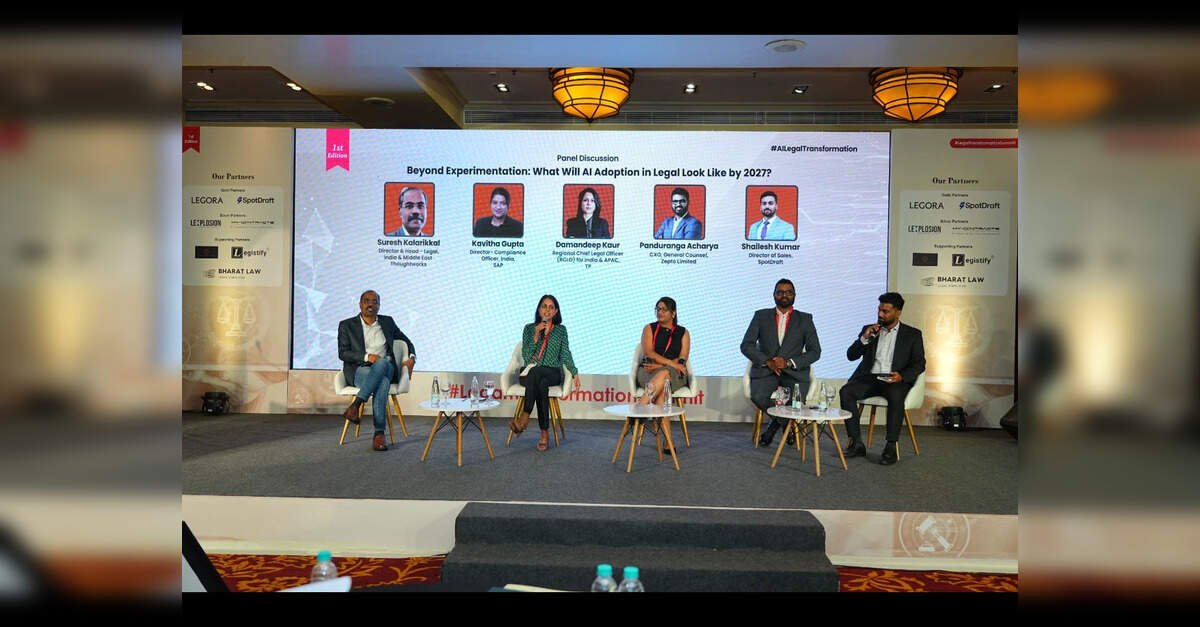
The fifth edition of the ETLegalWorld Commercial Disputes Conclave 2026 brought together senior members of the judiciary, government, corporate legal teams, law firms, arbitration institutions and the wider business community to examine how India’s commercial justice ecosystem can keep pace with its economic ambitions.
Held on September 11 in New Delhi under the theme “Building Trust, Speed & Certainty in India’s Commercial Justice Ecosystem”, the conclave featured more than 35 speakers across seven-plus sessions, with discussions spanning commercial courts, infrastructure disputes, arbitration, energy, technology, geopolitical risk and online dispute resolution.
The discussions converged on a broader question: how can dispute resolution move beyond providing remedies after a commercial conflict and become part of the infrastructure that supports investment, capital deployment and business growth?
Attorney General for India R. Venkataramani, in the inaugural address, called for the law to move from “catching up” with economic growth to helping drive it. Dr. Lalit Bhasin, President, Society of Indian Law Firms, who delivered the chairperson address, also highlighted the importance of legal expertise and institutional credibility as India seeks a larger role in global commerce.
Commercial justice as economic infrastructure
The opening panel, “Dispute Resolution as a Pillar of India’s Economic Infrastructure”, brought together Amar Sundram, General Counsel and Senior VP (Legal) & Chief Compliance Officer, NEC Corporation India, Amitabh Lal Das, Senior General Counsel and Business Leader, Prathiba Jain, Head of Strategy & Group General Counsel, Everstone Group, Dinesh Sharma, Senior Intellectual Property Policy Advisor for India, USPTO, and Manu Kulkarni, Partner, Poovayya & Co.. The panel was moderated by Arpinder Singh, India & Emerging Markets Leader, EY Forensic & Integrity ServicesThe discussion focused on reducing pendency, improving ease of doing business and strengthening investor confidence through more efficient commercial justice. The central message was that delays and uncertainty in dispute resolution have consequences beyond individual cases, affecting business decisions and the broader investment environment.
Infrastructure disputes require commercial solutions
The infrastructure session featured Ajay Kapoor, Chief (Legal, Regulatory and Advocacy), Tata Power, Rajarshi Sen, General Counsel, Siemens Energy, Dr Sunil Mittal, Group General Counsel, Kalpataru Projects International, Gaurav Khanna, Head of Litigations and Advisor on Sustainability, Nestle India, and Ashish Kumar Pandey, Head – Governance, Compliance and Company Secretary, Hero Future Energies. The panel was moderated by Shri Venkatesh, Founding Partner, SKV Law Offices.
The panel examined disputes in large infrastructure projects, public-private partnerships, government contracts and regulatory matters. Speakers highlighted the impact of delayed approvals, regulatory complexity and contractual risk allocation on project execution and long-term capital deployment.
Arbitration and the question of efficiency
Arbitration featured across multiple sessions, with speakers examining rising costs, prolonged timelines, institutional versus ad hoc arbitration and the need for stronger case management.
The spotlight session brought together Basudeb Biswas, General Counsel, TARC India, Prashant Agarwal, Group General Counsel, SAR Group of Companies, and Devna Arora, Deputy Head, South Asia, SIAC. The panel was moderated by John Whittaker, Senior Equity Partner at Clyde & Co..
The discussion examined whether arbitration is continuing to deliver the speed and cost advantages expected by businesses, with greater institutionalisation and technology-enabled case management emerging as part of the discussion around reform.
Energy disputes call for sector-specific approach
The energy panel brought together Sandeep Chowdhury, Group General Counsel, Suzlon Group, Preet Sethi, Deputy General Counsel, Vedanta Resources, Kumar Ankit, General Counsel and Chief Risk Officer, Shree Cement, and Vineet Bose, Head Legal and Senior Vice President, Ambuja Cements and ACC. The panel was moderated by Shryeshth Ramesh Sharma, senior partner, SKV Law Offices.
The speakers examined renewable energy disputes, oil and gas arbitration, power purchase agreements and infrastructure and energy-transition challenges. The discussion focused on drawing a clearer line between regulatory and technical questions that may require sectoral expertise and contractual disputes that may be more suited to arbitration.
Commercial risk moves into the boardroom
The conclave also looked at disputes before they reach a courtroom or arbitral tribunal. Mehak Oberoi, Founder, ConstructHER Legal Network, moderated a discussion featuring Rajeev Goswami, Vice President – Legal, Indus Towers, Suparna Bhattacharyya, CFO & VP, Yanmar Engine Manufacturing, India, Jogendra Singh, President & Group CFO, Hero Corporate Service, Ajay Bagri, CFO, SEIL Energy India, Dr Mukul Shastry, Group General Counsel, Cube Highways, and Niti Mittal, General Counsel, Coforge.
The panel examined the financial impact of litigation, legal spend and the need to quantify contractual and counterparty risks before they translate into disputes. Speakers stressed the importance of legal, finance, commercial and operational teams working together on dispute prevention.
Geopolitical risks add new layers to disputes
The global trade and investor-state disputes session featured Avaneesh Singh, Chief Legal Officer and Senior VP – Legal, Navitas Life Sciences, Varun Singh, Managing Partner, Foresight Law Offices, Saurabh Malhotra, General Counsel and Head – Legal Risk & Compliance, Intertek, Campbell Jackson, Global Claims & Disputes Leader, EY, and Jonathan Rodrigues, Mediator & Founder, The PACT. The panel was moderated by Senior Advocate Karuna Nundy.
The discussion covered geopolitical uncertainty, bilateral investment treaties, international arbitration, protection of Indian investments abroad and cross-border enforcement of arbitral awards, including questions around sovereign immunity and asset recovery.
Technology changes the legal function
Technology and AI also formed part of the conclave’s discussions. In a fireside chat, Amit Sethi, Senior Solution Consultant, Thomson Reuters, and Abhishek Sharma, Regional Counsel, Thomson Reuters, discussed the transition towards AI-enabled legal functions.
The conversation examined how AI can automate repetitive legal work while leaving responsibility for legal advice and outcomes with lawyers. The discussion also highlighted trust, security and accountability as important considerations for adoption.
ODR and the future of commercial justice
The concluding substantive panel focused on Online Dispute Resolution and brought together Rajbeer Sachdeva, President Group Legal, JK Organisation, Prarabdha R Jaipuriar, General Counsel – Indian Subcontinent, SUEZ, Ashit Garg, Head of Global Legal Service and Company Secretary, Ramboll, Rituu Aggarwal, General Counsel, Air India SATS Airport Services and Srijit Mukherjee, Group General Counsel, Kocho. The panel was moderated by Pranjal Sinha, Co-Founder and CEO, Sama.
The panel examined AI-enabled dispute resolution, ODR for MSMEs and digital commerce, smart-contract disputes and the integration of ODR with courts and arbitration. Speakers noted that wider adoption would depend on enforceability, data protection, digital capability and institutional trust.
Across the sessions, the discussions pointed towards a common requirement: commercial justice needs to deliver not merely a legal remedy, but greater predictability for businesses.
ETLegalWorld extends special thanks to its silver partners, EY, SKV Law Offices and Thomson Reuters, for their valuable support to the fifth edition of Commercial Disputes Conclave 2026. We also thank our supporting partners, Sama, Trilegal, MCO Legal, Foresight Law, Agarwal Law Associates and Poovayya Law, for their participation and support in bringing together diverse perspectives from across the commercial dispute-resolution ecosystem. Our appreciation also goes to Society of Indian Law Firms (SILF) and Singapore International Arbitration Centre (SIAC) for supporting the conclave and contributing to its larger objective of advancing dialogue around India’s commercial justice framework.
The fifth edition concluded with a shared focus on building greater trust, speed and certainty in commercial dispute resolution, while recognising that the next phase of India’s economic growth will require its legal and dispute-resolution institutions to evolve alongside the businesses and markets they serve.


