



Kashmir has been celebrated in legend, mythology, history and poetry for ages. The very name Kashmir evokes a psychological image of peace, natural beauty, harmony and learning. The valley presents picturesque vistas in every season, each with its own exquisite charm. God has sanctified the valley with all the beauty of nature, and Kashmir is indeed a Divine Land. The Sanskrit poet Kalidasa wrote about the valley: “The place is more beautiful than heaven and is the benefactor of supreme bliss and happiness. It seems to me that I am taking a bath in the Lake of Nectar.”
Tourism forms the backbone of Kashmir’s economy. Not only does it generate employment and livelihoods for the people, but it also acts as a strong interface for people-to-people interaction. Various initiatives have been and are being taken by the government to promote tourism in Kashmir, despite developments such as the Pahalgam attack.
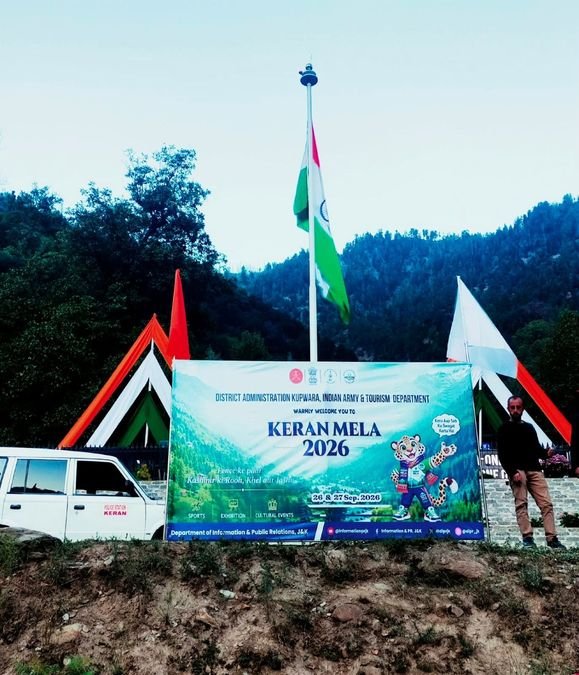
Recently, the Indian Army, along with the Tourism Department, Jammu and Kashmir Academy of Art, Culture and Languages, and the District Administration, Kupwara, organised Keran Mela 2026 at Keran. The crystal-clear Kishanganga River, flowing between the two mirrored villages and serving as the natural border, formed the backdrop.
Having spent 35 years in the Indian Navy, sailing the oceans and diving beneath the sea in submarines, it was a mesmerising experience to celebrate a cultural event beneath the stunning Rooh-e-Hind Flag Post on this side of the fence. Surrounded by majestic hills and watching people across the Kishanganga, just a stone’s throw away in what is referred to as POK, enjoying the event was a great feeling.
The cultural evening turned out to be a huge hit. Artists from various quarters sang songs in Gojri, Pahari, Potohari and Punjabi, and also performed local dance sequences. These dialects are used by the people as their local languages, but to me, they appeared to be in direct sync with Hindko. I too participated in the event by presenting a Gojri song and was surprised by the overwhelming response from the audience and, later, by the warmth shown towards me by some members of the community.
As per the 2011 Census, there are over 1.17 million Gojri-speaking individuals spread across Poonch, Rajouri, Reasi, Uri and Kupwara. As far as the Pahari/Potohari-speaking population is concerned, it is estimated at 1 to 1.25 million (2011 Census) in the northern districts of Baramulla and Kupwara. Hindko (the language of Hind) reflects cultural identity, historical continuity and social structure. Historically, Hindko developed alongside Punjabi, Saraiki and other Lahnda languages, sharing a common linguistic ancestry.
Earlier, during a walk around the area, one could see the abandoned homes left by people who crossed over to the other side in 1990. Many homestays and modern tented accommodations have come up in the area. During my interaction with the authorities, I learnt that approximately 50,000 tourists had visited Keran this year so far. The successful conduct of the Mela once again proved that the Indian Army not only defends the borders but, in complete cooperation with various agencies, also helps promote tourism in remote areas. The Indian Army helps build bridges across various sections of society and cultures, thus promoting national integration.
The government’s decision to open various axes on the LoC for tourism is a welcome step. At Kaman Aman Setu Bridge, a small museum set up with artefacts donated by locals looks impressive. The busts of Brigadier Rajinder Singh, Lieutenant Colonel Kaman Singh Pathania, Jamadar Nand Singh, Maqbool Sherwani and Zuma Muhammad on the Veer Path reflect true examples of supreme sacrifice.
The only place in the valley where one finds a trace of Maharaja Ranjit Singh (who ruled Kashmir for 27 years) displayed is here, on the Akhand Bharat Varsh plaque. A documentary on the 1947 Kabali Raid and the subsequent Sadbhavana projects undertaken by the 19 Division, Infantry Division, is also a great learning experience.
The Teetwal Sector, too, has seen a huge influx of tourists as well as pilgrims since the construction of the Sharda Temple here. As far as Gurez and Lolab are concerned, these areas, too, have been opened up, and a number of homestays and tented accommodations have come up.
Habba Khatoon Hill is a huge attraction for tourists. There is a need for wider promotion of these areas for tourism so that the people of these far-flung regions benefit and the tourism canvas of Kashmir helps attract more and more visitors from within the country and abroad.
(The writer is a former Deputy Assistant Chief of Headquarters Integrated Staff (IT), author, and Social Activist. Feedback: [email protected])
