



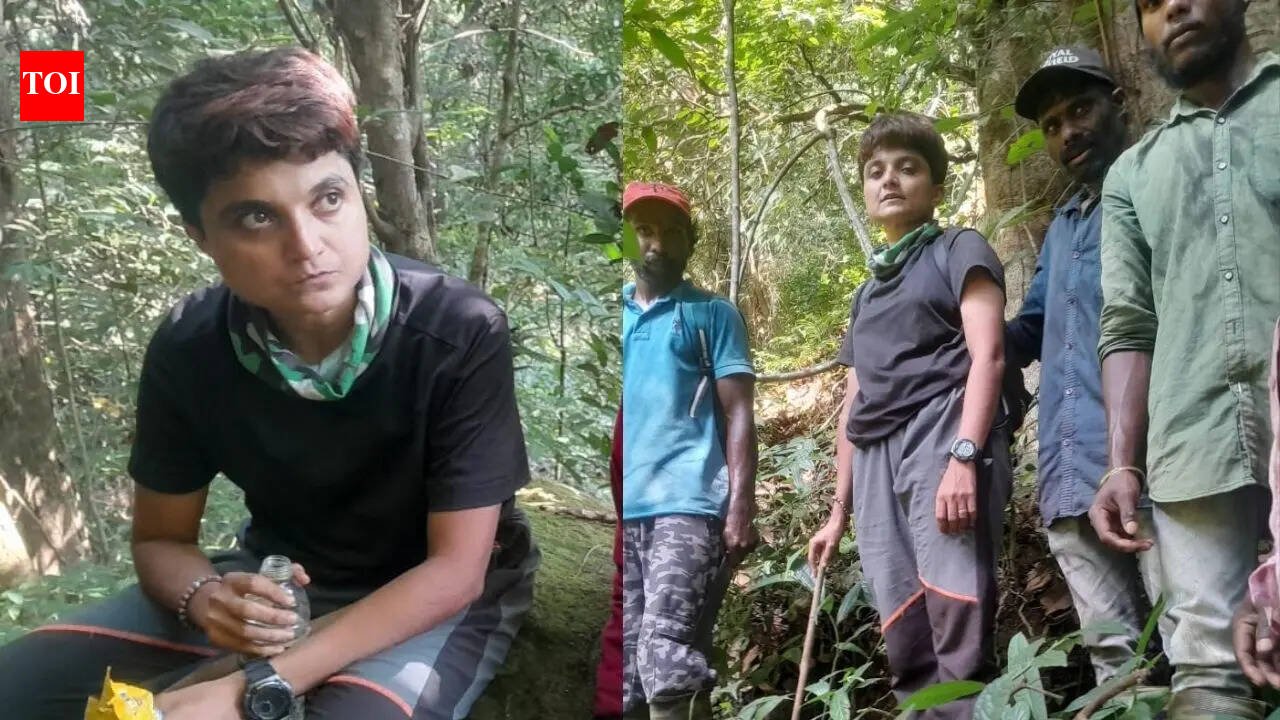
MYSURU: For four days, there was no signal, no contact, and no clear path out.Somewhere inside the dense forests of Kodagu — a terrain known for wild elephants, steep descents and sudden weather shifts — 36-year-old GS Sharanya kept moving, stopping, waiting, and calling out, hoping someone would hear her.She had set out on April 2 for what was meant to be a routine one-day trek to Tadiandamol, the highest peak in the district. Travelling from Kozhikode, the IT professional had checked into a homestay near Kakkabe and joined a group of trekkers. But while descending the peak that evening, she got separated.By the time others returned safely, Sharanya was missing.Her phone had little charge left. The network was patchy at best. Within hours, she was completely cut off.On the first day, she tried to retrace her steps, walking till evening. But as the forest thickened and light faded, she stopped near a rocky stream. Moving further in the dark, she realised, could make things worse. With just a 500ml bottle of water and no food, she spent the night outdoors.The next two days were a test of restraint as much as survival.With a leg injury slowing her down, Sharanya avoided venturing deeper into unfamiliar terrain. Instead, she stayed close to areas where she might be visible. At one point, she moved to a relatively open patch, hoping she could be spotted if search teams used drones.“No food, sleep for 3 days, didn’t panic”
- April 1, Wednesday | Kozhikode
Resident GS Sharanya, 36, arrives in Kodagu for 1-day trekLeaves for Tadiandamol, the highest peak in Kodagu district. Sharanya goes missing by evening and rescue operation is launched to locate herCops and forest department jointly relaunch the operationCops seek help from Anti-Naxal Force and dog squad. Foresters use thermal drone cameras & tribals join the operationBack outside, a large-scale operation had already begun.Police, forest officials, Anti-Naxal Force personnel and local tribal communities fanned out across the region. Nine teams searched through dense vegetation, working against rain, fog and failing light. Thermal drone cameras were deployed, and additional teams were stationed along the Karnataka–Kerala border as a precaution.But the terrain was unforgiving.On the third day, Sharanya considered climbing to higher ground to improve her chances of being spotted. Heavy rain forced her to abandon the plan. She waited instead, conserving energy, drying her clothes, and calling out intermittently.“I kept walking expecting to meet someone,” she later said. “I did not feel scared. I don’t know why.”That calm would prove critical.By the fourth day, as the search intensified under directions from senior officials, members of the Kudiya tribal community — familiar with the terrain — picked up faint calls from a remote stretch of the Pattighat reserve forest, an area officials described as one “where nobody usually goes”.They followed the sound.Around 4pm on Sunday, more than 72 hours after she went missing, Sharanya was found — conscious, stable, and remarkably composed.She was escorted out, taken for medical evaluation, and later returned to her homestay. Authorities confirmed she had no major injuries.Her survival, officials said, was shaped not just by endurance, but by a series of cautious decisions — staying put when needed, avoiding risky movement, and holding on until help arrived.What began as a one-day trek had turned into a four-day ordeal.And yet, when she finally walked out of the forest, Sharanya was smiling.


