


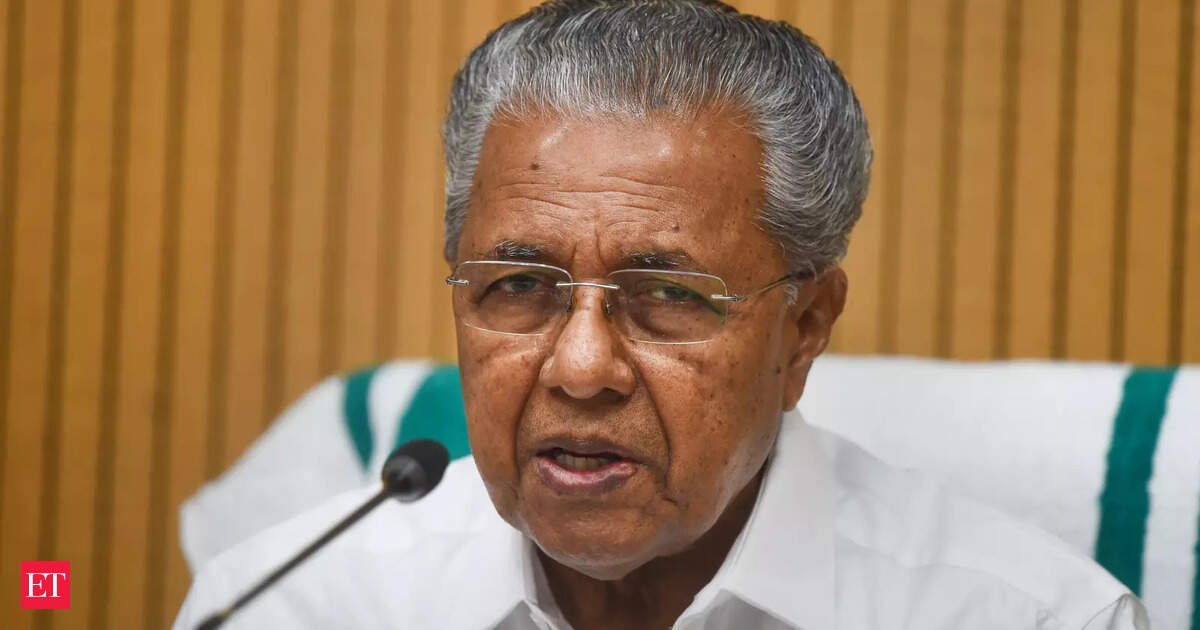
Addressing the valedictory session of the Vision 2031 International Conference here, he said states today play an increasingly important role in delivering public services and driving development, but their fiscal space has become more constrained.
Referring to Kerala’s experience, Vijayan said the state has consistently mobilised a high proportion of its own revenues and maintained strong public service delivery, even as changes in intergovernmental fiscal arrangements, borrowing limits, and the structure of central transfers have created new challenges.
He said the issue should be viewed not in the language of confrontation but as a matter of democratic governance.
“Cooperative federalism requires predictability, fairness, and respect for constitutional roles. States must have the fiscal capacity to fulfil the responsibilities entrusted to them, particularly in areas such as health, education, social protection, and infrastructure,” he said.
According to him, despite constraints, Kerala has continued to prioritise welfare, education and public services. Measures supporting students, workers and vulnerable groups reflect an effort to balance fiscal responsibility with social commitment.
Highlighting the state’s secular ethos, the CM said secularism in Kerala is not merely a constitutional principle but a lived social practice visible in schools, neighbourhoods and workplaces.At a time when many societies, including India, are witnessing growing polarisation, Kerala has largely preserved social harmony through inclusive public institutions and a culture of mutual respect, he said.
Quoting nobel winning economist Amartya Sen, Vijayan said social cohesion is a precondition for development, as trust between communities and confidence in institutions are essential for economic activity, innovation and investment.
Kerala’s secular ethos, he said, has been one of its most valuable economic assets.
The Chief Minister said Vision 2031 was a collective exercise in reflection, dialogue and imagination aimed at understanding Kerala’s past, critically assessing its present and constructively shaping its future as the state approaches its 75th year.
He noted that the formulation of public policy in Kerala has been a participatory process shaped by dialogue between the state and society, and that the Vision 2031 discussions have evolved beyond a technical document into a shared framework informed by evidence and democratic consultation.
Tracing the state’s development journey from land reforms and investments in public education and health to social security and decentralised planning, he said Kerala’s experience has been one of continuous renewal based on the understanding that markets alone cannot deliver social justice.
Economic growth, he said, must be evaluated by its ability to secure dignity and basic security for all.
Noting that Kerala now stands at a new historical moment, he said the challenge ahead is to transform a high human development society into a productive, knowledge-driven economy that generates quality employment, fosters innovation and remains environmentally sustainable without abandoning social commitments.
He underscored Kerala’s long-standing commitment to participatory governance, recalling the People’s Plan Campaign of 1996 as a milestone in decentralisation.
Expressing gratitude to Congress veteran and former Union Minister Mani Shankar Aiyar for his remarks on Kerala’s achievements in decentralisation, Vijayan said the political roots of decentralisation in the state could be traced back to the first Communist ministry led by EMS Namboodiripad.
Acknowledging the need for further reforms, the CM said the government was seriously considering comprehensive legislative changes to the Kerala Municipal and Panchayati Raj Acts to strengthen administrative capacity, financial autonomy and accountability.
The discussions around Vision 2031 have made it clear that Kerala’s future strategy rests on three interlinked principles-growth with quality employment, democratic participation and social justice, he said.
The Kerala of 2031 must be prosperous, innovative and resilient, Vijayan said adding that “but above all, it must remain democratic and secular in spirit.”


