


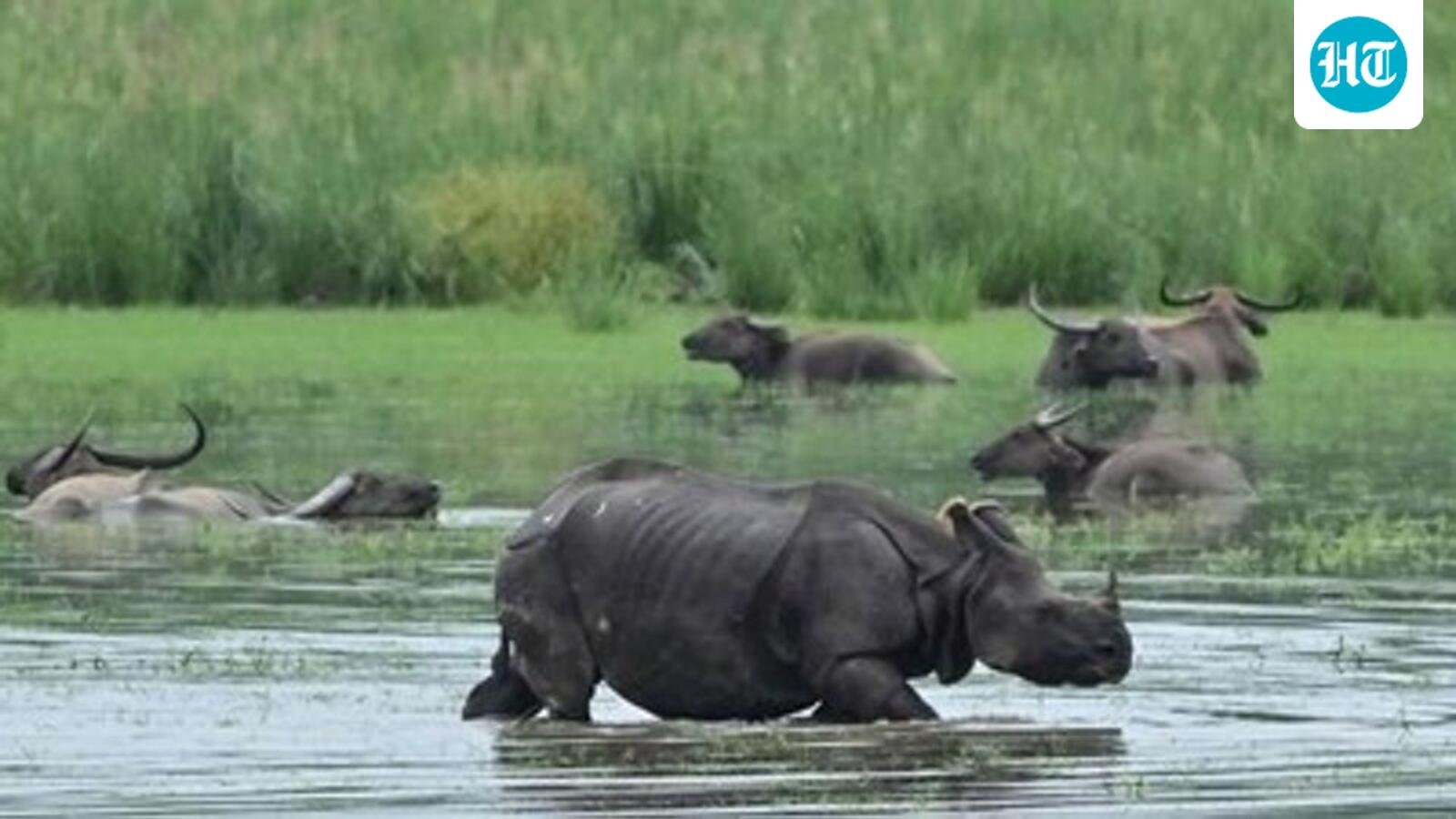
Assam chief minister Himanta Biswa Sarma on Wednesday said the state government’s move to reduce the eco-sensitive zone (ESZ) around Kaziranga National Park and Tiger Reserve (KNPTR) from 10 km to 1 km would follow Supreme Court guidelines.
On August 8, the CM had commented that the ESZ around the UNESCO World Heritage Site, which is the largest habitat of the endangered one-horned rhinos, was 10 km ‘by default’ and the Assam government would send a proposal to the Centre within two months to reduce the limit to 1 km. He stated that it was needed for development activities in the area, including constructing a stadium.
“The SC itself had stated that the ESZ would be of 1 km. But till the state government’s doesn’t notify the ESZ, the limit of that zone would be 10 km. Once the state notifies the ESZ properly, it will come down to 1 km, which is what the apex court had specified,” Sarma said.
“If we have to maintain that 10 km limit around KNPTR than towns like Kaliabar, Doboka, Jakhalabandha, Bokakhat would not remain. The SC guidelines specifies that the ESZ should be 1 km, but it can extend to 3 km depending on circumstances. There’s no wildlife sanctuary in the world which has an ESZ of 10 km surrounding it,” he added.
In June 2022, the SC had ordered that ESZs of a minimum of 1 km should be declared around protected forests, national parks and wildlife sanctuaries.
But in April 2023, following submissions from states and the Centre that such a uniform practice was not feasible, the SC modified its order, stating that a stringent observance of its earlier order was not feasible as it could lead to more man-animal conflict and hamper the day-to-day activities of citizens. It, however, stipulated that no mining activity would be allowed within the 1 km boundary of the protected areas.
The Assam government’s proposal to reduce the ESZ has evoked negative reactions from wildlife activists and conservationists in the state.
“Kaziranga is not just Assam’s pride, but its a world heritage site. The proposal, if implemented would have a drastic effect on wildlife in the national park,” said Jadav Payeng, wildlife conservationist.
“During the annual floods, animals like rhinos, deer, elephants from Kaziranga leave the park and head to higher altitudes nearby for safety. If the ESZ is reduced, they won’t be able to move freely and get trapped. What’s the need to reduce the ESZ for construction activities near the national park?” questioned the Padma Sri awardee known as the Forest Man of India.
“Supreme Court in its earlier judgement has made it very clear that if a national park doesn’t declare ESZ, then the apex court will assume ESZ is up to 10 km from park boundary. Further the apex court in its June 2022 judgement held that every national park and wildlife sanctuary must have a mandatory ESZ of atleast 1 KM from demarcated boundary,” said Bibhab Talukdar, secretary general of Aaranyak, a wildlife conservation organisation.
“What is important is the spirit of the ESZ for proper implementation, whether is 10 km from the park boundary of whether even one km from the park boundary for long term conservation future of Kaziranga or in that matters all other national parks and wildlife sanctuaries. At the same time there has to be a balance between conservation and livelihood needs of local people living around such protected areas,” he added.
