


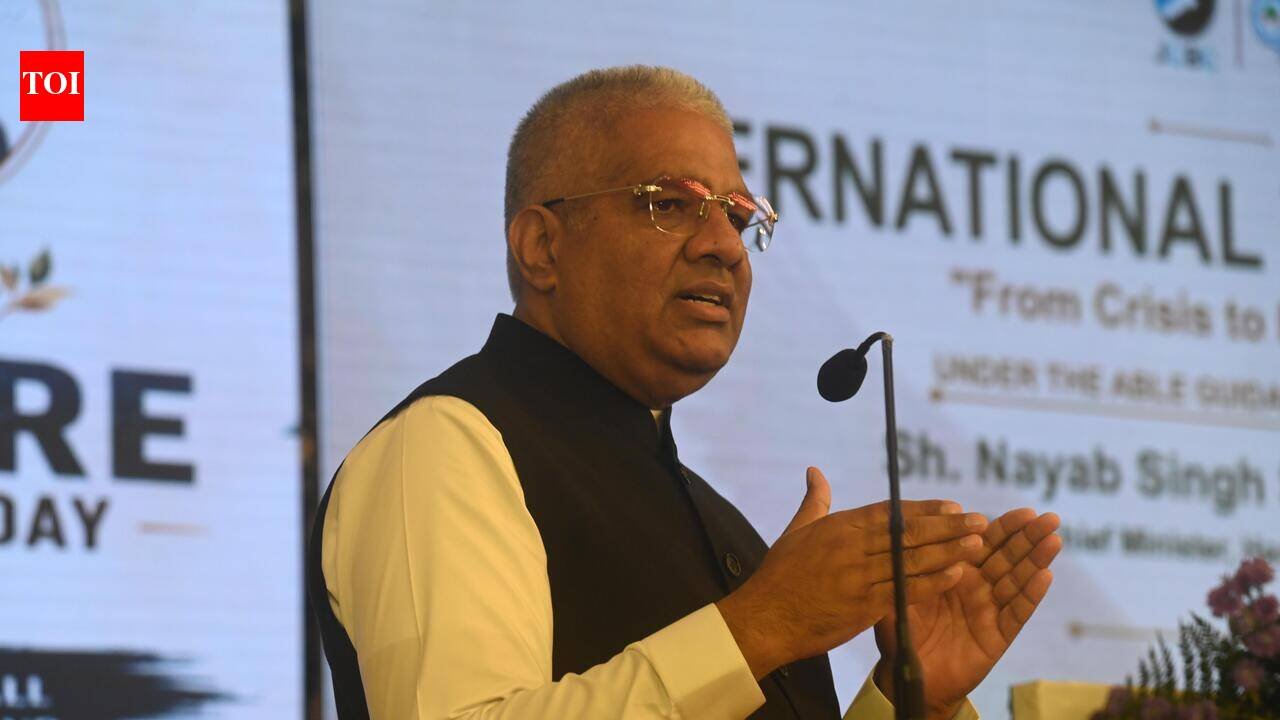
Chandigarh: Calling for stronger grassroots action to protect India’s rich natural heritage, Punjab governor and UT administrator Gulab Chand Kataria and Union environment minister Bhupender Yadav Sunday underscored the need to make local biodiversity institutions more effective and community-driven at the 16th National Meet of State Biodiversity Boards (SBBs) and Union Territory Biodiversity Councils (UTBCs) in Chandigarh.The two-day meet, organised by the National Biodiversity Authority (NBA) on Sept 6 and 7, has brought together chairpersons and member secretaries of biodiversity boards and councils from across the country, along with senior officials, experts and scientists.The inaugural session was attended by Kataria, Union minister for environment, forest and climate change Bhupender Yadav, and Haryana environment minister Rao Narbir Singh.Addressing delegates, Kataria highlighted India’s rich biodiversity and traditional environmental values, stressing that ecological security is intrinsically linked to food and water security, livelihoods and sustainable development. He emphasised the need to blend traditional knowledge and community participation with modern conservation practices.The governor also drew attention to the ecological importance of Punjab and Chandigarh’s wetlands, river ecosystems and agricultural biodiversity. He called for strengthening Biodiversity Management Committees (BMCs) and People’s Biodiversity Registers (PBRs), while advocating closer coordination between biodiversity institutions and local communities.Bhupender Yadav said India’s biodiversity conservation efforts combine scientific capabilities with the traditional wisdom of local communities. Referring to initiatives launched under Prime Minister Narendra Modi’s vision, he highlighted Mission LiFE, Ek Ped Maa Ke Naam, Amrit Sarovar and the Green Credit Programme.The Union minister said the Biological Diversity (Amendment) Act, 2023, and Biological Diversity Rules, 2024, have further streamlined and strengthened biodiversity governance in the country. He urged states and UTs to align their institutional mechanisms, rules and implementation processes with the amended framework.Emphasising implementation at the grassroots level, Yadav called for making more than 2.76 lakh Biodiversity Management Committees across the country fully functional and effective. He said People’s Biodiversity Registers should evolve into dynamic planning tools that help local bodies integrate biodiversity-related information and traditional knowledge into development planning.The minister also referred to India’s updated National Biodiversity Strategy and Action Plan (NBSAP) 2024-2030, aligned with the Kunming-Montreal Global Biodiversity Framework. He urged states and UTs to work towards measurable outcomes in ecosystem restoration, habitat and species conservation, agro-biodiversity protection and climate-resilient landscape development, while contributing to the global 30-by-30 conservation target.The meeting will serve as a platform for states and UTs to share experiences, innovations and implementation challenges, and discuss measures to strengthen biodiversity governance. Deliberations are expected to focus on improving institutional mechanisms, enhancing the functioning of Biodiversity Management Committees, improving the quality and use of People’s Biodiversity Registers, and building capacity for more effective biodiversity management at the grassroots level.
