



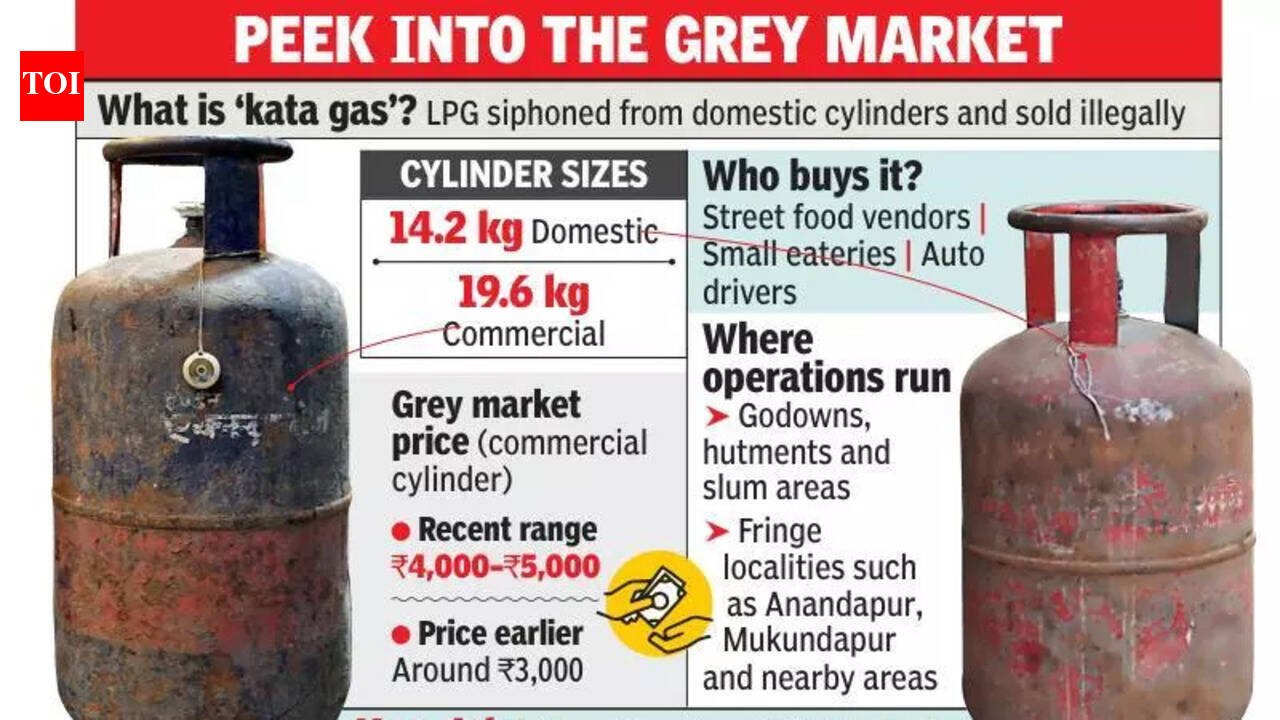
Kolkata: The city’s long-running underground trade in ‘kata gas’ — domestic LPG siphoned from household cylinders — has taken a new turn, with operators now diverting the fuel into commercial cylinders as prices soar in the grey market.On Friday, the unofficial market price of a 19-kg commercial LPG cylinder reportedly touched Rs 4,000–Rs 5,000, several times the official rate, making it far more lucrative for illegal operators to refill commercial cylinders rather than supply fuel to small users such as auto drivers.The spike in prices has also disrupted the informal ecosystem that once relied on kata gas as a cheap alternative fuel. Auto drivers who previously used the pilfered LPG to cut fuel costs say the sudden rise has made it unaffordable, forcing them back to purchasing auto LPG from authorised stations.“We always used kata gas because it gave better mileage and was much cheaper,” said Asim Kar, who drives an auto on the Behala-Gariahat route. “But on Thursday, we were shocked to see the price rise three to four times. Now we have no option but to buy LPG from fuel stations.”The illegal trade, which has existed for years, is now thriving amid supply disruptions and rising demand. According to sources, clandestine refilling operations are active in several pockets from Anandapur to Mukundapur, Mahishbathan, Dum Dum, Barasat and surrounding suburban areas.The modus operandi is simple but risky. Domestic cylinders — which contain 14.2 kg of LPG — are manually siphoned into larger 19.6 kg commercial cylinders using crude pipes and valves. The refilled cylinders are then sold in the grey market to eateries, street vendors and small establishments that cannot easily procure commercial LPG during supply crunches. Many of these operations function out of temporary setups — godowns, makeshift sheds, hutments and even slums. Operators shift locations to evade arrest.Rabi (name changed), a former LPG delivery worker who now operates in the grey market, said the business had recently become far more profitable. “Earlier, we sold the gas mainly to auto drivers or small users,” he said. “But now, LPG from domestic cylinders is being transferred to commercial cylinders because commercial gas is not easily available in the open market.”He added that prices have been extremely volatile in recent days. “A few days ago, we sold a commercial cylinder for around Rs 3,000. Now it sells anywhere between Rs 4,000 and Rs 5,000, depending on demand,” he said. According to Rabi, the supply of domestic cylinders feeding the illegal trade comes from multiple sources. “Many people sell their cylinders to us. Even cylinders given under the Ujjwala scheme often come to us because poor households cannot afford to refill them regularly,” he claimed.A roadside food stall owner said: “We cannot run the shop without gas. When official supply becomes uncertain, some people try to arrange cylinders through other channels, though it is risky,” he said.Authorities have repeatedly warned that illegal LPG transfer is extremely dangerous and can lead to accidents or explosions. Yet the trade continues to survive, driven by price gaps, supply disruptions and the steady demand from small businesses that depend on LPG for daily operations.


