Experts warn 10°C temp anomaly threatens snow accumulation
Srinagar, Feb 25: The record-breaking 21°C temperature in Srinagar — nearly 10 degrees above normal for late February — has triggered serious concern among glaciologists, who say Kashmir’s glaciers may have entered the melt phase weeks earlier than usual.
Winter is the season when glaciers grow. Snowfall between December and February accumulates, compacts into ice and replenishes the frozen reserves that feed rivers through summer. But this year’s prolonged dry spell and unusually warm days have disrupted that cycle.
Director Meteorological Centre Srinagar Mukhtar Ahmad said that abnormally high winter temperatures weaken the snowpack before it converts into stable ice. “Instead of accumulation, we are witnessing early melting. Repeated winters like this create a negative glacier mass balance,” he said.
Director MeT Ladakh Sonam Lotus echoed the concern, warning that Himalayan glaciers are highly sensitive to winter warming. “If snowfall reduces and temperatures remain high, glaciers lose the very season meant for recovery. That accelerates long-term retreat,” he said.
Satellite and field studies show that glacier shrinkage in Jammu & Kashmir is already well underway. Research indicates that more than 18 per cent of glaciers in the region have retreated in recent decades, while overall glacier mass in parts of the western Himalaya is thinning by an average of 30–40 centimetres water equivalent per year.
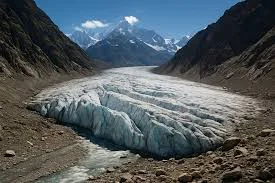
The Kolahoi Glacier, Kashmir’s largest and often called the Valley’s “water tower”, illustrates the trend. Studies show it has lost roughly 20–25 per cent of its area since the mid-20th century, with its snout retreating nearly 3 kilometres between the 1960s and early 2000s. Its decline is critical because it contributes a major share of the Lidder River’s flow, which supports agriculture and drinking water supply in south Kashmir.
The current temperature anomaly intensifies three glacier-damaging processes. First, early snowmelt exposes underlying ice sooner. Second, reduced fresh snowfall means less protective cover. Third, exposed darker ice absorbs more solar radiation, accelerating melt rates. Scientists warn that warm winters are often more destructive than hot summers, because glaciers depend on winter accumulation to offset summer loss.
In the Pir Panjal and Sonamarg regions, monitored glaciers have been retreating by several metres annually. In Ladakh’s higher altitudes, satellite imagery has also detected the expansion of glacial lakes formed by accelerated melting — a potential precursor to glacial lake outburst floods.
Experts caution that glacier shrinkage creates a dangerous hydrological imbalance. In the short term, rivers may swell earlier in spring due to rapid melt. In the long term, however, shrinking ice reserves reduce sustained summer discharge, affecting irrigation, hydropower and drinking water supplies.
Climate projections suggest that continued warming could significantly reduce glacier volume across the western Himalaya by mid-century. Even a few successive warm winters can push smaller glaciers beyond recovery thresholds, transforming perennial ice bodies into seasonal snowfields.
For now, the February heatwave may appear as an early taste of spring in the Valley. But in the mountains above, it signals something more permanent — a weakening of the natural ice reservoirs that have sustained Kashmir’s rivers for centuries. The thermometer in Srinagar may fall in the coming days. The question scientists are asking is whether the glaciers will recover as easily.