


Srinagar, Jul 17: Kashmir continued to remain in the grip of an intense heatwave on Friday with Srinagar recording a maximum temperature of 35 degrees Celsius, nearly five degrees above normal and the third highest day-time temperatures in July.
On June 30, Srinagar recorded 35.2 degrees Celsius just a day after the district logged 35.3 degrees Celsius in day temperatures. As per the official data, the temperature is also the third-highest July maximum recorded in Srinagar since 2016, behind 37.4°C on July 6, 2025, and 36.2°C on July 29, 2024.
Several other stations also recorded temperatures significantly above normal. Kupwara equalled Srinagar at 35 degrees Celsius, while Qazigund recorded 33.2 degrees Celsius and Kokernag 32.9 degrees Celsius. Even the usually cooler tourist destinations offered little respite, with Pahalgam recording 27.4 degrees Celsius and Gulmarg 25.6 degrees Celsius.
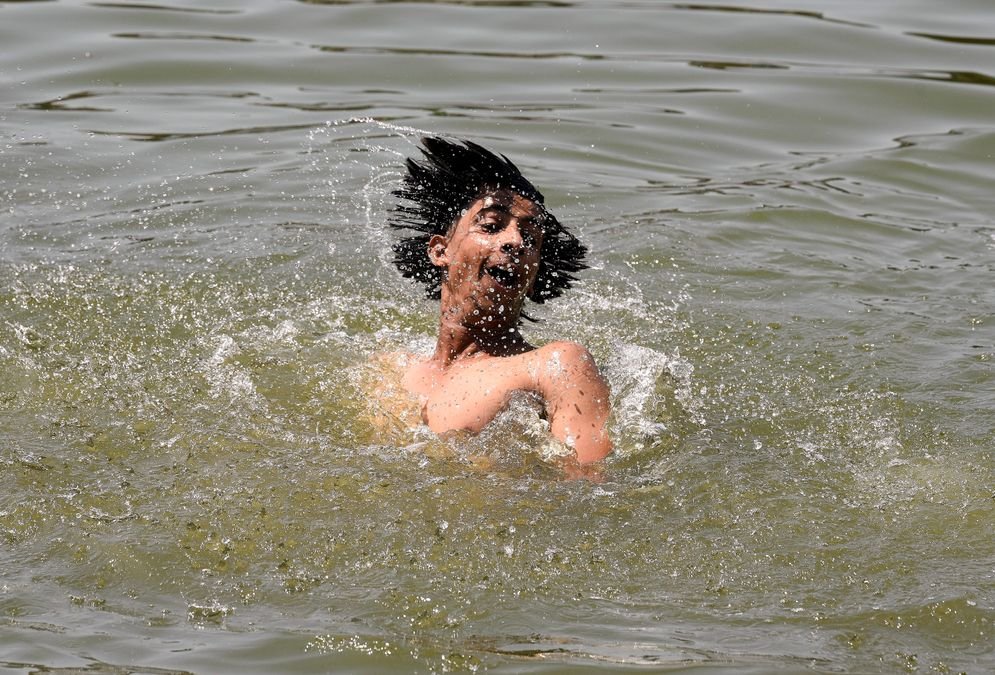
The soaring temperatures forced people indoors during afternoon hours while children across Srinagar and other parts of the Valley sought refuge in rivers, streams, canals and lakes.
From the banks of the Jhelum in Rajbagh and Chattabal to streams flowing through villages in north and south Kashmir, children were seen diving into the water and swimming to escape the oppressive heat and humidity.
“The river is our swimming pool during summer. We wait for these holidays to come here with friends,” said 13-year-old Danish Ahmad while taking a dip in the Jhelum in Srinagar.
“It becomes difficult to stay inside our homes during the afternoon. The water gives us some relief from the heat,” said another youngster, Aamir Bashir, as scores of children splashed in the river nearby.
The Valley had already witnessed its hottest day of the season earlier this month when Srinagar recorded 34.5 degrees Celsius on July 10, the highest temperature and among the highest July temperatures recorded in decades.
Director Meteorological Centre Srinagar, Dr Mukhtar Ahmad, said the prevailing hot and humid conditions are likely to continue for the next two days before a major weather system brings widespread rainfall to Jammu and Kashmir.
“We expect generally hot and humid weather to continue till July 19, with only isolated thundershower activity at scattered places. Thereafter, a significant wet spell is expected across Jammu and Kashmir between July 20 and July 22,” Dr Ahmad said.
He said heavy rainfall, intense showers and even torrential rain are likely at a few places, particularly in the Jammu division.
“There is a possibility of flash floods, landslides, mudslides and waterlogging in vulnerable areas during this period. People are advised to remain cautious and plan their travel accordingly,” he added.
Independent weather forecaster Faizan Arif said the upcoming rainfall is likely to bring much-needed respite to residents exhausted by the prolonged spell of heat and humidity.
“Kashmir has witnessed an unusually hot July this year, with temperatures consistently remaining above normal. The wet spell expected from July 20 onwards should bring a noticeable fall in day temperatures and provide relief from the uncomfortable conditions,” Arif said.
However, he cautioned that the rainfall may be intense in some areas.
“While people are eagerly waiting for rain, the possibility of brief but intense showers cannot be ignored. Residents living near streams, nallahs and landslide-prone areas should remain vigilant,” Arif said.
Residents say the heat this summer has been unusually harsh.
“Earlier evenings in Kashmir used to be pleasant even during summer, but now the heat continues well into the night. Climate patterns are clearly changing,” said Mohammad Yousuf, a resident of Srinagar’s downtown area.
Another resident, Shabir Ahmad of Baramulla, said, “Fans continue to run throughout the day and night now, something that was uncommon in Kashmir a decade ago. Everyone is waiting for the rains.”
The Meteorological Department has advised farmers to suspend agricultural operations during the peak rainfall period and warned of a significant rise in water levels in rivers and streams, besides the possibility of waterlogging in low-lying areas.
For now, Kashmir remains caught between an unforgiving summer sun and the promise of rain, with children finding relief in its waters even as officials prepare for those very waters to swell in the days ahead. Meanwhile, doctors have advised people, including children, to stay hydrated and avoid exposure to the sun, especially during peak hours. They have asked people to eat fruit and vegetables and drink plenty of water to avoid heat stroke.
