



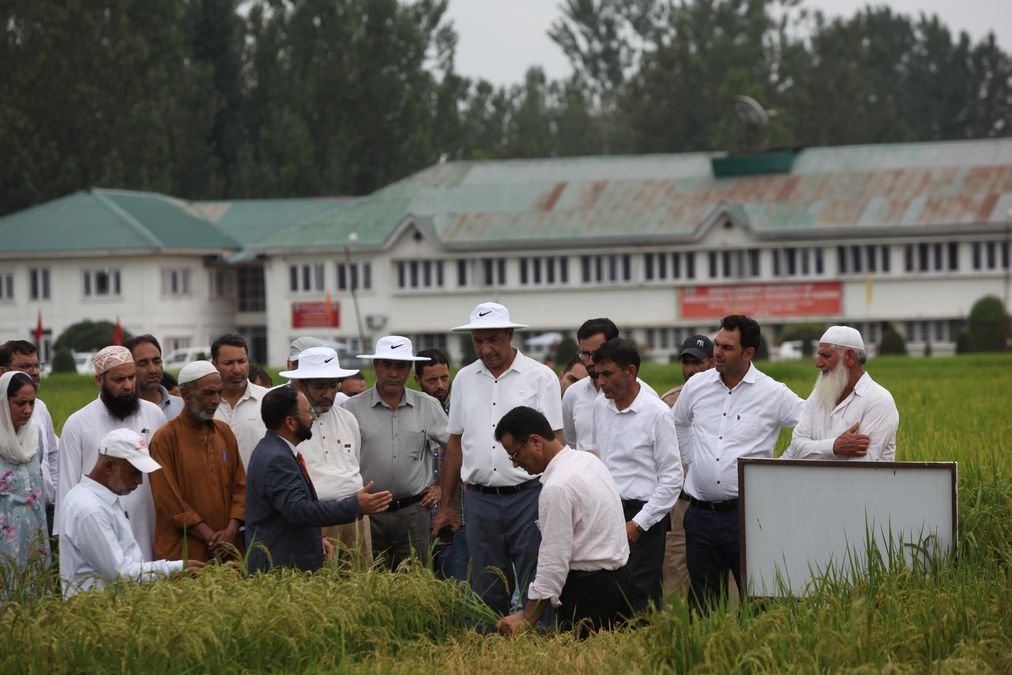
Kulgam, Aug 29: When Kashmir’s rice fields yield over 100 quintals per hectare – nearly three times the national average – the credit goes to a research station in Kulgam that has spent decades turning food security into a reality for the Valley.
The Mountain Research Station for Field Crops (MRFC) at Khudwani has been the backbone of Kashmir’s rice revolution, Prof (Dr) Nazir Ahmad Ganai, Vice Chancellor of Sher-e-Kashmir University of Agricultural Sciences and Technology, Kashmir (SKUAST-K), said during a visit to the station on Saturday.
The Vice Chancellor said that decades ago, rice productivity in the region stood at around one tonne, but research carried out at the station over the past 30 to 40 years has raised the potential yield to between 10 and 12 tonnes. “This progress has come even as the region faces a growing population, shrinking agricultural land, and mounting pressure from climate change and global warming, all of which continue to push up food requirements even as resources shrink,” he said.
National blast reference centre
The VC said MRFC Khudwani also functions as the country’s National Blast Reference Centre, where every rice variety released nationally is tested for resistance to blast disease. “The station’s testing has shown that the majority of nationally released varieties and traditional landraces suffer losses of 50 to 100 per cent when affected by blast,” he said.
Prof Ganai cited the example of Mushk Budji, a native Kashmiri rice variety that had gone extinct after proving highly susceptible to blast, which scientists at the station managed to recover through targeted breeding for blast resistance. He said Kashmir’s red rice, another local landrace known for its premium quality and high nutritional value, particularly its iron and zinc content, had also been vulnerable to blast and was similarly recovered through breeding efforts by the station’s scientists.
A Kashmiri Basmati, for the first time
The Vice Chancellor said the station has also developed what he described as Kashmir’s first Basmati rice variety, a medium-grain variety with a stronger aroma than mainland Basmati varieties, and a yield potential of eight to nine tonnes. He noted that Basmati rice had historically been associated only with the plains, and had never previously been cultivated in Kashmir.
Research on climate resilience and labour-saving technology
Prof Ganai said ongoing research at the station is also focused on reducing pesticide use and labour requirements in rice cultivation. He pointed to Direct Seeded Rice (DSR), a newer technology introduced by the university that has significantly cut down labour, manpower and water use in cultivation.
He said Kashmir’s current rice productivity level is nearly three times the national average, standing at over 100 quintals per hectare compared to a national average of around 30 quintals. “The potential yield of a newer variety being developed at the station, close to 12 tonnes or 120 quintals per hectare, would place it among the highest rice productivity levels recorded anywhere in the world, comparable, he said, to levels achieved in China,” he said.
Comparable to International Rice Research Institute
The Vice Chancellor said he took pride in the fact that the station’s work stood on par with that of the International Rice Research Institute (IRRI) in the Philippines, one of the world’s foremost rice research institutions. He said senior scientists at the Indian Council of Agricultural Research (ICAR) working on rice breeding were aware of the station’s achievements. He credited the station’s breeders, agronomists and pathologists, both past and present, for the progress made.
The university’s continuing goal, the VC said, is to improve farmers’ profitability while lowering the cost of production, since rice remains a staple diet in Kashmir that the region cannot do without.
Postgraduate college in the works
The VC SKUAST-K announced that the station, which has so far functioned purely as a rice research facility, is this year being developed into a postgraduate college of agriculture for South Kashmir, where Master’s and PhD programmes in agriculture will be introduced. “The move is intended to meet the growing need, both in Kashmir and across the country, for skilled and well-trained agricultural scientists,” he said.
Prof Ganai said the station’s research also involves breeding rice varieties suited to different altitudes, low, medium and high, since maturity periods vary significantly with elevation, and varieties suited to low altitude do not necessarily mature at higher altitudes.
The Vice Chancellor said an academic and laboratory block, along with separate hostel blocks for boys and girls, are currently under construction at the station, as part of the university’s broader effort to develop it into a state-of-the-art Centre of Excellence for South Kashmir.


