



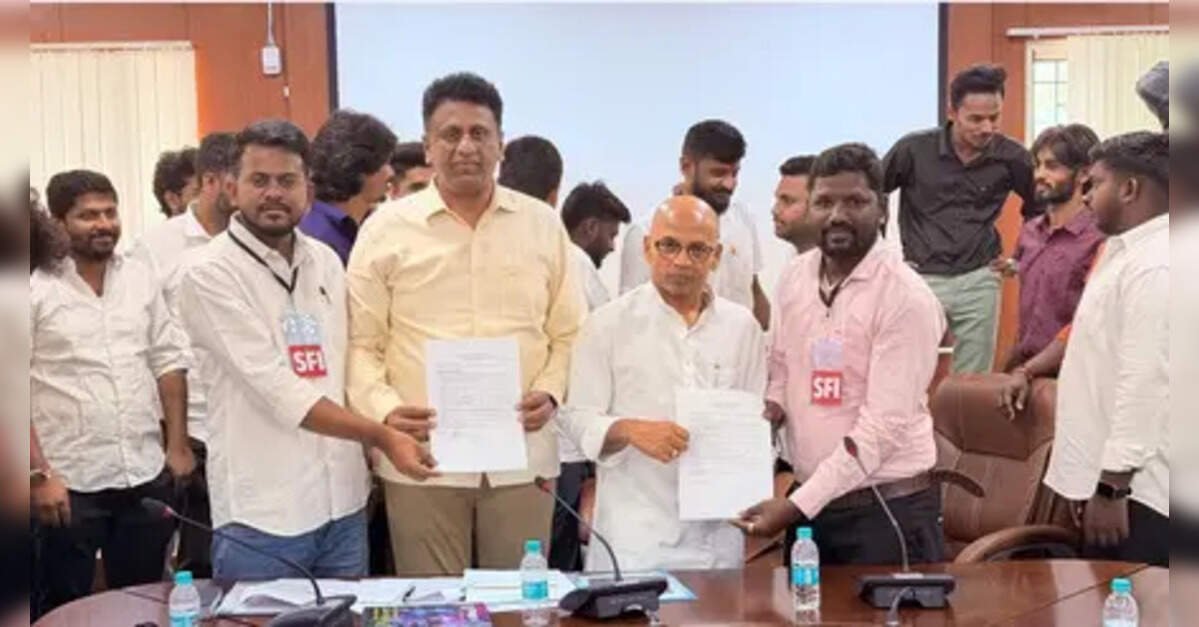
Bengaluru, Setting aside their parent parties’ political differences, student wings across Karnataka’s major political formations found rare common ground on Wednesday, unanimously demanding that student union elections be reinstated in colleges from the current academic year.
The consensus emerged at a day-long meeting of student union leaders convened under the leadership of Medical Education Minister Sharana Prakash R Patil and Higher Education Minister M C Sudhakar.
During the meeting, the ministers assured that the government would largely follow the recommendations of the former Chief Election Commissioner J M Lyngdoh Committee report on student union elections, with modifications suited to current conditions.
Student elections were banned in Karnataka in 1989 by the then Congress government led by Chief Minister Veerendra Patil, allegedly in response to a series of violent incidents and clashes on college campuses, as well as the increasing influence of political parties in campus life.
“Welcoming the state government’s budget announcement to revive student elections in colleges, representatives from the student wings of the Congress, BJP, JD(S), and Left parties spoke in one voice, urging that elections be conducted without delay,” Patil’s office said in a release.
Both ministers assured the gathering that they would recommend to Chief Minister Siddaramaiah that rules and guidelines be framed at the earliest to enable student polls, the release added.
Siddaramaiah had announced in the 2026-27 Budget that the government would revive student elections in colleges.
According to the release, student leaders representing Left-affiliated organisations-Students’ Federation of India (SFI), All India Students’ Federation (AISF), All India Democratic Students’ Organisation (AIDSO), and All India Students Organisation (AISO)-called for structured representation in elected bodies, demanding reserved seats for women candidates.
Representatives of Vidyarthi JD(S) took a regional stance, urging that 70 per cent of seats be reserved for Kannada-speaking students.
Representatives of the Akhil Bharatiya Vidyarthi Parishad (ABVP) urged the ministers to lay down eligibility criteria for student candidates, including a minimum attendance threshold of 60 per cent and the absence of any pending FIRs or academic backlogs.
This drew immediate objections from the National Students’ Union of India (NSUI) and Vidyarthi JD(S) representatives, who argued that several students may have faced FIRs while participating in pro-Kannada demonstrations. “It is not fair to bar a student based on attendance or an FIR. Everyone should have a fair chance,” they said.
Some students from Bangalore Medical College raised broader concerns, asking the government to clearly define the role, powers, and responsibilities of elected student bodies.
“The elected body should not be confined to organising college festivals. Students should be given substantive powers, including the right to participate in syndicate meetings of their respective universities,” the students urged, as per the release.
Patil and Sudhakar told the gathering that the government would largely follow the recommendations of the J M Lyngdoh Committee report on student union elections, with modifications suited to current conditions.
The committee was constituted pursuant to a Supreme Court order dated December 2, 2005, under former Chief Election Commissioner J M Lyngdoh, to examine and recommend guidelines for student body elections across universities and colleges in India.
The committee submitted its report on May 26, 2006, and the Supreme Court, in a subsequent order dated September 22, 2006, directed the then Ministry of Human Resource Development to implement its recommendations.
Representatives of faculty bodies, college managements, and teachers’ associations from various institutions separately met the ministers and expressed their support for the restoration of student elections, calling on the government to ensure that the polls are free and fair, the release added.


