



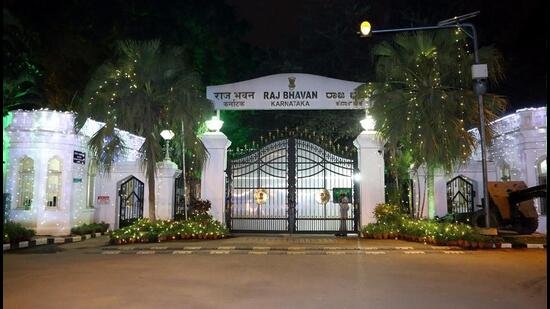
Karnataka governor Thawarchand Gehlot’s office has asked the state government to comprehensively examine its decision to replace the marks system for the third language in the Secondary School Leaving Certificate (SSLC) exam with a grading system that won’t impact a student’s overall results.


The move came after the Association for Preservation of Local Languages, Bengaluru, submitted a representation questioning the academic and systemic consequences of the decision for Class 10 students.
“I am directed to forward herewith a copy of a representation submitted by the Association for Preservation of Local Languages, Bengaluru, which has been addressed to the Governor of Karnataka, concerning the recent decision to award only grades, without including marks, for the third language in the SSLC examination,” the governor’s office said in a letter to chief secretary Shalini Rajneesh.
“The governor has taken note of the issues raised in the representation and desired that the matter be examined comprehensively, keeping in view its academic and administrative aspects across the education sector,” the communication said.
The concerns come from the perceived impact of the change on the status of third-language learning. The representation argued that these subjects play a role in promoting linguistic diversity and intellectual development, and warned that removing marks may reduce student motivation and weaken engagement.
The policy shift was announced on March 27, catching many by surprise and prompting criticism over its timing. The government has maintained that the idea was to ease academic pressure on students.
School education and literacy minister S. Madhu Bangarappa said that the SSLC examination had a total of 625 marks for six subjects, including 100 marks for the third language.
The change will reduce the total marks to 525 across five subjects. The sixth subject, the third language, will be assessed through grades and excluded from the pass-or-fail criteria.
Bangarappa said the decision was informed by performance trends.
Of the 164,000 students who couldn’t clear their secondary school exams in 2024-25 in Karnataka, a vast majority, 146,000, failed in the third-language paper, according to state data. He argued that this revealed a widespread difficulty with the subject and justified a shift to grading to protect student interests.
The change applies to a range of third languages, including Hindi, Kannada, English, Arabic, Urdu, Sanskrit, Konkani, Tulu and Marathi.
Data from the current academic year shows that a large majority of students — 7,52,398 out of 8,07,962 — have opted for Hindi as their third language.
The move has fed into a broader debate over language policy in the state. Kannada organisations had earlier threatened to protest, arguing that Hindi was being imposed and was affecting students’ prospects. The Kannada Development Authority and the State Education Policy Commission have recommended moving towards a two-language system.
The current change is being seen by some as a step in that direction. After the commission submitted its report in 2025, chief minister Siddaramaiah expressed support for a two-language formula, though it has not yet been implemented.
At the same time, opposition leaders have criticised the policy. Bharatiya Janata Party leaders, including Leader of the Opposition R. Ashok, have opposed the decision, declaring that the BJP would restore the earlier system when it returns to power. Union minister Shobha Karandlaje has also described the move as “anti-Hindi”.


