






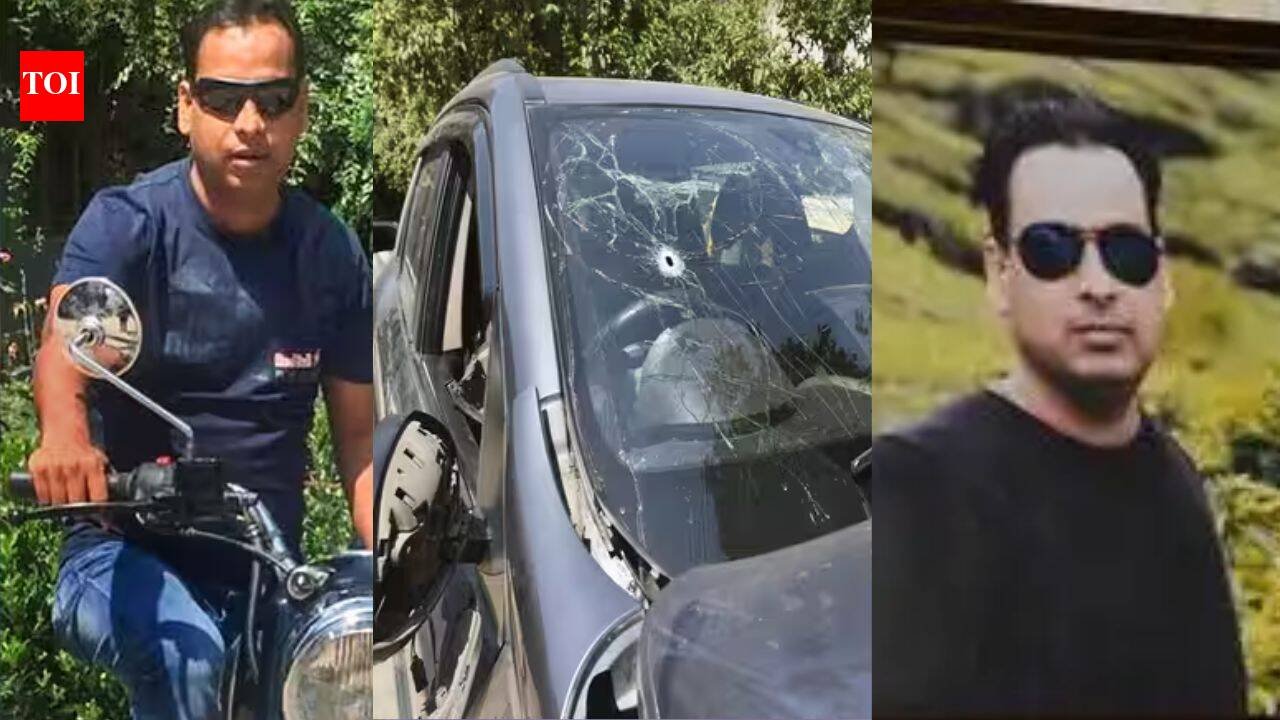
LUCKNOW: Eight years after Apple executive Vivek Tiwari was shot dead by a police constable in Lucknow, a sessions court has sentenced constable Prashant Kumar Chaudhary to 10 years of rigorous imprisonment for culpable homicide not amounting to murder.The court also fined him Rs 20,000 and acquitted his co-accused, constable Sandeep Kumar, of the charges against him.
Why Tiwari’s family calls verdict ‘injustice’
The verdict has brought a legal conclusion to one part of a case that began with a late-night police encounter in September 2018, but it has also left the victim’s family dissatisfied. Tiwari’s wife, Kalpana, termed the verdict “injustice” and said the family would challenge both Chaudhary’s 10-year sentence and Sandeep Kumar’s acquittal in a higher court.The case raises a difficult question: when a man dies after being shot by a police officer during a confrontation, does a conviction for culpable homicide, rather than murder, adequately address the circumstances of the death?
Court cited conflicting accounts
The night Vivek Tiwari was shotOn September 29, 2018, Vivek Tiwari, 38, was driving an SUV in Lucknow’s Gomti Nagar Extension while taking his former colleague Sana Siddiqui home.Two bike-borne policemen, Prashant Kumar Chaudhary and Sandeep Kumar, signalled the SUV to stop.According to the court record reported by TOI, Sana lowered the window to ask why they were being stopped, following which Sandeep allegedly struck her with a baton.Tiwari did not stop and continued driving. Chaudhary then took out his service pistol and fired at the SUV. The bullet passed through the vehicle’s windscreen and struck Tiwari.He lost control of the SUV, which crashed into a divider. The two policemen fled the spot, while Sana contacted the police control room and took Tiwari to hospital. He died during treatment.Two FIRs were subsequently registered — one by Sana against two unidentified policemen and another by Tiwari’s wife, Kalpana, naming Sandeep and Chaudhary. The chargesheet was filed in December 2018.Why the court rejected murder chargesThe key legal question was whether Chaudhary had the intention required for a conviction under Section 302 of the IPC, which deals with murder.In its September 17 judgment, the sessions court held that the circumstances did not establish the intention to kill required for murder. Instead, it convicted Chaudhary under Section 304 Part II of the IPC for culpable homicide not amounting to murder.The court’s reasoning was based on the circumstances surrounding the shooting. It considered the late-night setting, the glare from the SUV’s headlights, the vehicle’s movement towards the policemen and the repeated collisions involving the police motorcycle.The court also noted that only one shot had been fired.According to TOI’s analysis of the judgment, Sana testified during cross-examination that after the SUV initially hit the motorcycle, Tiwari reversed and then moved forward again. She said that when the shot was fired, the front tyre of the SUV was positioned over the front wheel of the motorcycle.Forensic evidence also played a role.An FSL report confirmed that the fatal bullet had been fired from the 9mm service pistol issued to Chaudhary and had entered through the front windscreen while he was positioned in front of the advancing vehicle.The court found that the repeated ramming gave Chaudhary a right of private defence. However, it concluded that he exceeded that right by firing at the vehicle instead of taking a non-lethal course of action.The confrontation, the court observed, unfolded in less than a minute, leaving little time for deliberation. It also noted that Chaudhary fired only once and reported the incident immediately.Eight years later, a 10-year sentenceNearly eight years after the shooting, Chaudhary was sentenced to 10 years of rigorous imprisonment.The court imposed a fine of Rs 20,000, with an additional two months in prison in case of non-payment. It also ordered that the period Chaudhary had already spent in custody during the investigation, inquiry and trial be set off against his sentence.Chaudhary was arrested on September 29, 2018, and had remained in jail for nearly eight years by the time of sentencing.The prosecution had argued that Chaudhary was a trained police officer who had received arms and behavioural training and was therefore expected to act responsibly while performing his duty. The prosecution sought the maximum punishment, citing the circumstances and manner of the offence.Chaudhary’s lawyer, meanwhile, urged the court to take into account the period already spent in custody, his lack of previous criminal history and his personal circumstances.Why was Sandeep Kumar acquitted?The second major aspect of the verdict concerns Sandeep Kumar, the other constable involved in the incident.Sandeep was acquitted of charges under Section 323 and Section 302 read with Section 114 of the IPC. The court found that the prosecution had failed to prove the charge of voluntarily causing hurt beyond reasonable doubt.A major issue was the testimony of Sana Siddiqui, who was the key eyewitness to the events.According to the court’s findings reported by TOI, Sana did not accuse Sandeep of assault in her initial FIR. Her allegation that Sandeep struck her on the arm with a stick appeared later, first in a subsequent statement and then in her Section 164 CrPC statement and examination-in-chief.The court also considered the medical evidence inconsistent with her later account.Her first medical examination, conducted within hours of the incident, recorded no visible external injury. A second examination recorded four injuries on her nose, chin and left forearm.The court found it difficult to reconcile those injuries with her claim that she had been hit once on the arm with a stick.There was also no recovery of the alleged stick from Sandeep. An INSAS rifle was recovered from him instead.The court further considered Sana’s statement that Kalpana Tiwari had visited her residence the morning after the incident and that an altercation had taken place. It held that the possibility that the injuries noted during the second medical examination were caused during that later scuffle could not be ruled out.Taken together, the court found that the absence of the allegation in the FIR, conflicting medical evidence, an alternative explanation for the injuries and the non-recovery of the alleged weapon created reasonable doubt.Justice delayed — or justice denied?For Tiwari’s family, the distinction between murder and culpable homicide has been central to their response to the verdict.The family has described the judgment as incomplete and said it would challenge both the 10-year sentence awarded to Chaudhary and Sandeep Kumar’s acquittal. Kalpana questioned how a trained police constable could have made what she described as a fatal mistake while firing his service weapon.The family’s lawyer, Pranshu Agarwal, told TOI that a criminal appeal would be filed in the high court.The court’s judgment, however, rests on a different legal assessment: that the prosecution did not establish the intention to kill required for murder, while the circumstances showed that Chaudhary’s use of force went beyond the limits of private defence.That distinction is at the heart of the case.Eight years after the shooting, there is a conviction and a prison sentence, but the family continues to challenge the nature and extent of that punishment. The acquittal of the co-accused is also being contested.The next chapter, therefore, may not be the end of the legal battle. For the family, the question remains whether the punishment imposed reflects the circumstances in which Vivek Tiwari lost his life. For the court at the trial stage, the answer was a conviction for culpable homicide rather than murder, with the sentence fixed at 10 years.The case thus ends its trial-court phase with a verdict — but not necessarily the final word on the matter.


