






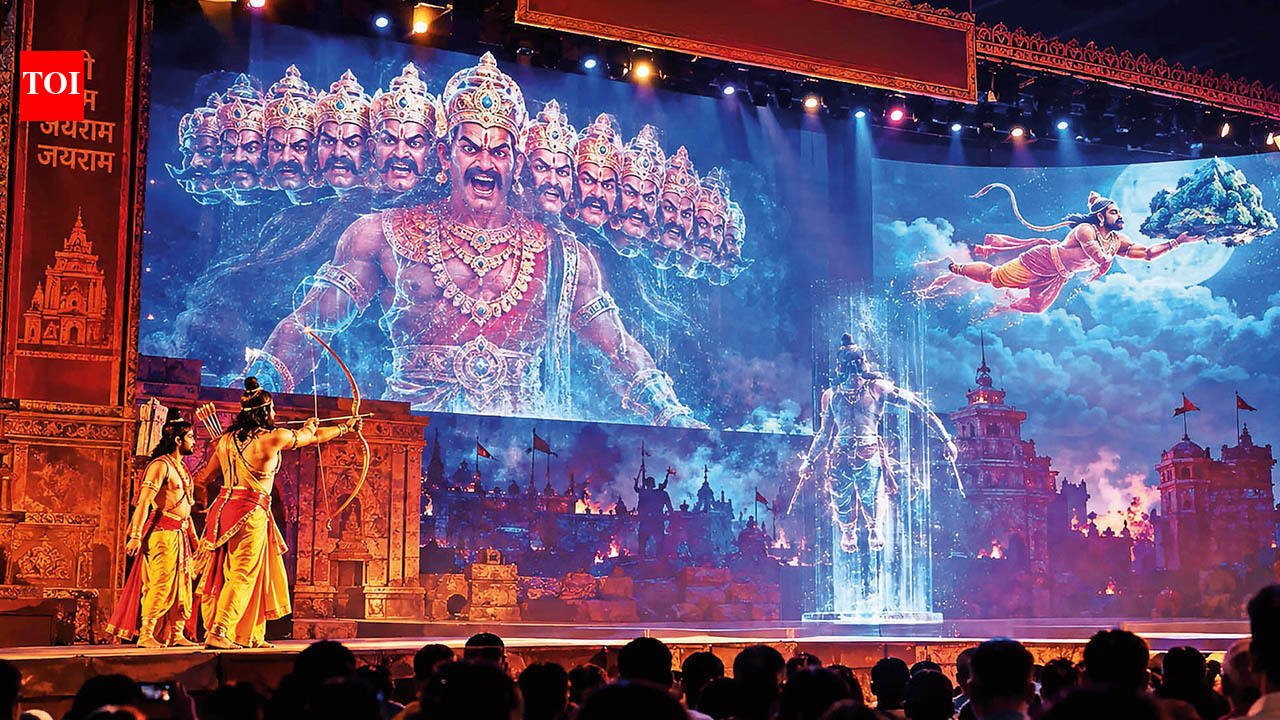
The 400-year-old Aishbagh Ramleela is preparing to add artificial intelligence and advanced visual effects to its traditional stagecraft, with organisers exploring holograms, LED projections and other technologies to make key episodes from the Ramayana more immersive for audiences. The proposed changes are aimed at enhancing the performance rather than replacing the live artistes. The organisers say the human element will remain central to the Ramleela, while technology will be used for scenes that are difficult to execute through conventional stage arrangements. Among the effects being explored are the appearance of Ravan’s ten heads when he becomes enraged and the disappearance and reappearance of Meghnad during a battle scene. Such sequences could be created through a combination of AI-generated visuals, holographic effects and projection technology.
AI to add new dimensions to Aishbagh Ramleela
Harish Chandra Agarwal, president of the Aishbagh Ramleela Samiti, said the plans were still at the discussion and development stage and that the committee was consulting technology experts before finalising the execution. “This year, we are working towards bringing artificial intelligence and advanced visual technology into the Aishbagh Ramleela, but the process is still at the discussion and development stage. We are speaking to technology experts to explore what can be realistically achieved. Our intention is not to replace the artistes or the traditional performance; the human element will remain at the heart of the Ramleela, with artistes continuing to perform live on stage. AI, holograms and LED projections will be used to enhance the visual experience and present certain scenes in a way that is difficult to achieve through conventional stagecraft,” he shares, adding, “For instance, when Ravan becomes angry, we would like to show his ten heads appearing dramatically and radiating anger. Similarly, in the scenes involving Meghnad and Ravan’s magical powers, we are exploring whether a character can disappear during a battle and reappear in the air through holographic or projection-based effects. These are possibilities we are currently examining, and we will implement them only after ensuring that they complement the story and the performance.”Talking about the changes already done in the past few years, he says, “We have already been using LED screens for several years to show scenes and visuals that cannot be presented physically on stage. The artistes are filmed and their performances are projected for the audience. AI will take this effort further by allowing us to create more advanced special effects while retaining the live performance and emotional connect of the Ramleela.”The craze for Ramleela hasn’t faded a bit, he feels. “The appeal of Ramleela remains very strong. Around 7,000 to 9,000 people watch the performance every year. Our aim is to use technology to attract the younger generation without diluting the values of the Ramayana. Technology should serve the story and help communicate these timeless values to a new generation.”The move is part of the Ramleela’s gradual transition from traditional open-ground staging to a more technology-assisted production. The Aishbagh Ramleela is regarded as one of India’s oldest Ramleelas. Local historical accounts trace its origins to the 16th century and associate its early development with Goswami Tulsidas. The tradition is also linked to Nawab Asaf-ud-Daula, who is said to have supported the Ramleela by providing land for its continued staging.


