





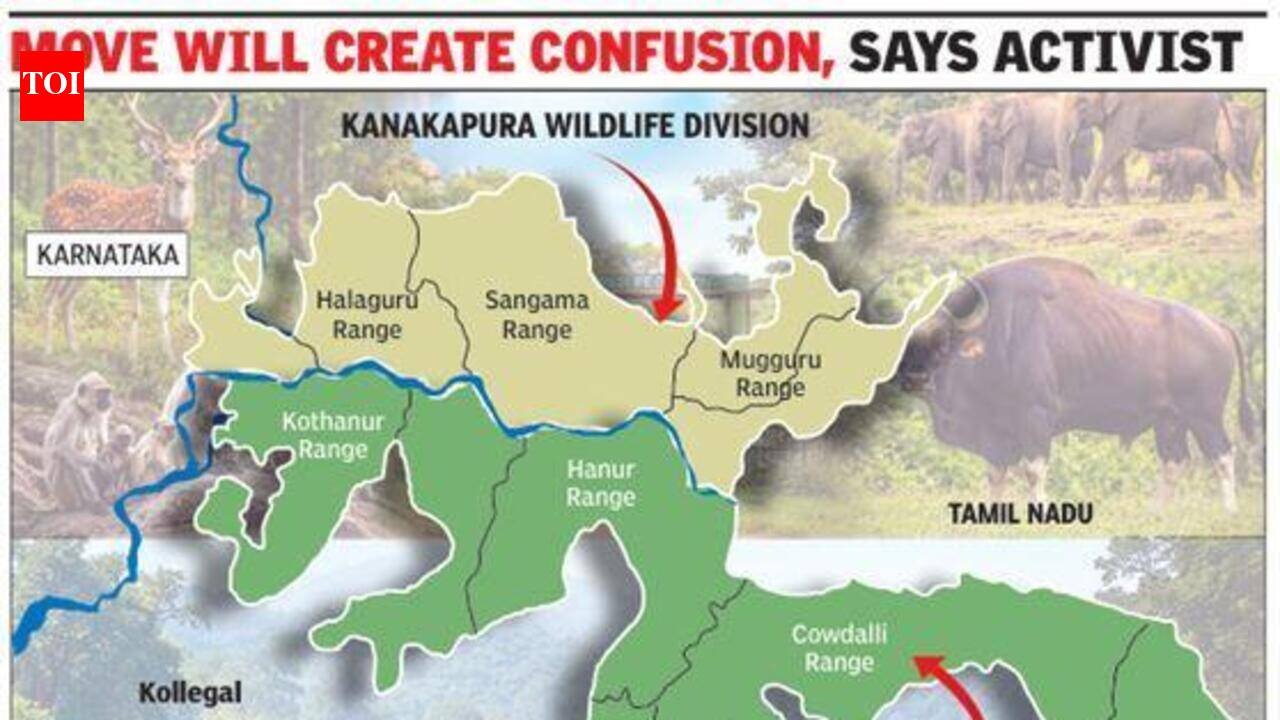
Bengaluru: The battle for Kanakapura, the home turf of chief minister DK Shivakumar, is no longer confined to politics. It is unfolding across the taluk’s farms and plantations, where frequent elephant incursions have intensified human-wildlife conflict. Struggling to contain the crisis through conventional measures, the forest department has turned to an unusual solution: redrawing Karnataka’s elephant management landscape.In a first for the state, the department has carved out key human-elephant conflict hotspots from the sprawling Cauvery Wildlife Sanctuary, which spans three districts, and brought them under the closer oversight of the Bengaluru South (Ramanagara) territorial division, with Kanakapura serving as the headquarters of the newly created wildlife division. The rationale behind the move is simple: if elephants do not recognise administrative boundaries, forest management must be aligned with their movement patterns.As part of the restructuring, Kanakapura wildlife division will comprise Mugguru, Sangama and Halaguru ranges spread across Kanakapura and Malavalli taluks. The division will be headed by a deputy conservator of forests (DCF). The govt has directed the department to establish a dedicated office in Kanakapura.The decision stems from a longstanding turf issue between the wildlife wing, which administers the sanctuary, and the territorial forest department, which deals directly with farmers and villages affected by elephant raids. Although conflict incidents have risen sharply in Kanakapura, Channapatna and Kabbalu, much of the authority to address them has remained with the Cauvery Wildlife Sanctuary administration headquartered in distant Kollegal in Chamarajanagar district.An official said the move would place a vast and interconnected elephant habitat under a more responsive administrative structure. “Bengaluru South district has around 46,000 hectares of forest area. Nearly 24,000 hectares of the Cauvery Wildlife Sanctuary fall within Kanakapura taluk, while another 26,000 hectares are linked through Bannerghatta landscape. Together, this creates a contiguous forest stretch of over 90,000 hectares. Bringing these areas under a unified management framework will enable quicker decision making and more effective monitoring of elephant movement,” the official said.Officials noted that the sanctuary connects forest corridors stretching towards Malavalli on one side and Tamil Nadu on the other, allowing elephants to move freely across districts and administrative jurisdictions.“The challenge is that elephants removed from conflict-prone villages are often driven into sanctuary areas, only to return through adjoining forest tracts and resume crop raids. Managing such a mobile population requires seamless coordination and a landscape-level approach rather than fragmented administration,” another official said.Move will create confusion: ActivistThe restructuring, however, has drawn criticism from wildlife activists, who fear it could complicate conservation management. “The sanctuary headquarters was originally located in Kanakapura and was shifted to Kollegal in 2000 to improve coordination with the MM Hills landscape. Bringing it back after more than two decades raises questions about the rationale. Today, compensation claims are processed digitally through the e-Parihara system and forest staff visit affected villages directly. Farmers no longer need to travel to Kollegal,” said a wildlife activist from Bengaluru South.The activist argued that the move may be driven more by the prospect of increased funding for mitigation measures such as rail fencing, elephant-proof trenches and solar fences than by administrative necessity. “Instead of creating a separate division, the focus should be on strengthening coordination between existing agencies. Splitting the sanctuary’s administration could create confusion and complicate long-term wildlife management,” the activist added.


