



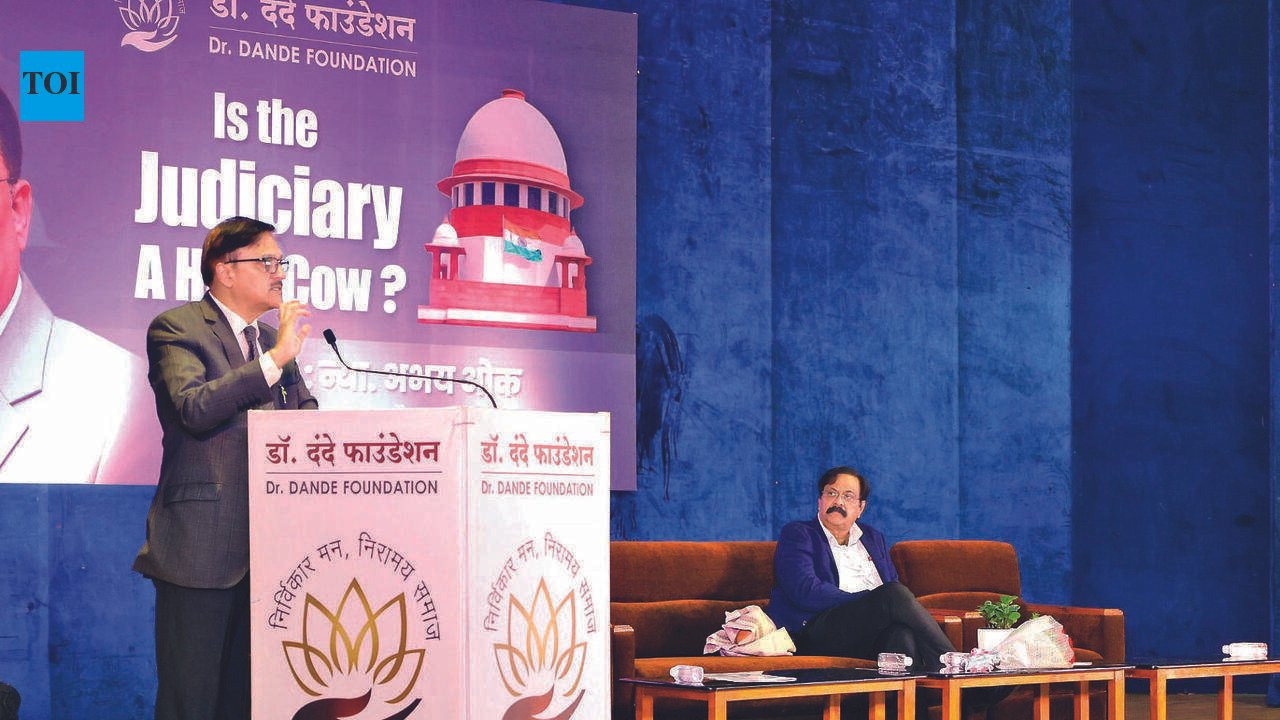
Nagpur: India’s judiciary is facing a credibility crisis as nearly five crore cases remain pending across courts, with delays in delivering justice increasingly testing the faith of ordinary citizens, former Supreme Court judge Abhay Oka said on Saturday.Speaking at a lecture organised by Dande Foundation at Vanamati on “Is the judiciary a holy cow?”, the former Karnataka high court chief justice said the credibility problem could not be attributed to one section alone and required introspection by judges, lawyers, police and other stakeholders, including himself.“The institution must examine where it was falling short of the aspirations of the common man,” he said. Dr Pinak Dande and senior journalist Shailesh Pande shared the dais. Referring to Dr BR Ambedkar’s views, Oka said no constitutional institution should be treated as a “holy cow” and placed beyond scrutiny.The scale of pendency, Oka said, was particularly troubling at the trial-court level, where ordinary citizens first approach the justice system. He referred to the judicial national grid and said more than five crore cases were pending, about 70% relating to criminal matters. “Tareekh pe tareekh is reality,” Oka said, referring to the prolonged cycle of repeated hearings that has become synonymous with judicial delay.Oka said the problem was compounded by an inadequate judge-to-population ratio. India, he said, had only about 13 judges for every 10 lakh people in 2002, against Supreme Court’s suggested benchmark of 50. “Even today, the judges’ number is 22 for 10 lakh people. The increase in litigation alongside population growth had placed further pressure on an already stretched system,” he said.Oka also pointed to vacancies, inadequate court infrastructure and a shortage of prosecutors as structural problems. “While infrastructure had improved in Maharashtra in recent years, several courts continued to face basic deficiencies,” he said.The former Bombay high court judge said the judicial system also needed a clearer policy for deciding which cases should receive priority. Bail matters, fresh cases and long-pending litigation often compete for limited judicial time, while litigants with greater financial means can more easily pursue proceedings before higher courts.“I think new cases should be heard within a week,” Oka said, recalling that similar directions issued during the Covid-19 pandemic when he was Karnataka HC CJ had helped improve case management.Oka, who has over four decades of experience as a lawyer and judge, said the judiciary must also recognise the changing nature of litigation. “Matrimonial disputes can generate multiple proceedings involving allegations under criminal law, domestic violence claims and child-custody disputes. Increasing crime and the absence of adequate witness protection also contribute to the burden on courts,” he said.He defended the need for public scrutiny of the judiciary, saying citizens have the right to criticise judgments and point out errors. At the same time, he stressed that criticism should be informed and aimed at improving the institution rather than undermining it.“There’s a need for greater transparency and public communication. Live streaming of court proceedings could improve transparency, provided safeguards were put in place to prevent misuse,” he said.The former judge warned against media trials and the growing practice of police officers discussing cases publicly with the media before trials are concluded. “Statements by politicians predicting punishment for accused persons and disclosures made during investigations can create pressure and distort public perception,” he said.


