



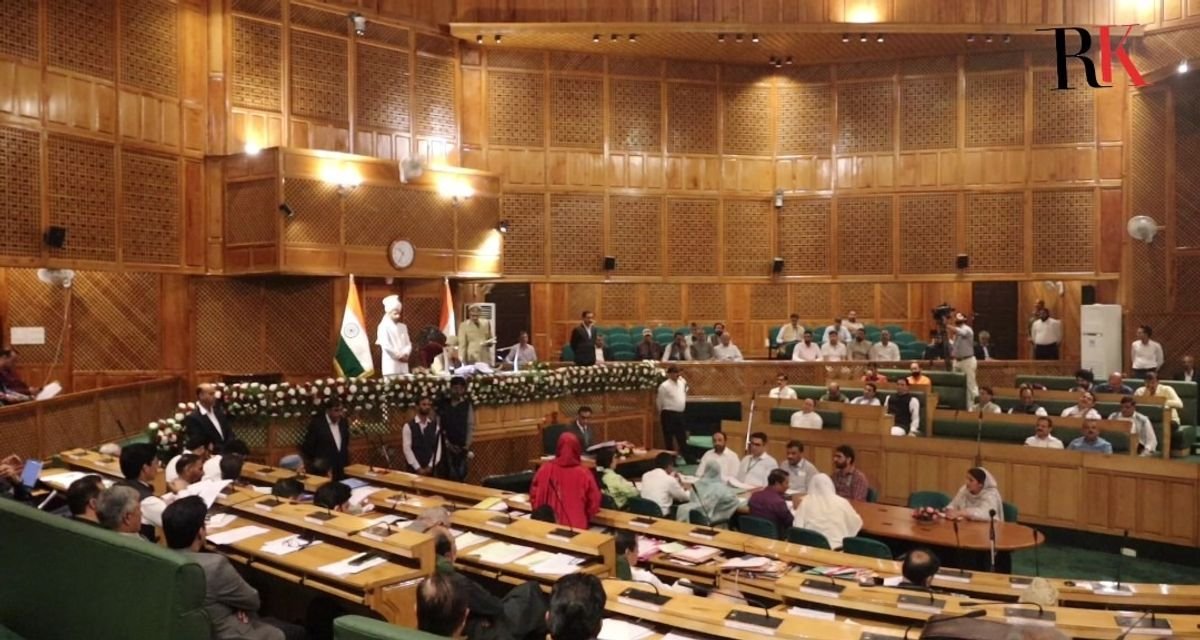
Srinagar, Sep 27: Jobs, job security, housing, drinking water, connectivity and urban planning emerged as the defining public-interest themes of Private Members’ Business in the Jammu and Kashmir Legislative Assembly, with seven resolutions placing specific demands before the government.
The resolutions—moved by legislators cutting across the National Conference (NC), Bharatiya Janata Party (BJP) and Congress—range from a uniform policy for regularising daily-rated and similarly placed workers to measurable annual employment targets, five-marla land for eligible homeless families and restoration of shrinking water bodies and traditional water channels.
Rather than individual constituency grievances, several of the proposals seek policy-level interventions with fixed timelines, making the Private Members’ Business a snapshot of some of the biggest issues confronting households across J&K.
BJP MLA Pawan Kumar Gupta has demanded a comprehensive and uniform policy for regularisation of Daily Rated, Casual, NYC, Mid-Day Meal and similarly placed workers across government departments and agencies. “This is why people have elected us,” Gupta told Rising Kashmir. “The House should benefit in the form of redressal of peoples issues.”
His resolution seeks that the policy be framed and notified within a fixed timeframe. An amendment proposed by NC legislator Farooq Ahmad Shah seeks to replace “uniform” with “legally enforceable”, while Congress MLA Nizam-Ud-Din Bhat has proposed that workers already under consideration of the Cabinet sub-committee should also be covered.
The employment question has been separately raised by NC MLA Mir Saifullah, who has sought a comprehensive J&K employment and livelihood policy with measurable annual targets, alongside accelerated recruitment against vacant government posts through a transparent, time-bound and merit-based process. “Youth is our future and we should raise their voice in the House, which is the highest form,” Saifullah said.
The proposal assumes added significance amid the Assembly’s recent disclosures on the scale of vacancies and recruitment. An amendment moved by Congress party’s Bhat goes further, proposing a monthly sustenance allowance of Rs 5,000 for unemployed youth from families living below the poverty line until an employment policy is formulated and implemented. The proposal thus seeks both a long-term recruitment framework and an interim support mechanism for the poorest unemployed households.
Housing has also found a specific legislative proposal. Congress MLA Irfan Hafiz Lone has sought allotment of five marlas of State land to homeless families and formulation of a policy without delay. His proposed amendment seeks to cover “landless, economically poor and homeless” families who are original residents of J&K, while Mir Saifullah has proposed that Khachari land be considered where State land is unavailable. The infrastructure agenda stretches from the mountains to the cities.
NC MLA Qaysar Jamshaid Lone has sought expediting construction of the Lolab-Bandipora tunnel and road project. Bhat has proposed that an amendment set a target of completing the project and opening it to the public by the end of 2027.
In Srinagar, NC MLA Salman Sagar has sought denotification of Phaak and Rural Block Harwan from the Srinagar Master Plan, arguing for regulation of predominantly rural areas under Panchayati Raj and rural-development laws and withdrawal of planning restrictions causing hardship to residents. The proposal has also triggered an attempt to expand its geographical scope, with Mubarik Gul seeking inclusion of several rural areas of Eidgah constituency.
In Jammu, BJP MLA Yudhvir Sethi has sought a comprehensive, time-bound Master Plan for adequate parking facilities in Jammu East, particularly in congested markets, commercial areas, major junctions and residential localities.
The proposal has been widened through amendments, including a demand for a scientific long-term parking strategy covering the most congested areas of J&K. Irshad Rasool Kar has also proposed inclusion of Sopore town. The seventh resolution shifts the focus from jobs and infrastructure to J&K’s environmental future.
Taken together, the seven resolutions present an unusually broad legislative checklist–regularise long-serving workers, create measurable employment targets, provide land to vulnerable families, complete a strategic tunnel project, ease urban planning restrictions, address parking congestion and restore J&K’s disappearing water network.
The proposals also contain several concrete timelines and numbers—from five marlas of land and a proposed Rs 5,000 monthly allowance to the proposed 2027 deadline for the Lolab-Bandipora project and 2027-28 water-restoration year.
For the government, the significance of the debate therefore lies not only in whether individual resolutions are adopted, but in how it responds to the demand for time-bound, measurable action on issues that directly affect employment, housing, mobility, infrastructure and environmental security.
The seven resolutions were selected through balloting for Private Members’ Business and cover proposals moved by three NC MLAs, two BJP MLAs and two Congress MLAs.
