






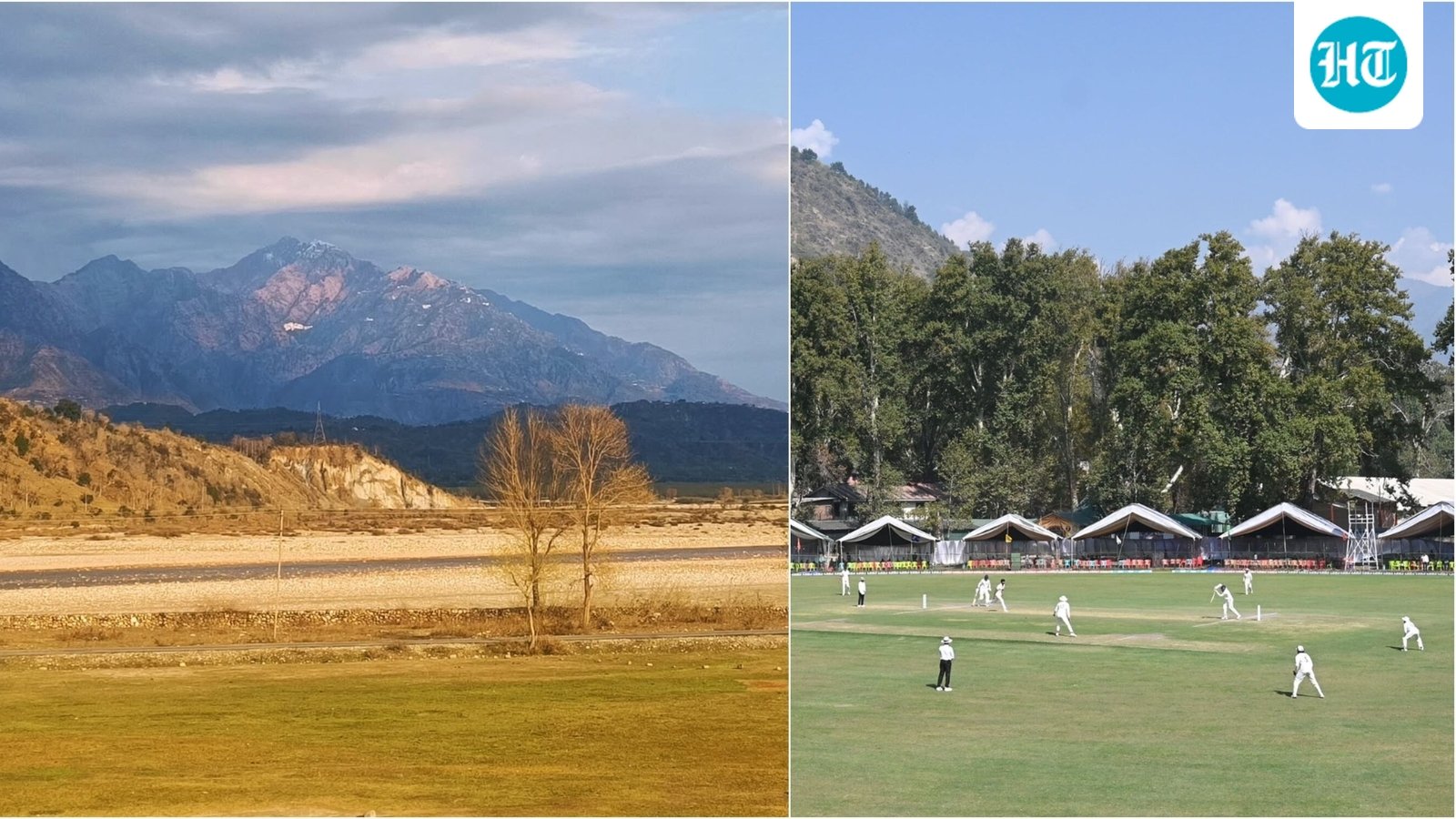
Last season, Jammu & Kashmir climbed to the summit of domestic cricket to be crowned Ranji Trophy champions. It was the classic underdog tale where a side went from being contenders to challengers and eventually, champions. The win was expected to create a kind of ripple effect and maybe, it has. But more is needed.
Last season’s hero Auqib Nabi receiving an India call-up, Srinagar staging a major cricket fixture with the Irani Cup and several players joining the larger North Zone team during the Duleep Trophy suggest the region is entering the mainstream.
Yet, while the team’s fortunes have risen, the infrastructure available to its cricketers has struggled to keep pace.
As they begin their Ranji Trophy title defence against Madhya Pradesh on Sunday, the contrast is difficult to ignore – a team that has shown it can compete with the country’s best, and a grassroots system in which aspiring players in several areas still struggle to find a clear pathway into the game.
At the Sher-e-Kashmir Stadium in Srinagar, former Jammu & Kashmir captain Parvez Rasool sees a familiar picture. The venue, which hosted international and high-profile matches decades ago, has changed little in key respects.
“Even in 2026, it’s in the same condition,” Rasool said, comparing the stadium to how it was when the Clive Lloyd-led West Indies visited back in 1983. “We’ve even won Ranji, we’ve come this far after doing so well, yet it’s the same story.”
For a team preparing to defend its biggest domestic cricket achievement till date, the theme is not only how far J&K have come, but whether the system around them can help sustain that progress.
Left-arm pacer Sunil Kumar, from Akhnoor, a town nestled on the banks of Chenab, began playing tennis-ball cricket in his village when he was around seven. For years, his training ground was simply the natural open space available near home.
“Before going to college, it was just about wanting to do something big in cricket, but how to do it, I had no idea because that system just didn’t exist in the village,” he told HT after finishing as J&K’s second-leading wicket-taker (31 wickets) last season.
It was only after he went to college that Sunil learnt about the age-group structure, including the Under-19 and Under-23 pathways. Formal coaching came much later, through the Jammu and Kashmir Cricket Association. However, reaching training facilities in Jammu meant a journey of 65-70 km from home, often taking him between one-and-a-half and two hours each way.
His experience pointed to a gap that can be easy to miss when looking at a successful senior team. Facilities may exist in larger regions such as Jammu and Srinagar, but access is a different question for a youngster living beyond them.
All-rounder Abid Mustaq’s journey was also shaped by what was missing around him. Belonging to Bhaderwah, in Doda district, nearly 200 km from Jammu, he grew up in an area where cricket infrastructure and a formal cricketing culture was only a dream. He grew up with matting wickets before he and others relied on makeshift cement tracks to practice.
The environment has started to change, Abid said, with more academies and better practice facilities emerging, alongside a shift in how families view the sport. The continued success of J&K players at higher levels is now helping parents imagine a serious future in cricket for their children.
“Having such a big match held there, having an Irani Trophy match there, is a boost for us,” he stold HT. “Major changes have happened since last year in families, their mindsets. They now they want and believe that our boys from here can also play at that level.”
For a region with unenviable raw talent, the change in aspiration matters. However, the next step is to make sure young players do not have to depend on extraordinary personal circumstances to find their way into the sport.
Auqib — one of J&K’s standout performers in their title-winning campaign with 60 wickets — saw seen the same challenges in Baramullah. The lack of suitable practice wickets and open spaces made it difficult for aspiring cricketers like him to train consistently. Even where nets existed, access is not always straightforward, and the ground available to a player may not be suitable for practising in proper cricket spikes.
Auqib said families had initially been reluctant to see cricket as a career because the infrastructure did not offer enough reassurance. He may have become only the third player from the J&K to play for India but he was once studying medicine. His prescription is straightforward — every district needs grounds, turf wickets, accessible nets and academies where players can develop.
“If you don’t have facilities, then you have to create them, if your dream is big and you are serious about it,” he told HT after the title win.
The title has given J&K cricket a new level of visibility, but it has also sharpened the question of what happens beyond the established players. A stronger network of district-level facilities could make it easier for young cricketers to receive coaching, play with the right equipment and enter organised competitions without having to relocate or make long journeys.
Rasool believes the region has talent in villages and far-flung areas, but players need infrastructure and a platform to reach the highest level. The association has Sher-i-Kashmir Srinagar and the Hostel Ground at the GGM Science College in Jammu.
Bakshi Stadium, in Srinagar often hosts some local matches but it is essentially a football ground under the Jammu & Kashmir Sports Council. He hopes for a proper international stadium and more grounds in other districts, along with improved facilities.
On the banks of Chenab where Sunil once practiced, he notices that the number of youngsters turning up to play in his village has grown. Where there were once eight to 10 boys playing in the evenings, he now sees around 20 to 25, including children travelling from other places.
“It’s a small change visible right here,” he said.
From Akhnoor to Bhaderwah to Baramullah, there are signs that their success has already begun to do some of that work especially with former JKCA administrator Mithun Manhas now becoming president of the BCCI and the region’s growth being one of his long-standing visions.


