






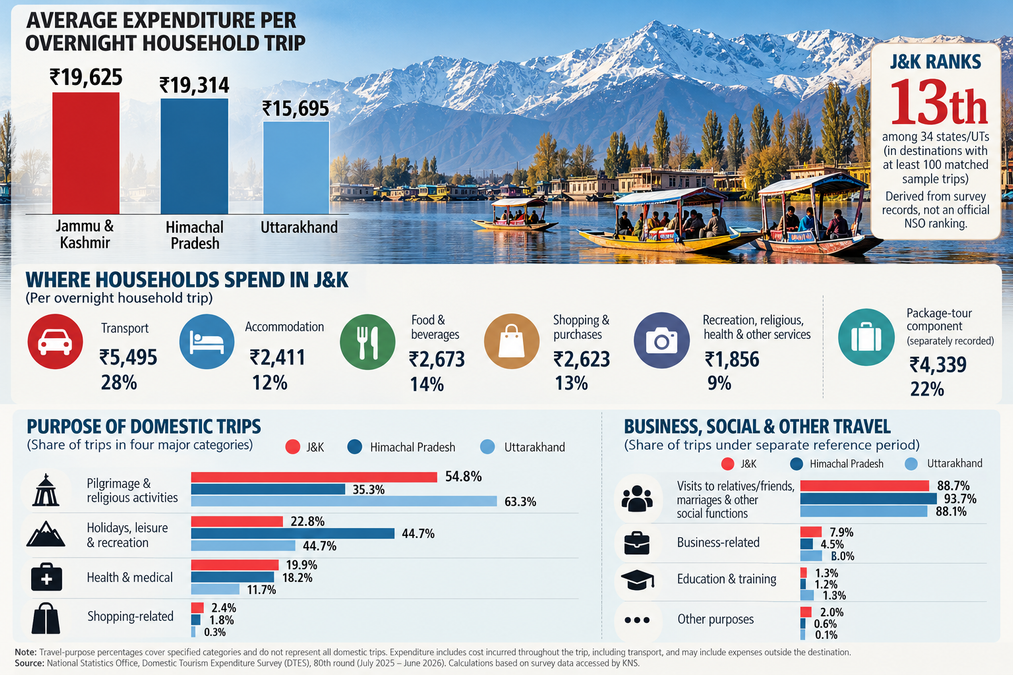
Srinagar, Oct 20: Domestic overnight trips to Jammu and Kashmir cost households an average of Rs 19,625, higher than comparable trips to Himachal Pradesh and Uttarakhand, but transport accounts for the largest separately recorded share of expenditure, while pilgrimage rather than leisure dominates travel in the Union Territory, according to a government survey accessed by Rising Kashmir.
The National Statistics Office’s (NSO) Domestic Tourism Expenditure Survey, conducted between July 2025 and June 2026 under the 80th round of the National Sample Survey, provides a detailed picture of how much households spend on trips to Jammu and Kashmir, where the money goes and what brings travellers to the region.
The findings show that although Jammu and Kashmir records higher average trip expenditure than two major Himalayan destinations, a substantial portion goes towards transport, including journeys undertaken outside the Union Territory. The figures, therefore, do not necessarily reflect the amount earned by local tourism businesses.
According to the survey data, average expenditure on an overnight household trip to Jammu and Kashmir stood at Rs 19,625, compared with Rs 19,314 for Himachal Pradesh and Rs 15,695 for Uttarakhand.
A trip to Jammu and Kashmir thus involved approximately Rs 3,930 more expenditure than one to Uttarakhand, a difference of around 25 per cent. The gap with Himachal Pradesh was considerably smaller at Rs 311, or about 1.6 per cent.
Jammu and Kashmir stood 13th among 34 states and Union Territories in a comparison restricted to destinations with at least 100 matched sample trips. The position was derived from the survey records and does not represent an official ranking published by the NSO.
The expenditure calculations covered 2,698 sampled overnight household trips to Jammu and Kashmir, compared with 1,921 for Himachal Pradesh and 4,461 for Uttarakhand.
A closer examination of expenditure reveals that transport accounted for Rs 5,495 per overnight household trip to Jammu and Kashmir, representing approximately 28 per cent of the overall expenditure.
Accommodation cost an average of Rs 2,411, while food and beverages accounted for Rs 2,673. Households spent another Rs 2,623 on shopping and purchases, while recreation, religious activities, health-related services and other activities covered under the relevant expenditure category accounted for Rs 1,856.
The survey separately recorded an average package-tour expenditure component of Rs 4,339 per household trip, with package spending treated separately from individual categories to avoid double counting.
Transport expenditure on trips to Jammu and Kashmir was Rs 833 higher than Himachal Pradesh’s Rs 4,662 and Rs 1,692 higher than Uttarakhand’s Rs 3,803.
However, the pattern was different for accommodation. Households travelling to Himachal Pradesh spent an average of Rs 2,960 on accommodation, compared with Rs 2,411 for Jammu and Kashmir and Rs 2,292 for Uttarakhand.
Food expenditure was also marginally higher in Himachal Pradesh at Rs 2,750, compared with Rs 2,673 in Jammu and Kashmir and Rs 2,076 in Uttarakhand.
The figures suggest that Jammu and Kashmir’s higher overall trip expenditure is not accompanied by higher spending across every category of tourism-related services.
Importantly, the transport estimates include expenditure incurred during the entire journey, including travel to the destination and the return trip. Consequently, the amount cannot be interpreted as revenue earned exclusively by transport operators based in Jammu and Kashmir.
Beyond expenditure, the survey reveals a striking difference in the purpose of domestic travel to the three Himalayan destinations.
Pilgrimage and religious activities accounted for 54.8 per cent of overnight household trips to Jammu and Kashmir within four major travel-purpose categories, compared with 22.8 per cent for holidaying, leisure and recreation.
Health and medical travel accounted for another 19.9 per cent, while shopping-related trips represented 2.4 per cent.This means that religious travel accounted for more than twice the share of leisure travel within these categories, indicating that Jammu and Kashmir’s domestic travel composition extends considerably beyond conventional holiday tourism.
The corresponding figures for Himachal Pradesh presented a different picture. Holidaying and leisure accounted for 44.7 per cent of trips, while pilgrimage and religious activities represented 35.3 per cent.
Uttarakhand recorded an even greater share of religious travel than Jammu and Kashmir, with pilgrimage accounting for 63.3 per cent of trips in the same categories, compared with 24.7 per cent for leisure.
Medical travel also accounted for a relatively substantial share in Jammu and Kashmir at 19.9 per cent, compared with 18.2 per cent in Himachal Pradesh and 11.7 per cent in Uttarakhand.
The percentages, however, relate only to the four specified travel purposes and do not represent the distribution of every domestic trip undertaken for all purposes.
The survey separately examined business, social, educational and other overnight travel using a different reference period, revealing another important dimension of domestic movement to Jammu and Kashmir.
Social visits, including journeys to meet relatives and friends or attend marriages and other functions, accounted for 88.7 per cent of trips within this separate group.
Business-related travel accounted for 7.9 per cent, while education and training represented 1.3 per cent and other activities accounted for 2 per cent.
The business-travel share in Jammu and Kashmir was nearly 1.8 times that of Himachal Pradesh, where it stood at 4.5 per cent, and marginally below Uttarakhand’s 8 per cent.
Social visits remained the dominant purpose across all three destinations, accounting for 93.7 per cent of trips in Himachal Pradesh and 88.1 per cent in Uttarakhand within the corresponding group.
The estimates for these categories were based on 1,846 sampled overnight household trips to Jammu and Kashmir, including 115 classified as business-related. The corresponding sample covered 1,122 trips to Himachal Pradesh and 1,141 to Uttarakhand.
However, the survey recorded business, social, educational and other trips completed during the preceding 30 days, while holidays, pilgrimage, medical treatment and shopping were covered separately using a different reference period.
As a result, the 7.9 per cent business-travel figure cannot be interpreted as the share of business travel among all domestic overnight trips to Jammu and Kashmir during the year. Similarly, the social-travel percentage cannot be combined directly with the pilgrimage and leisure figures to construct an overall distribution of travel purposes.
The NSO conducted the survey using a multi-stage stratified sampling method and applied statistical multipliers to derive estimates from household responses.


