



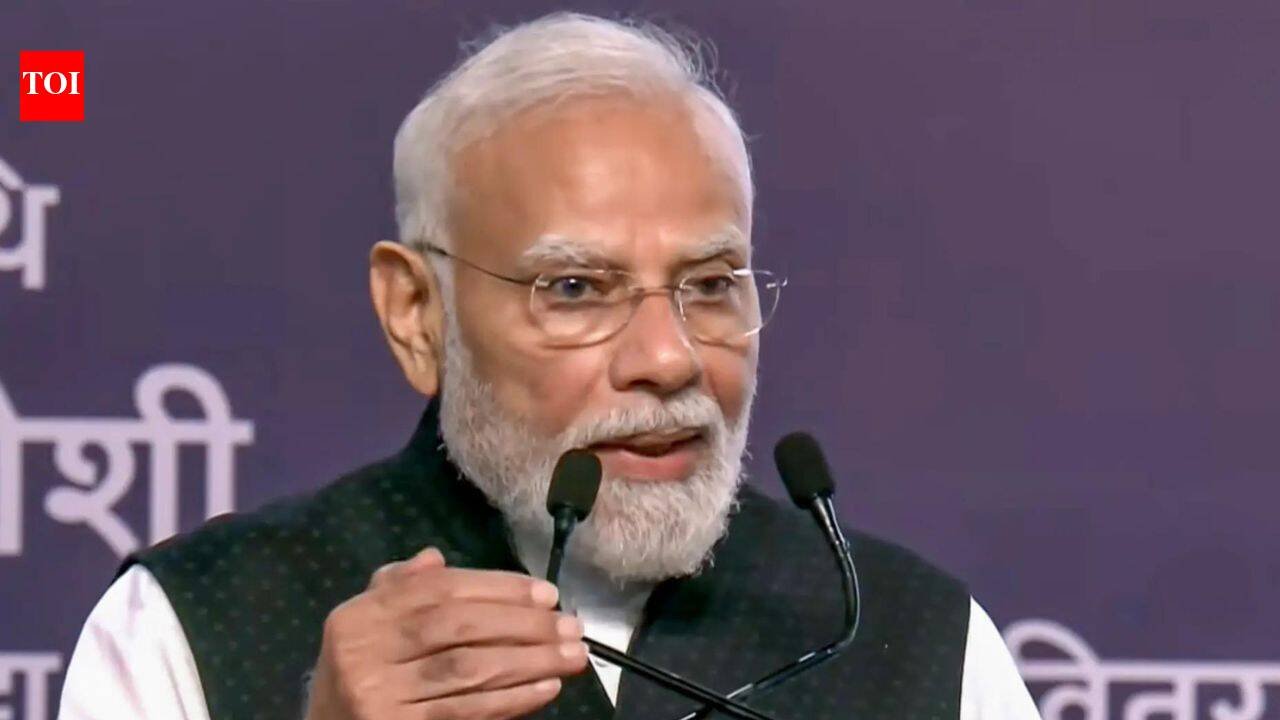
NEW DELHI: Prime Minister Narendra Modi on Saturday took a jibe at leader of opposition Rahul Gandhi, describing the Congress party’s student outreach campaign “Chhatron Ki Goonj” as “jhooth ki goonj”.‘Chhatron Ki Goonj’ is a student-dialogue campaign launched by the Congress to raise issues including examination paper leaks, rising education costs, irregularities in government recruitment and unemployment.Over the past three months, the campaign has been held in Kota in Rajasthan, Dehradun in Uttarakhand, Prayagraj in Uttar Pradesh and Pune in Maharashtra.Addressing the centenary celebrations of Delhi University’s Shri Ram College of Commerce (SRCC), PM Modi said, “…Main jaanta hoon, sach ki Hunkkaar ke aage jhooth ki goonj tik nahi sakegi (I know that the echo of lies cannot stand before the roar of truth).”
- “This is Modi. He stands like a rock in front of those who favour the ‘mai-baap’ culture. I have the courage, which is why I am reminding you of what I said that day. I have come before you with my report card. At the same programme in 2013, when I said that we needed to work towards “Made in India,” people from the ecosystem of that time simply could not understand it. They believed that Made in India was impossible during that period of despair. And those who were brought up with that mindset still make fun of Made in India today. But today you can see the brand value of Make in India.”
- “But outside this campus, you will encounter a new world. You will meet two kinds of people. One kind consists of people who positively transform the strength of society into the strength of the nation. The second kind is made up of people who become the “Naraz Fufa” whenever any work is started. Their favourite thing is to oppose everything. They have only one dialogue: What is the need for this? When we were building the world’s tallest statue, the “Fufa” said, “What is the need for this?” When we started working on the high-speed train, the “Fufa” again said, What is the need for this? When we introduced UPI, these same “Fufas” asked, Why UPI? When we built the new Parliament building, they again said, “What is the need for this?” We built a memorial for our brave military heroes who dedicated their lives and made the supreme sacrifice for the country. The “Fufa” came onto the field again and asked, “What was the need for this?” But India gave an answer to all these “Fufas.” No one can stop India from doing what is necessary for the country.”
- Referring to the economic and political situation at the time, PM Modi said, “There is a gang that will take what I am saying, break it into small pieces and put it in my account. So, let me warn you in advance about this. Let me tell you what used to dominate the media during that period in 2013. For example, Indian soldiers were being killed along the LoC. The current generation may find it surprising; perhaps they may wonder, “Did this really happen?” Yes, it did. The World Bank had lowered its GDP growth forecast. The current account deficit was at an all-time high. Inflation was around 10 per cent. The industrial sector was in the grip of a slowdown. Corruption in the helicopter deal had been exposed. There were bomb blasts in Hyderabad. These were all headlines at that time. I firmly believe that our students today may not know about all these things.”
- “These developments show what the condition of the country was at that time. Growth was at the bottom, while inflation was at the peak. Scams were at their height, and the corrupt were moving around fearlessly. The economy was in distress. There was discussion everywhere about policy paralysis. The world was counting India among the “Fragile Five.” Terrorists were operating unchecked, and Pakistan was out of control. In other words, there was nothing but disappointment and despair. There was a time when the country was struggling on every front…” he added.
- “You may have heard my speech from Red Fort. I gave a homeopathic pill from the Red Fort—”Dimagi Naxal”. According to the principles of homeopathy, when you begin homeopathic treatment, the disease initially gets worse. That is the nature of homeopathy. Similarly, as soon as I gave the “Dimagi Naxal” homeopathic pill, all the “Dimagi Naxals” started coming out one after another. And now the public is also seeing the true colours of those who are promoting this illness,” PM Modi said.
- “I have told you so many things. Some people may think, “What is this? This is a country of 140 crore people. It was very easy. What new thing did Modi do?” But was it really that easy? I want to take you back to the old days once again. Remember, when you were in school, there was a disaster in Kedarnath in 2013. The entire government was shaken. They simply did not know what to do or how to respond. When the banking crisis came in 2008, the government at the time tried to hide behind the crisis for years. It did not even have the courage to tackle it. The entire banking system of India was pushed to the brink of collapse. In 2008 itself, there was a horrific terror attack in Mumbai. The government of the time came under pressure from outside but did not even have the courage to teach Pakistan a lesson…Over the past six years, we have faced major crises. First came the COVID-19 pandemic, which brought the entire world to a standstill. Then the war between Russia and Ukraine broke out. After that, there was a period when trade and supply chains began to be weaponised. Then came the crisis in West Asia. Every time, people said, “Now India will not survive.” And those who are my biggest admirers were happy, thinking, “Now Modi is trapped. Now Modi has fallen. Now they will crush him.” But the blessings of the people of my country have so much strength, so much strength, that every wish of those who want India to fail is being left unfulfilled.”
- “Now in the 21st century, a new world of opportunities is before us. I am happy that you are ambitious because ambition cannot be taught from any textbook. Ambitions come from an environment that inspires you to dream big.”
- “13 years ago, your seniors could not dream such dreams. But today, you are dreaming these dreams because today’s India has an ecosystem that supports those dreams. Now is the time to set big goals and achieve them…We have to walk on such a new path where the sun is ours, the sea is ours. The boat is ours, and the sailor is also ours. The courage to write victory on the waves should be ours. The flight should be ours, the sky should be ours. The spirit to confront strong winds should be ours. The dream should be ours; the resolve should be ours. The flag of Aatmanirbhar Bharat should be ours. On the path to a developed India, every step that moves swiftly towards a developed India should be ours,” PM said.
- “Over the past six years, India has faced major crises, including COVID-19, the Russia-Ukraine war and the West Asia crisis. Every time, people said India would not survive. Those who are my biggest admirers thought, ‘Now Modi is trapped’ But the blessings of the people ensured that every wish of those who wanted India to fail remained unfulfilled.”
- PM Modi recalled his previous visit to SRCC in 2013, when he was the chief minister of Gujarat and a member of the opposition BJP. “Your seniors were sitting here in 2013, and at that time I was the Chief Minister, but I was also a member of the country’s main opposition party. Perhaps people were expecting me to launch a long, strong attack on the then Central Government and level a barrage of allegations. But, even though I was in the Opposition and a critic of the government of the time, I did not use this platform for that purpose. I presented a vision. I spoke positively. Whatever I said then was my conviction. I have always lived those thoughts and dreams. I continued to follow that path, to dedicate myself wholeheartedly to the country and to have the passion to live for the nation…At that time, all of you may have been in school. But today, if you go on the internet and read the news from 2013 and around that period, you will get an idea of what the situation was like then.”
- PM Modi also said his 2013 address at SRCC continued to have an impact years later. “My 2013 speech at SRCC had become a wave, and even today, 13-14 years later, the impact of that address remains intact,” he said.
- The prime minister also highlighted India’s latest economic growth figures, saying the 7.8 per cent quarterly growth had boosted confidence in the economy.
- “The world was calling India one of the ‘Fragile Five.’ Today, the world is watching India become the fastest-growing major economy. In just the past week, there have been several positive developments regarding India’s economy. The 7.8 per cent quarterly growth has boosted the country’s confidence. Meanwhile, a Japanese credit rating agency has upgraded India’s rating. And this 7.8 per cent growth has come at a time when the war in West Asia is ongoing and there have been several trade-related challenges. Achieving such growth under these circumstances shows India’s strength and potential. I know, and you also know, that those who became infamous for pushing India into the ‘Fragile Five’ are finding these figures difficult to digest. But all of you understand the data seriously…In other words, India is not only growing but also creating new employment opportunities. Despite this, those for whom the glass was half empty in 2013 continue to think the same way even today. For them, the glass will always be half empty. I talk about the glass; I am not talking about anything remaining empty,” thr PM said.
- PM Modi also claimed that the security situation had improved, saying, “Today, those spreading terrorism are on the back foot. If Pakistan indulges in any misadventure, India’s armed forces enter their territory and strike. Peace has increased from Jammu and Kashmir to the Northeast.”
- “The back of Maoist terrorism and Naxalism has been broken. The world that was once concerned about India’s policy paralysis is today talking about India’s policy dynamism,” he added.
- Praising the institution and its alumni, Modi said SRCC had produced leaders across fields, including economics, politics, law and the arts.
- “The alumni of SRCC have also been very special. In your language, I would say the alumni here are the OGs. They have taken the name of SRCC across the world and made a mark for themselves in different fields. Our Arun Jaitley ji studied here. And I can say that perhaps there was hardly a meeting with him where he did not share an incident from his SRCC days. Sometimes I would get tired because he would tell me the same incident again and again. Even today, Sanjeev Sanyal, who is part of my team, is an alumnus of SRCC. We have many other colleagues who studied here as well. And it is not that SRCC has produced people only from the world of economics. From artists to politicians, lawyers and judges, people from every field have emerged from here.”
- He also described the institution’s 100-year journey as one marked by achievements and inspiration. “When a person lives for 100 years, they are considered an ocean of experience. And when an institution completes 100 years, it becomes an ocean of achievements and inspiration. In its 100-year journey, SRCC has shaped generations and connected them with a brighter future. Those who came here studied, and those who left emerged as well-shaped individuals,” he added.
PM Modi took a metro ride to the college and interacted with students and fellow passengers during the journey. He also released a commemorative Rs 100 coin to mark the centenary.
Share your thoughts in the comments
Be respectful · TOI community guidelines
The prime minister’s visit comes amid the BJP’s ongoing outreach to young voters. He had last visited SRCC in 2013, when he was Gujarat chief minister.In April this year, PM Modi met the SRCC governing body and a delegation from the college at his residence to mark the institution’s centenary. He also released a special commemorative postage stamp on the occasion.Established in 1926, SRCC has completed 100 years and has produced scholars, professionals, entrepreneurs, policymakers and leaders across different fields.


